- Take the request seriously before asking questions
- Ask what they want next—not what is wrong with the picture
- Offer storage without turning it into another exhibition
- Give children a real say in the next display
- Make the choices usable at different ages
- Handle visitors, shared work and online copies separately
- Sources and further reading
By EdCaptain editorial desk · Published
You proudly put a drawing on the fridge. A week later, its maker says, “Take that down.” Perhaps your child chose the spot themselves, or happily showed the picture to everyone yesterday. It can feel puzzling when something you meant as appreciation is no longer welcome.
For children aged 3–9, a request to remove their own work is a chance to practise expressing a preference and changing a decision. Start with the display, not a verdict about their confidence. They may want privacy, space for another picture or simply a different arrangement. You do not have to establish a reason before listening.
Take the request seriously before asking questions
Try: “You don’t want this one on the fridge now. I’ll help you take it down.” An adult can handle tape or fasteners and put the paper somewhere safe while you decide what happens next. Do not ask a child to climb furniture to reach a display.
If you hung it without asking, acknowledge that plainly: “I put it up because I enjoyed looking at it. I should have checked with you.” There is no need for a long apology that asks your child to reassure you.
Avoid “But it’s beautiful!” as a reason to leave it up. Liking a picture and agreeing to display it are different questions. Nor does the child need to produce a better replacement to earn an empty space.
Ask what they want next—not what is wrong with the picture
Once the immediate request has been heard, ask a practical question: “Would you like to keep it in your folder, put it somewhere else, or decide later?” Accept “I’m not sure.” A temporary flat storage spot can prevent a rushed choice about throwing something away.
If your child wants to explain, listen. “I don’t like everybody asking about it” calls for a different response from “The tape covers my dinosaur.” Do not assume a private picture is embarrassing, a sad picture reveals a diagnosis, or a removed drawing means your child has stopped enjoying art.
When the child says, “Someone laughed at it,” ask what happened and address the unkind treatment. Removing the display need not become a demand that they hide all their work. If they want help showing something again, our guide to sharing work before it feels perfect offers a separate, voluntary next step.
Offer storage without turning it into another exhibition
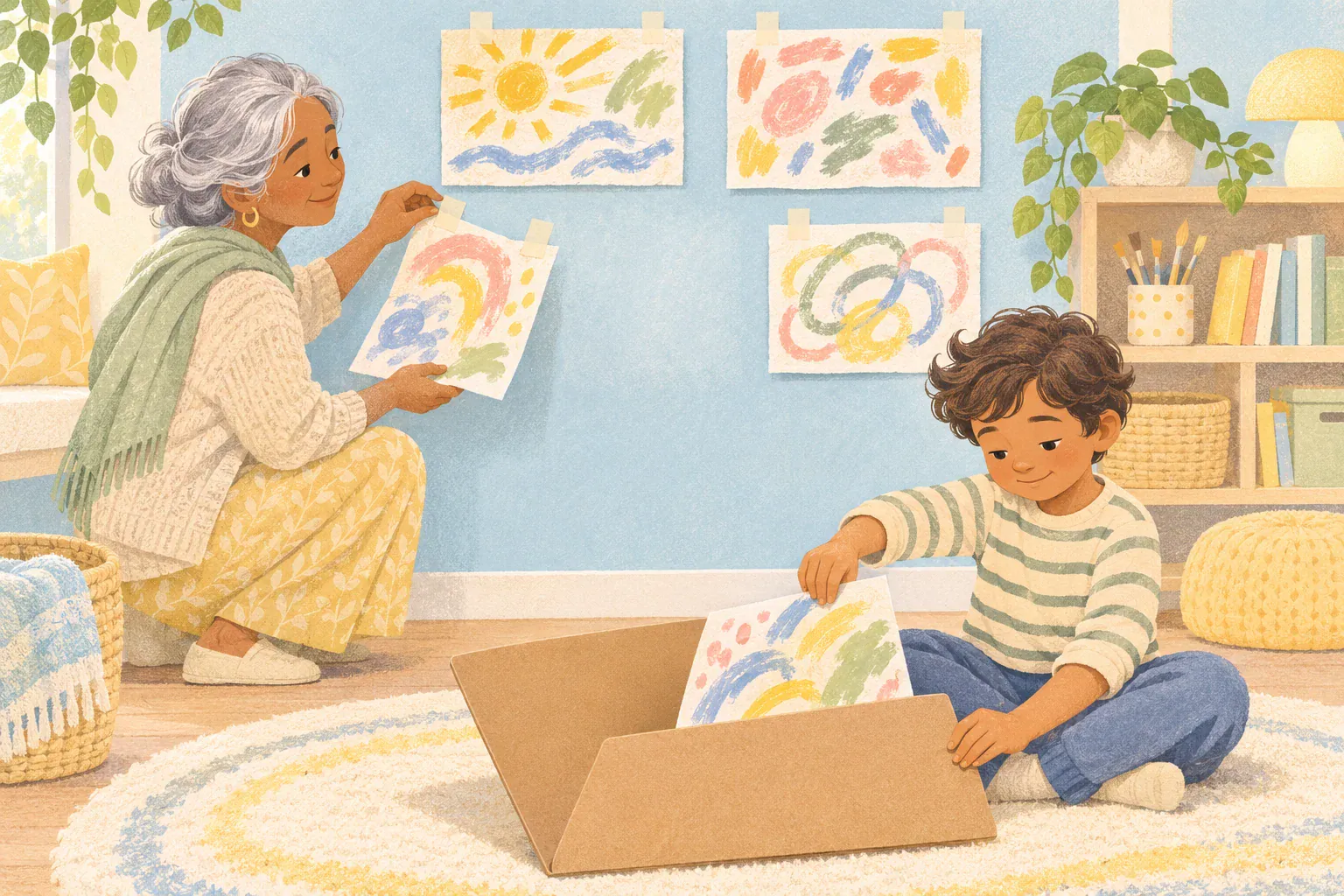
A plain folder, envelope or shallow box may be enough. Agree on where it lives and who may look inside. A folder called private should not become the collection you open for every visitor.
Ask before photographing the drawing as a keepsake. “Can I keep a photo just on my device?” is a different request from “Can I send it to Grandma?” A yes to one does not automatically answer the other. A child can also prefer no photograph.
You may feel attached to the work. Say, “I liked seeing how you made those shapes. Would you like me to remember that with you, or leave it for now?” Keep your disappointment with the other adults rather than saying the child has made you sad by taking it down.
Storage can have limits. Explain the actual space available and arrange an occasional review together. Discuss whether to keep, reuse or recycle selected pieces instead of quietly discarding everything or promising to preserve every sheet forever. This is a household arrangement, not a rule that art must always be saved.
Give children a real say in the next display
Before putting up a new piece, ask which work, where and for how long. “Would you like this on the wall until Sunday, with the option to take it down sooner?” is clearer than assuming every finished picture belongs in a gallery.
In NAEYC’s discussion of artwork displays, educators describe inviting children to hang their work and choose how names appear. A home version can include choosing not to display a piece, moving it or leaving a name off. These are suggestions for participation, not a requirement to create a classroom-style display.
Do not write a title, interpretation or story onto the picture without checking. If your child wants a label, ask what they want it to say and keep it separate where practical. “Blue lines” may be their whole explanation. They do not owe visitors a story about what the work means.
Make the choices usable at different ages
Ages 3–5: show two concrete options: hold up the folder and point to a possible display spot. “Folder or wall?” is enough. Help with removal and storage, and let pointing, signing or a familiar communication aid count as an answer. Ask again another day rather than treating today’s choice as permanent.
Ages 6–9: agree on who may see the piece and how they can request a change. The child might choose a private sketch folder and a separate selection for visitors. They can decide whether they want comments, help or simply someone to look quietly.
At either age, keep making separate from displaying. NAEYC’s guidance on exploratory art emphasises children’s choices and expression rather than an adult-designed end product. A drawing can be worth making even when it never becomes a decoration.
Handle visitors, shared work and online copies separately
If a relative asks where the picture went, keep the answer ordinary: “They chose to put it away.” Do not call across the room for your child to explain. For a shared artwork, hear from the other makers before removing or altering their contributions; a photo or copy may be an option only if everyone involved agrees.
If the work was given as a gift or belongs in a school display, clarify the situation with the recipient or teacher rather than promising an outcome you cannot control. Help your child explain what they would like changed and ask what is possible.
A home-display decision also does not settle online sharing. UNICEF’s sharenting guidance recommends considering the child’s perspective, audience and identifying details; young children cannot give fully informed consent about digital exposure. If you already posted a copy, review it with your child and remove it where possible if it is no longer welcome. Do not promise that every forwarded copy can be recovered.
For families who want a digital collection, our private portfolio guide covers storage and separate audiences. A paper folder remains a perfectly useful option.
The next time your child makes something, you can enjoy the moment without reaching for the wall or camera: “Would you like to show me, tell me about it, or keep working?” Their answer can change. Keep room for that.
Sources and further reading
- NAEYC: educators discuss children’s participation in artwork displays
- NAEYC: supporting creativity through exploratory art
- UNICEF Parenting: children’s views and online sharing
Read our editorial policy and review methodology.