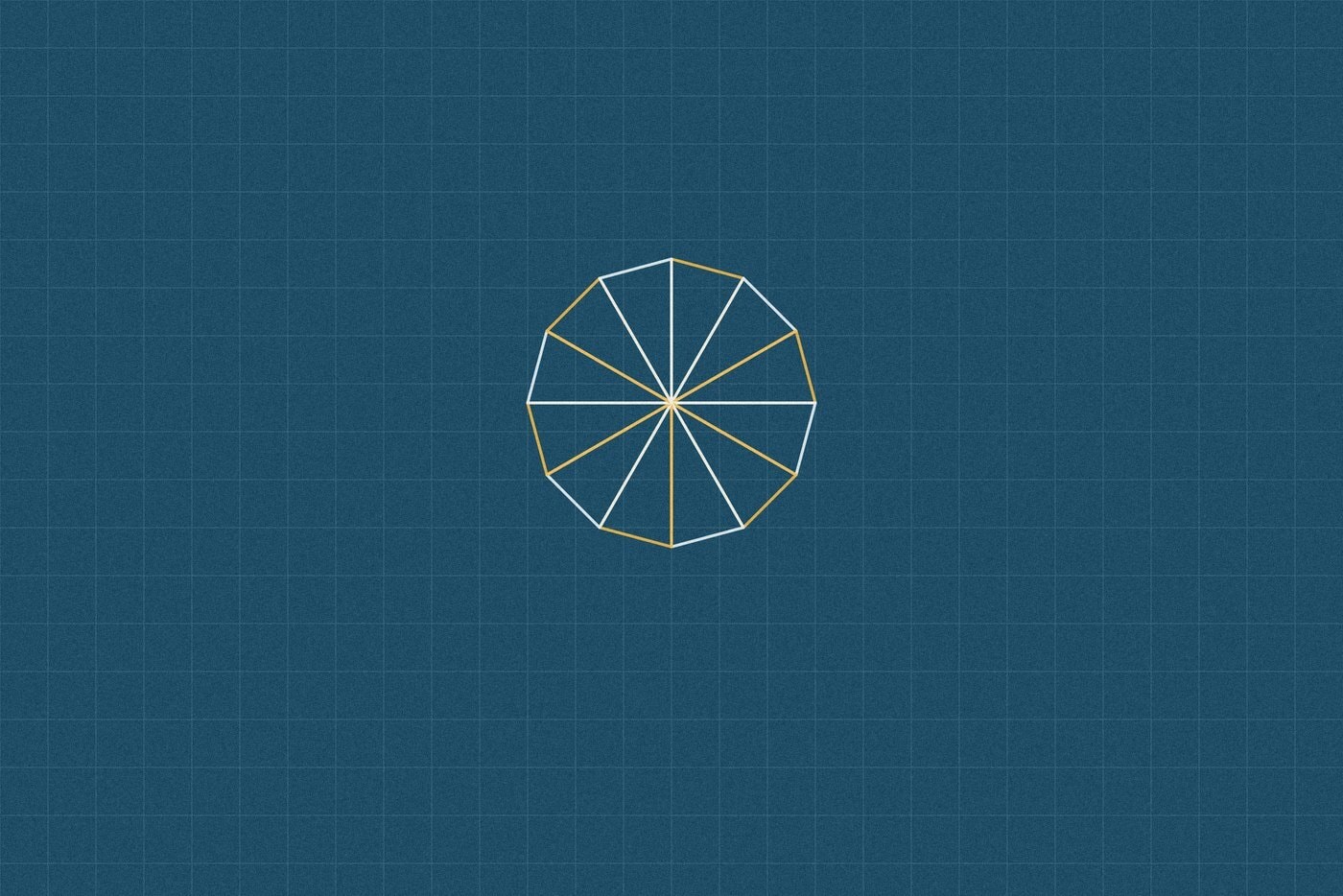
A circle cut into twelve equal wedges, rearranged into something that looks surprisingly like a rectangle, and a genuinely elegant way to show a child why the formula for a circle’s area actually works, rather than simply handing it to them to memorise. Slice the Circle turns an abstract formula into a hands-on demonstration.
What you need
A large circle drawn on paper or card, divided into twelve equal wedge-shaped sectors (like slicing a pizza into twelve pieces). Scissors. A ruler.
How to play
Draw a large circle and divide it into twelve equal sectors, like slices of a pie, numbering them so they can be reassembled in order. Cut out each of the twelve slices.
Now rearrange the slices: alternate them, point up, point down, point up, point down, lining them up in a row. The shape that emerges is not a perfect rectangle, since the curved edges of each slice create a slightly wavy top and bottom, but it is recognisably rectangle-shaped, especially once a few more slices are involved.
Point out what’s happened: the height of this rough rectangle is roughly the circle’s radius (the distance from the centre to the edge), and the width is roughly half the circle’s circumference (the distance all the way around). Since the area of a rectangle is simply height multiplied by width, this gives a genuine, visual reason why a circle’s area works out to radius multiplied by half the circumference, which, once circumference is written in terms of the radius, becomes the familiar formula most children eventually memorise without ever seeing why it’s actually true.
Making it more precise
If your child is curious, cut a second circle into twice as many sectors, twenty-four instead of twelve, and rearrange those. The resulting shape looks noticeably more like a true rectangle than the twelve-slice version did. Ask your child why they think that is (more, thinner slices means less curve left in each one), which is a genuinely good, intuitive first taste of a mathematical idea they’ll meet formally much later: that cutting something into finer and finer pieces gets you closer and closer to an exact answer.
Why it works
A formula handed to a child with no explanation of where it comes from is just something to memorise and eventually forget. Physically cutting and rearranging a circle into a rough rectangle gives a child a genuine, visual reason the formula makes sense, which tends to produce a far more durable understanding than memorisation alone, and often sticks around long after the exact formula itself has been forgotten and needs looking up again.
A pair of scissors and a circle cut into slices is a small, slightly messy activity. What it leaves behind, an actual felt sense of why a famously abstract formula is true, rather than just a memorised string of symbols, is the kind of understanding that tends to outlast the specific formula itself.