
By EdCaptain editorial desk · Published
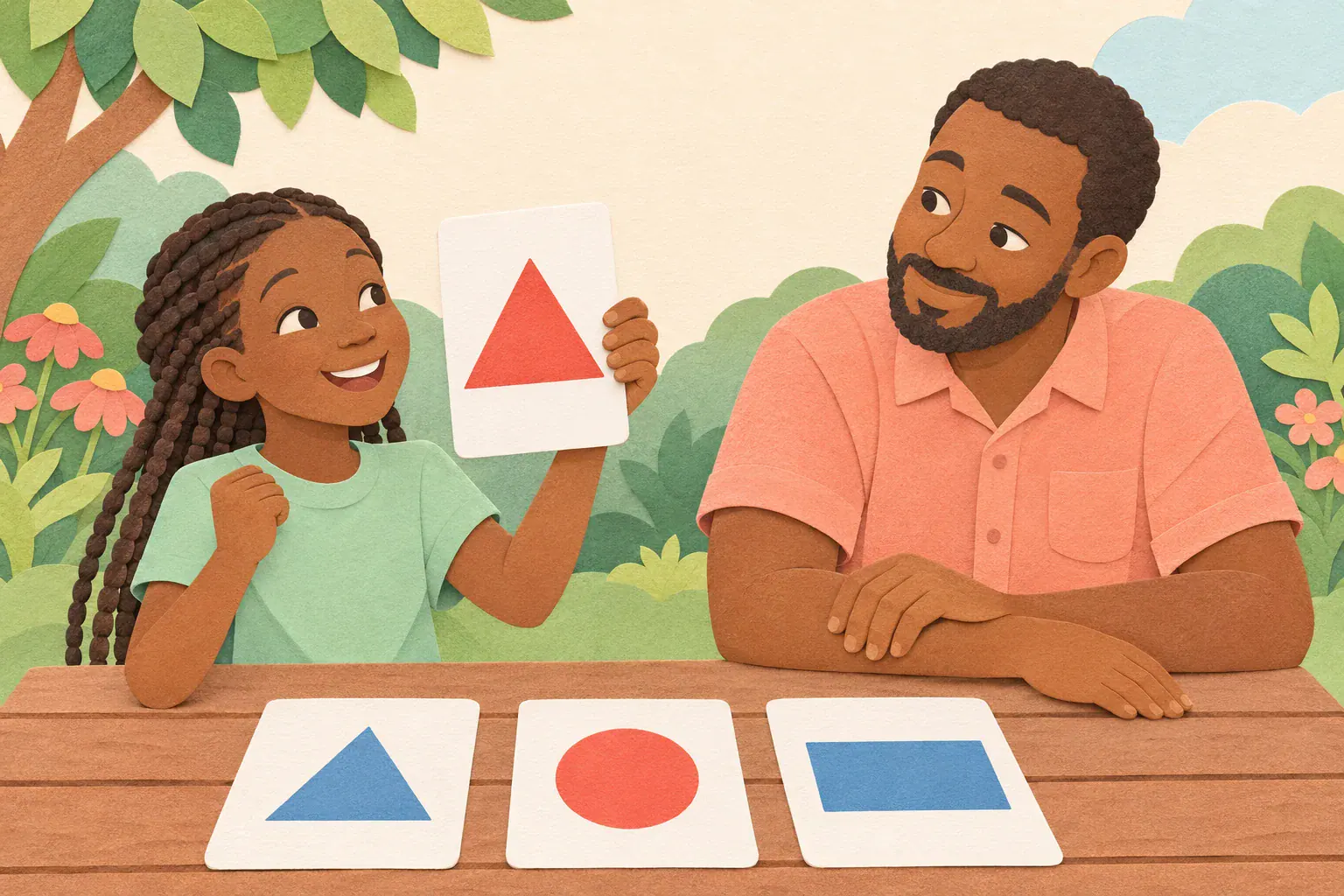
“Every triangle is blue,” you say, pointing to a blue triangle card. Your child reaches for a red triangle. That single card is enough to show why the word every needs checking.
This counterexample game for ages 7–11 uses four homemade shape cards. The aim is to look for a case that does not fit a claim, rather than collect more and more cases that do. A counterexample is an example that makes a proposed general claim false.
NRICH, the University of Cambridge mathematics project, uses Always, Sometimes or Never? tasks to invite examples, counterexamples and explanations. The family game below adapts that established reasoning approach with an original, small card collection. It is cooperative: the adults’ statements are available to challenge, too.
Make the whole collection visible
You need paper, pencils and two distinguishable colours. Draw one large shape on each of four sheets or folded paper sections:
- a blue triangle;
- a red triangle;
- a blue rectangle;
- a red circle.
Make shapes clear enough to recognise together. The rectangle should be noticeably longer than it is wide. No precise measurement, printing or cutting is required. If you cut cards, an adult can prepare them or supervise suitable scissors. Keep small offcuts and drawing tools away from children who might mouth them.
Place all four cards on a stable surface within reach. Name the shapes and colours together before starting. Say: “When I say ‘in our collection’, I mean these four cards. We can check every one.” Do not hide an extra card and later produce it as a gotcha.
Try three claims
- “Every triangle in our collection is blue.” Let your child look, point or move a card beside the claim. The blue triangle fits it; the red triangle does not. Explain that the red triangle is a counterexample because it is a triangle and is not blue. The red circle does not test this particular claim, because it is not a triangle.
- “Every red shape in our collection is a circle.” The red circle fits, but the red triangle is an exception. A blue rectangle does not disprove the claim: the claim is only about the red shapes.
- “Every card in our collection shows a red or blue shape.” Check all four cards. This statement is true for the complete collection on the table. There is no need to invent an exception that is not there.
Pause after any one claim if that is enough. You can write the sentence on a separate sheet, read it aloud or repeat it while pointing to the relevant cards. This is not a race to name the answer.
Use one exception carefully
After the first claim, ask: “Does finding a red triangle mean there are no blue triangles?” Look at the blue triangle together. The answer is no: the exception shows that not every triangle here is blue. It does not show that none are.
Try repairing the sentence. “Some triangles in our collection are blue” fits these cards. So does “The triangle on this card is blue,” if you point to the blue one. Let your child choose wording and check it against what is visible.
For the third claim, add a new card only after announcing that the collection is changing. A green circle would make the old red-or-blue claim false for the enlarged collection. Say, “That statement worked for our four cards. Does it work for these five?” Keeping the scope explicit makes the change fair.
Show why checking several examples is different from checking all
Keep this distinction small and concrete. If you inspect every card in a known four-card collection, you can establish a claim about those four. Seeing four blue triangles does not establish that every triangle anywhere is blue.
NRICH’s tasks ask how a learner knows a statement is always true and whether every example can be checked. For older children, that opens a useful difference between examples and a general reason. A triangle has three straight sides because that is part of what “triangle” means, not because you happened to find three-sided examples today.
You do not need to introduce formal proof notation. “This one does not fit” is already a meaningful explanation when the child can show why.
Take turns making claims
Invite your child to create a statement for you. Ask whether it concerns the current cards or a wider group. Try it honestly, including a pause if you are unsure. You can say, “I found two that fit. I still need to check the other ones.”
If the wording is unclear, agree its meaning before judging it. “All the shapes are big” needs a shared meaning for “big”; it is a different problem from a clear statement with an exception. Our guide to noticing missing information can help with that next step.
Avoid claims about classmates, bodies, family groups or who is “good” at something. Keep the first game about paper shapes, where challenging a statement does not put a person on trial. Real health and safety decisions remain adults’ responsibility.
Adjust the challenge and the way of joining in
Ages 7–9: Start with just the two triangle cards. Ask whether both are blue, then introduce “every”. Accept pointing to the red triangle as a response; you can supply the word “counterexample” afterwards if useful.
Ages 10–11: Use all four cards and ask which items are relevant to a claim. Invite a repaired sentence, then change one card and check whether the repair still works. An explanation can be one sentence or a diagram.
Use large, high-contrast drawings. If colour is hard to distinguish, name it aloud, add a readable colour label, or redesign the game around plain and striped shapes with matching claims. Offer a verbal description or large tactile shapes if those make the properties more accessible. Agree the properties together before play.
A child can select through speech, signing, eye gaze or a communication aid while a partner moves the cards. Remove time limits and keep unused cards covered if the full display is distracting. The guide to explaining reasoning without pressure offers more ways to make thinking visible.
Finish by asking, “Which card changed our mind?” Then let the child keep, redraw or put away the collection. Finding a useful exception is the result; nobody needs a score.
Sources and further reading
- NRICH: Always, Sometimes or Never? — examples, counterexamples and the question of how an “always” statement is justified.
- NRICH: Always, Sometimes or Never? Shape — the established shape-reasoning task that informs this family adaptation.