

By EdCaptain editorial desk · Published
“Fifty-eight is bigger than six, so 0.58 must be bigger than 0.6.” That answer has a reason behind it: your child is treating the digits after the decimal point as a separate whole number. Instead of asking them to remember an exception, help them see what those digits count.
This explanation and paper-strip activity is for ages 8–12. Begin with tenths for a child who is new to decimals; use the later comparisons when hundredths are familiar. The age guide is a practical starting point, not a deadline for mastering the topic.
First agree what one whole means
In 0.6, the 6 represents six tenths of one whole. In 0.58, the 5 represents five tenths and the 8 represents eight hundredths. You are not comparing six objects with fifty-eight objects of the same kind.
Read the numbers as “zero point six” and “zero point five eight”, then describe their values: “six tenths” and “fifty-eight hundredths”. Saying the hundredths separately helps connect the written number with the amount it represents.
Oak National Academy’s decimal-comparison guidance identifies the “more digits means greater” misconception and recommends reasoning about place value. Here is one way to make the comparison visible at home.
Make two matching strips
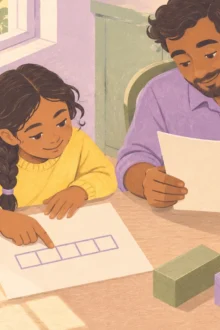
You need paper, a ruler and a pencil or coloured pencils. An adult can prepare two matching strips, each 20 cm long. Mark each into ten equal sections, 2 cm wide. The complete length of each strip represents one whole. You do not need scissors during the activity; strips can also be drawn on the same sheet.
Keep both wholes the same length and line up their starting ends. Otherwise, comparing shaded lengths will be misleading. Use large, bold marks, textured shading or an adult’s hands following the child’s directions if seeing or drawing small divisions is difficult.
- Shade six sections on the first strip. Count the tenths and label the amount 0.6. The shading reaches the sixth dividing mark, not the sixth line counted from the starting edge.
- Shade five sections on the second strip. That gives 0.5. Ask what is needed to reach 0.58: eight hundredths more.
- Subdivide the next tenth. Mark that one 2 cm section into ten equal small parts. Each small part represents one hundredth of the whole strip. Shade eight of those parts, stopping two parts short of the sixth-tenths mark.
- Compare the endpoints. Both strips start together. The six-tenths shading extends farther, so 0.6 is greater than 0.58. Ask your child to point to the unshaded gap rather than simply repeat the answer.
The small marks need care: on this model, each hundredth is 2 mm. An adult can draw them before the session, or use a larger drawing if the detail is too crowded. The ruler helps construct the model; the full 20 cm still represents one whole, not the number twenty in this comparison.
Explain the extra zero before using it
Each tenth can be divided into ten hundredths. Six tenths therefore contains sixty hundredths: 0.6 = 0.60. Writing the extra zero at the end of the decimal changes its appearance, not its value. It records zero additional hundredths.
Now the comparison can be expressed in matching units: sixty hundredths is greater than fifty-eight hundredths. The difference is two hundredths, or 0.02.
Avoid “just add zeros” as the entire explanation. Ask, “What does this zero tell us?” Also distinguish a trailing zero from one inside the decimal: 0.06 is six hundredths, so it is not equal to 0.6. Where the zero sits matters.
Compare values, then compare digits
Once the strips make sense, write these examples. Compare the whole-number parts first, then tenths, then hundredths. Stop at the first place where the values differ.
| Numbers | What to notice | Result |
|---|---|---|
| 0.6 and 0.58 | Six tenths is greater than five tenths plus eight hundredths. | 0.6 > 0.58 |
| 0.42 and 0.47 | The tenths match; compare two hundredths with seven hundredths. | 0.42 < 0.47 |
| 1.03 and 0.99 | Compare whole-number parts before looking at decimal digits. | 1.03 > 0.99 |
Do not replace “longer decimals are bigger” with “shorter decimals are bigger”. Neither is a dependable rule. For example, 0.6 is smaller than 0.68. The amount, not the number of written digits, decides.
Choose the next step your child can use
For ages 8–9, or a first encounter: stay with tenths. Shade 0.3 and 0.7 on matching strips and compare. Then show that shading five tenths reaches the halfway point. Introduce the hundredth subdivisions only when the child can identify a tenth of the whole.
For ages 10–12, or a confident next step: write 0.58, 0.6, 0.06 and 0.60 on paper. Ask your child to arrange them from smallest to largest, placing equal values together. The order is 0.06, 0.58, then 0.6 and 0.60 together. They can check by drawing a number line from zero to one, or by explaining each number in hundredths.
These are options, not timed tests. A child can point, explain aloud or direct an adult to write. If confusion persists, take one worked example to their teacher and ask which model and language the class uses.
The English mathematics curriculum connects tenths, hundredths, fractions and number lines. Different schools introduce these ideas in different sequences. Keep the whole and the unit clear as your child moves between representations.
Leave with an explanation
Finish by asking, “How could you convince someone that 0.6 and 0.60 name the same amount?” Let your child choose the strip, words or a drawing. One explanation you can inspect together is more useful here than a page of hurried comparisons.
If the idea of equal parts needs revisiting, try starting fractions with the whole. For the meaning of equality, explore what the equals sign tells us.
Sources and further reading
- Oak National Academy: Compare and order decimal numbers with hundredths — © Oak National Academy Limited (2025).
- Department for Education: Mathematics programmes of study — © Crown copyright 2021.
Contains public sector information licensed under the Open Government Licence v3.0.