Age guide: 4–9 years; informal exploration before formal calculation
“I want the biggest half!” Children often use fraction words before those words mean exactly what adults intend. That is a useful place to begin. You can explore sharing a whole without launching into a lesson about denominators.
The short answer
- Identify the whole before naming a part.
- Make equal-sized parts.
- Compare fractions using the same-sized whole at first.
- Let folding and checking do some of the explaining.
DREME’s September 2026 discussion of everyday fraction talk highlights opportunities to connect fraction language with visible quantities. It does not show that one home activity guarantees later achievement.
1. Start with two matching paper strips
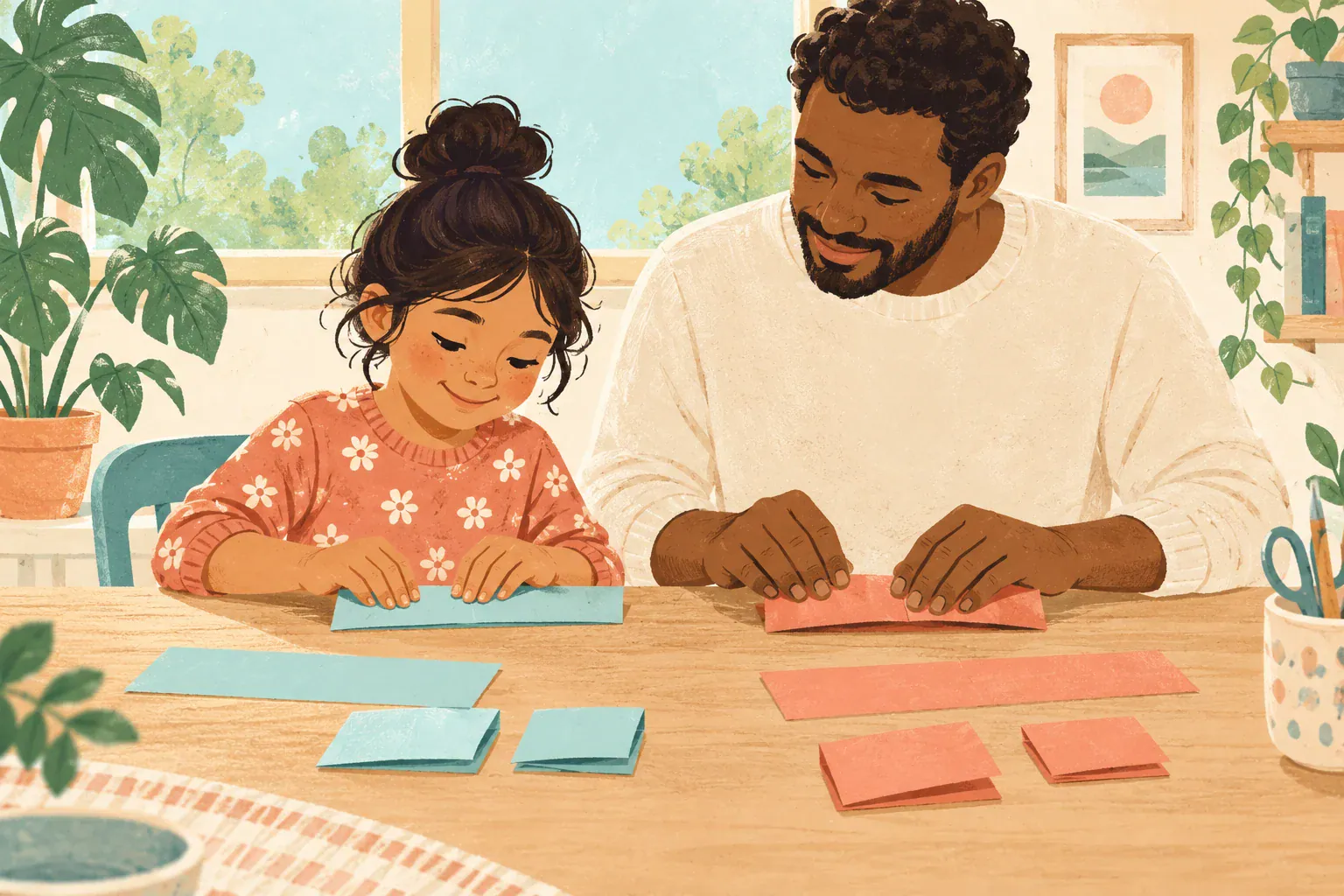
Place identical strips side by side and agree that each complete strip is one whole. Fold one into two equal parts. Open it and trace one part: “This is one half of this strip.”
Fold the second strip into four equal parts. Talk about one quarter as one of those four equal parts. The folds do not need to be beautiful; check the intended equal divisions together.
2. Keep the whole in the conversation
Compare one half of the first strip with one quarter of the second. Because the original strips are the same size, the half is larger. Put them alongside each other to see it.
Avoid the shortcut “Halves are always bigger than quarters.” A quarter of a very large whole can be larger than half of a much smaller one. For now, simply keep saying which whole you mean.
3. Check an unequal division
Draw a third strip divided into two noticeably unequal regions. Ask whether each region is half of that strip. You can acknowledge “two pieces” while explaining why two unequal pieces are not two halves.
- Compare by folding or tracing if useful.
- Invite your child to suggest a fair division.
- Keep the task about the represented amount, not drawing accuracy.
- Allow pointing or directing an adult’s hands.
4. Use the parts to rebuild the whole
With adult-prepared paper pieces, arrange two halves or four quarters to cover a matching whole strip. Notice that taking more pieces does not necessarily mean taking more of the original whole.
Adults should manage cutting when needed. Keep loose pieces away from younger children who may mouth them. There is no need to use food, which can add unnecessary sharing pressure or allergy concerns.
Try one everyday connection
Notice a sheet folded into two equal parts or equal sections in a drawing. Ask what the whole is before discussing the fraction. Avoid turning every snack or journey into a quiz.
If your child is confused, return to the visible whole and equal parts. Fraction notation can wait until the underlying idea has something clear to attach to.
Keep exploring
- How long is the toy road? Start measuring with what you have
- You don’t need to be the maths genius: how parents can help without knowing every answer