By EdCaptain editorial desk · Published
Your child correctly counts the squares inside a shape, then uses that number when the homework asks for its perimeter. Reminding them to “use the other formula” may get one answer fixed without explaining what changed. Try giving the two measurements different jobs: one tells you how much surface is covered; the other tells you how far you would travel around its outside edge.
This tabletop activity is for ages 8–12, with a simpler start for children who need it. It uses paper rather than a real building or gardening project. School sequences vary, so begin with what your child can show, not what they are supposed to know at a particular birthday.
Give the measurements a job
Imagine making a flat patchwork mat. The paper squares cover its surface: that is its area. A narrow border would follow the outside edge: the distance it follows is the perimeter. You are answering two different questions about the same shape.
Oak National Academy’s area and perimeter lesson distinguishes square units from units of length. Keep that distinction visible: count square faces for area and edge lengths for perimeter. Neither number is simply “the size”.
Set out one small patchwork
- Twelve equal paper squares, about 3–5 cm across, pre-cut by an adult.
- A clear, reachable table or tray.
- Paper and a pencil for recording; a finger can do the tracing.
Use sturdy, high-contrast paper if that helps. Keep scissors and scraps out of reach of younger children. There is no need for beads, pins or a loop of string. Let a child direct an adult to move the pieces if picking them up is tiring or difficult.
For the first round, call the length of one square’s side one unit. One whole square covers one square unit. Unless the squares really measure 1 cm on each side, the results below are not centimetres and square centimetres.
Build, cover, then walk the boundary
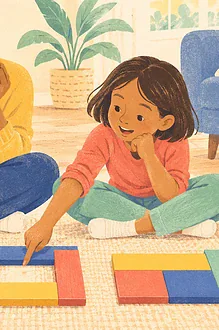
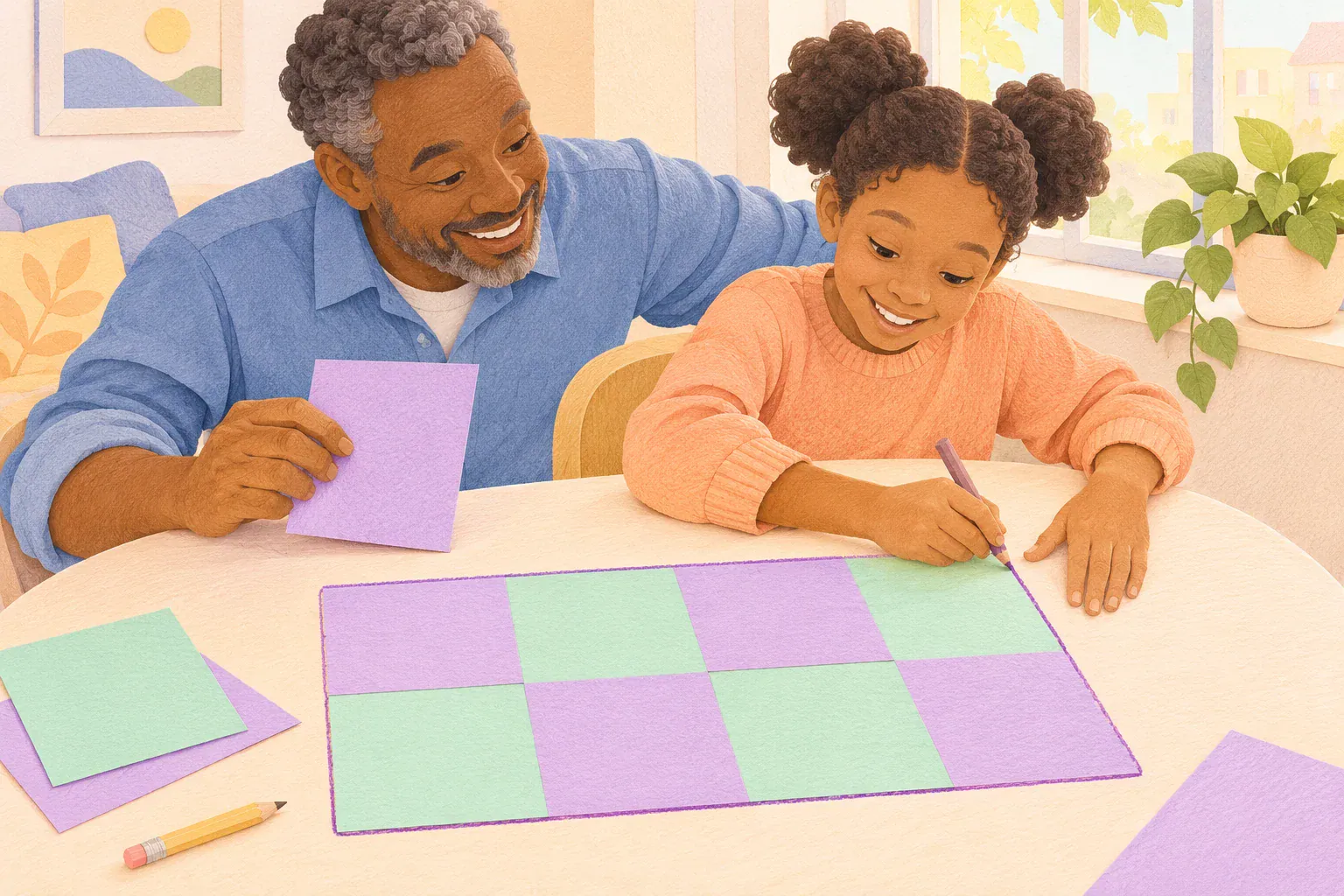
- Make two rows of six. Fit all twelve squares together edge to edge, with no gaps or overlaps. Ask your child to count the square faces, touching each once. Record “area: 12 square units”. Counting two rows of six is another way to check.
- Choose a starting corner. Move a finger all the way around the outside, returning to the start. Count each exposed square-side length once. Do not follow the lines between neighbouring squares.
- Check the four sides. The rectangle is six units long and two units wide. Its perimeter is 6 + 2 + 6 + 2 = 16 units. Ask, “Where can you show me each part of that calculation?”
- Rebuild with three rows of four. Before counting, ask whether the covering amount changed. Check that every original square is still there, then trace the new boundary. Its area is still 12 square units; its perimeter is 4 + 3 + 4 + 3 = 14 units.
Pause at the surprise. You did not lose any paper, yet the outside distance became shorter. Some square sides that were exposed are now touching other squares inside the patchwork. Those shared sides are not part of the outside boundary.
Use a record that keeps the units separate
| Rows × squares in each row | Area | Perimeter |
|---|---|---|
| 1 × 12 | 12 square units | 26 units |
| 2 × 6 | 12 square units | 16 units |
| 3 × 4 | 12 square units | 14 units |
Build the long, single-row rectangle if there is room. Otherwise draw it on squared paper. Ask, “Which mat would need the longest border? How can we check?” Turning a rectangle sideways changes its orientation, not its area or perimeter.
For children around 10–12 who enjoy investigating, reverse the condition. Draw a 1-by-5 rectangle and a 2-by-4 rectangle on squared paper. Both have perimeter 12 units, but their areas are 5 and 8 square units. This time the boundary amount stays the same while the covering amount changes. The English mathematics curriculum includes this relationship; it is a useful exploration, not a universal attainment deadline.
When the counting gets tangled
They count every line in the patchwork. Say, “Imagine a tiny walker staying outside the mat. Can the walker reach that line without crossing the paper?” Trace just one continuous outside route together.
They say the longer rectangle must have more area. Avoid correcting the guess immediately. Ask them to check whether any square was added or removed. Then count the faces again.
They remember a formula but cannot explain it. Let them point first. Once the model makes sense, connect a rectangle’s area to rows multiplied by squares per row, and its perimeter to adding all four side lengths. Keep the model nearby when returning to homework.
For ages 8–9, or any child finding twelve pieces too demanding, start with six: one row of six has area 6 square units and perimeter 14 units; two rows of three still have area 6 square units, but perimeter 10 units. Stop after that comparison. Use larger textured squares, verbal directions or an adult tracing while the child counts; handwriting is optional.
Finish with a choice, not a speed test
Ask your child to invent a question: “Am I buying material to cover the mat, or border to go around it?” Have them explain which measurement would help and point to what would be counted. A clear explanation with small numbers is a worthwhile stopping point.
If measuring units are still confusing, revisit measuring with equal units at home. For a change of pace, the estimate-and-check measurement trail explores choosing tools. If the session turns into “I hate maths”, use these ways to listen for the difficulty behind the words before adding another example.
Sources and further reading
- Oak National Academy: Shapes with the same areas can have different perimeters and vice versa — © Oak National Academy Limited (2025).
- Department for Education: Mathematics programmes of study — © Crown copyright 2021.
Contains public sector information licensed under the Open Government Licence v3.0.