By EdCaptain editorial desk · Published
A wrong answer needs teaching. “I got it wrong because girls can’t do maths” adds another problem: a child is turning one difficult moment into a rule about who can learn. For a parent or caregiver, the useful response has two parts—challenge the gender claim and help with the actual maths.
This guide focuses on ages 6–9, when children are building early school maths skills and hearing messages about who is supposedly good at them. It applies when a girl doubts herself, a boy repeats the claim, or another child is being put down.
What to say before returning to the question
Keep the correction brief: “Being a girl or a boy doesn’t tell us whether someone can solve this. Let’s find the part that needs explaining.” If the remark targets someone else, add: “We don’t use gender to put someone’s learning down.”
Then ask one calm question: “Did someone say that, or did it seem like the explanation when this felt hard?” Listen without demanding a name or launching an investigation in front of other children. Your child may be repeating a classmate, noticing who answers quickest, or borrowing an adult’s comment.
Avoid making the child defend an entire gender. “Show them girls are better!” leaves the same competition in place. “You’re brilliant, so you’ll get it” can also make the next error feel confusing. Try: “You don’t have to prove anything about girls. We can work on this question.”
Use research to guide adults, not to predict a child
A 2025 study by Martinot and colleagues, published in Nature, followed French first- and second-grade cohorts. Average maths scores were similar for girls and boys at school entry, with a gap favouring boys emerging during the first school year. The study does not establish one cause or tell you what an individual child can achieve.
UNESCO’s 2026 guidance draws attention to learning experiences, stereotypes, expectations and classroom interactions. The practical question for adults is what opportunities and teaching a child receives—not which group should win.
Give the mistake a specific explanation
Return to the work when your child is ready. Ask them to show where they began. Perhaps they missed a word, lost count, confused a symbol or do not yet understand the method. “You counted that object twice” offers something to check. “Girls struggle with numbers” offers no teaching at all.
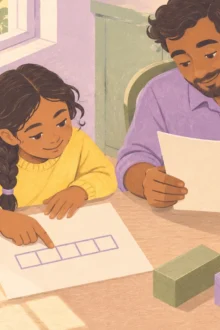
Offer one useful support: draw the situation, arrange objects, read the instruction aloud or look at the teacher’s example. Let the child do the next manageable step. You can say, “Your drawing shows three groups. Now we need to check how many are in each.”
Do not insist that every problem will become easy with enough enthusiasm. Children can need explicit teaching, accessible materials and more time. Our guide to finding the problem behind “I hate maths” can help separate difficulty with the task from reluctance to begin.
Try a quiet six-square investigation
At a relaxed time, offer an optional five- to ten-minute investigation. This is a chance to discuss strategies, not a test of whether your child has stopped believing a stereotype.
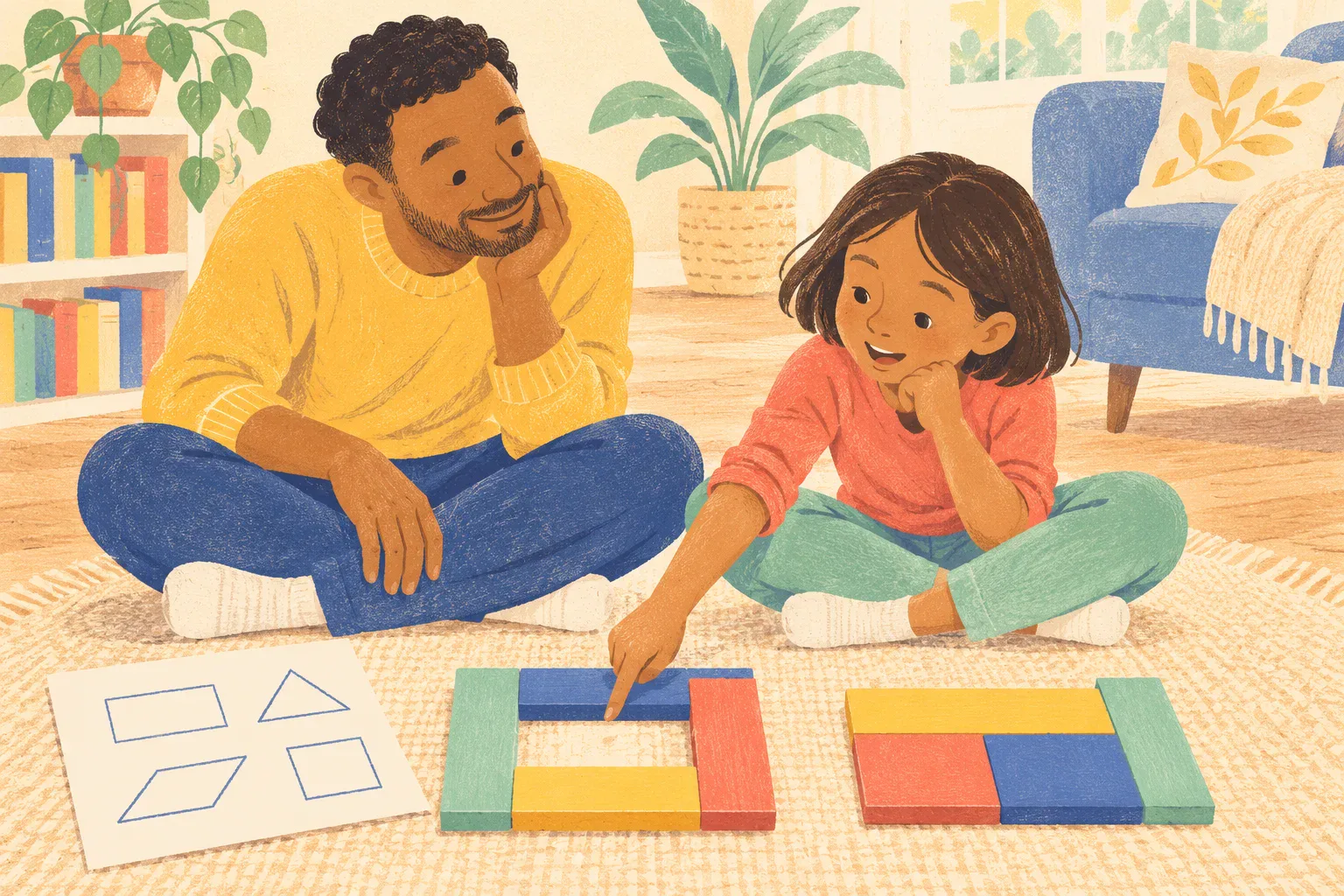
Materials and setup: an adult prepares six large, equal paper squares and clears a tabletop or reachable floor space. No tiny counters, scissors or purchases are needed. Say, “We’re going to rearrange these and notice what changes.”
- Make a row. Invite your child to lay out all six squares with their edges touching. Count together if useful. Ask how they can check none were missed.
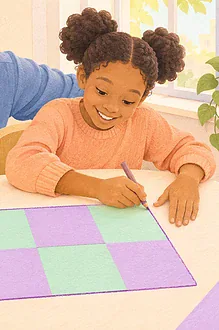
- Rearrange the same pieces. Make two rows of three. Ask, “Did moving them change how many squares we have?” Let the child count, point, draw or explain.
- Compare methods. An adult might count one by one; the child might notice two groups of three. Describe both methods without racing. There is no prize for being fastest.
- Check a slip without a label. If someone loses count, move each square slightly as it is counted, or mark a starting edge. Say what helped rather than who is “a maths person.” Do not deliberately trick the child.
- Close with one observation. Ask, “What helped us check?” Accept a gesture or a short answer and pack away. Do not end with a quiz about boys and girls.
For ages 6–7, stay with counting and noticing the unchanged total. For ages 8–9, invite another arrangement and ask how its rows help them check the total. If handling paper is difficult, an adult can move it while the child directs; use large, high-contrast squares or describe positions aloud as needed.
Declining an optional activity is allowed. Stanford DREME’s guidance on maths reluctance recommends attending to timing, interest and difficulty rather than creating a power struggle. Required schoolwork still needs an agreed plan with the teacher.
Check the opportunities around the child
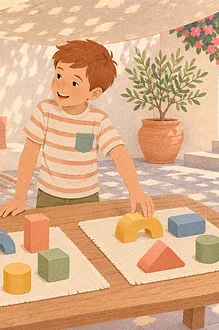
Notice who gets to build, measure, handle materials and explain an answer. Are girls mostly decorating a project while boys work out dimensions? Does an adult take over a daughter’s calculation sooner? Offer comparable chances and appropriate support, without forcing every child into the same interest.
UNESCO’s early-learning discussion encourages varied numeracy and spatial experiences and attention to gendered assumptions in play. One family activity is not a proven remedy for a wider pattern, but adults can change which opportunities they offer.
Ask the school for an observable next step
If the comment recurs, share the exact words and context privately: “After this worksheet, she said girls can’t do maths. What are you noticing, and how can we support participation?” Ask about turn-taking, access to materials, feedback and the specific skill that needs teaching. Agree on one action and a time to review it.
Persistent difficulty or distress deserves attention even after adults challenge the stereotype. Ask about teaching adjustments and whether further learning support is appropriate; do not diagnose from one remark. If your own school memories make helping tense, our guide for parents who don’t feel confident in maths offers a calmer role.
The message to keep repeating is modest and useful: “You belong in this learning. A mistake tells us what to examine next.”