By EdCaptain editorial desk · Published
Your child has drawn several outfits for a teddy. One looks familiar, another may be missing, and the answer to “Have we found them all?” is a hopeful shrug. A small recording system can make that question easier to answer.
This paper outfit puzzle for ages 6–12 asks children to find every pairing of two hats and three scarves, without counting the same pairing twice. The useful work is showing how the collection is complete. Multiplication can come later.
NRICH, the University of Cambridge mathematics project, explores clothing combinations in Elf Suits. Its guidance on working systematically describes several ways to organise a search. This smaller family adaptation uses an original two-item teddy wardrobe, with no real dressing-up materials or printed worksheets required.
Make a wardrobe small enough to explore
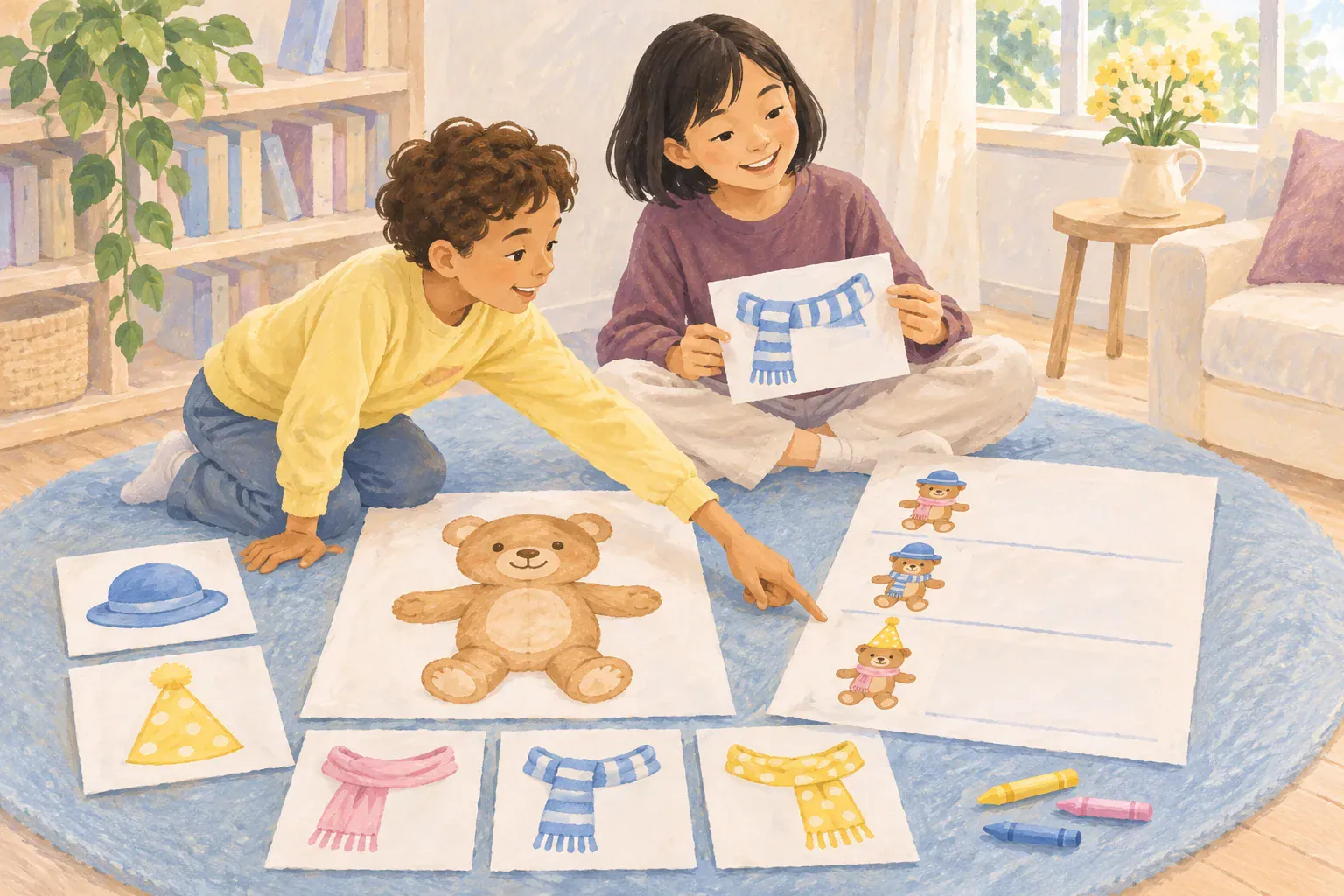
You need paper, pencils or crayons and a clear working surface. Draw a teddy or another invented character if your child wants one. Then make five large picture cards:
- two hats: a rounded hat and a pointed party hat;
- three scarves: plain, striped and dotted.
Different outlines and patterns keep the choices distinguishable without relying only on colour. Artwork can be rough. An adult can draw under the child’s direction, and folded sheets can replace cut cards. If cutting is wanted, use suitable scissors with supervision or adult preparation. Keep tools and small offcuts away from younger children.
Agree the rules before beginning: every outfit has exactly one hat and exactly one scarf. Every hat can go with every scarf. The items can be reused for each new outfit because you are recording possibilities, not dressing several toys at once.
Changing the teddy’s expression or drawing the same pair in another colour does not create a new outfit in this puzzle. Only the chosen hat and scarf matter.
Explore first, then organise
- Make any outfit. Put one hat card beside one scarf card. Record the pair with a quick sketch, two symbols or a few words. Keep the recording visible.
- Try another. Let your child choose freely for a few turns. Before adding it to the collection, compare it with what is already recorded. “Have we used this hat with this scarf before?” is enough.
- Look for a way to check. If the results feel jumbled, ask, “Could we put the outfits in an order that shows what is missing?” Allow time for an idea before offering your own.
- Finish and explain. Use the chosen arrangement to fill any gaps and remove repeated pairs. Ask your child to show how someone else could check the collection.
Some children will organise immediately. Others may prefer trying combinations before a system feels useful. There is no need to make the first attempts deliberately messy.
Hold one choice steady
One workable method is to keep the rounded hat in place while trying all three scarves. Record those three outfits together. Then use the pointed hat and try the same three scarves in the same order.
You can suggest this with a question: “What if we finished everything with this hat before swapping hats?” It is a support, not the only correct strategy. Starting with one scarf and trying both hats works equally well.
Here is one complete collection:
| Hat | Scarf |
|---|---|
| Rounded | Plain |
| Rounded | Striped |
| Rounded | Dotted |
| Pointed | Plain |
| Pointed | Striped |
| Pointed | Dotted |
There are six different outfits. The reason the list is complete is not just that it contains six entries: each of the two hats appears with every one of the three scarves, once. Check that explanation against the cards.
A grid is another option. Put hat pictures above two columns and scarf pictures beside three rows. Each space represents one pair. A child can point to a space while someone else records it. The grid should help the child see the choices, rather than become another page to fill perfectly.
Use a repeat or a gap as information
If your child records rounded-and-striped twice, place the two recordings together. Say, “These have the same hat and scarf. Shall we keep one in our outfit collection?” Do not treat a slightly different sketch as a different mathematical result.
If a pair is missing, ask which hat group or scarf group would contain it. Avoid announcing “You forgot one” before the child has a chance to inspect the arrangement. For a child who finds explanation tiring, our guide to showing reasoning without an interrogation offers alternatives to answering repeated questions aloud.
Change one part of the puzzle
For a second round, add a fourth scarf. Ask what new outfits this permits before rebuilding everything. Each hat gains one pairing with the new scarf, so the collection grows from six to eight. Keep the old records visible so the change can be checked.
Older children can try a restriction: the pointed hat cannot go with the striped scarf. Remove that one pair from the original six, leaving five. Here, counting every hat with every scarf would include an outfit the new rule excludes. State the restriction openly; do not invent it after the child has finished.
If your child likes writing number sentences, the unrestricted first collection can be described as two groups of three, or 2 × 3 = 6. The recorded pairs give the calculation a meaning. There is no need to require the formula before exploring.
Fit the task to the child
Ages 6–9: Begin with two hats and two scarves if five choices feel crowded. Help record the four resulting pairs, then offer the third scarf. Read or describe each card and accept pointing, moving cards or directing your hands.
Ages 10–12: Use the full collection and ask how the organisation prevents repeats. Offer either the extra scarf or the restriction, rather than adding both at once. They can predict, then check using their list or grid.
At either age, enlarge pictures, use high contrast and keep patterns distinct. Offer tactile symbols, verbal descriptions or the child’s usual communication aid. Support comfortable reach and remove time pressure. A partner can move and record choices without choosing them for the child.
If the task feels too large, the guide to finding one manageable starting step may help you reduce it. Stop when interest fades. Finish by asking, “What helped us know nothing was missing?” A row of carefully arranged pictures can be the whole answer.
Sources and further reading
- NRICH: Elf Suits — the established clothing-combinations problem that informs this smaller family adaptation.
- NRICH: Developing Mathematical Thinking—Working Systematically — guidance and examples of organised mathematical searches.