By EdCaptain editorial desk · Published
Imagine a child looking out at a wet garden path: “There are umbrellas and puddles. Do umbrellas make puddles?” The answer may seem obvious, but explaining it offers a useful puzzle. Two things can appear together because something else helps explain both.
This indoor picture-card activity is for ages 10–18, with a guided version for ages 10–12 and an extra challenge for teens. The scene below is an invented story, not a report of observations or a scientific study. You will build possible explanations, then discuss what evidence would help check them.
Put three pictures on the table
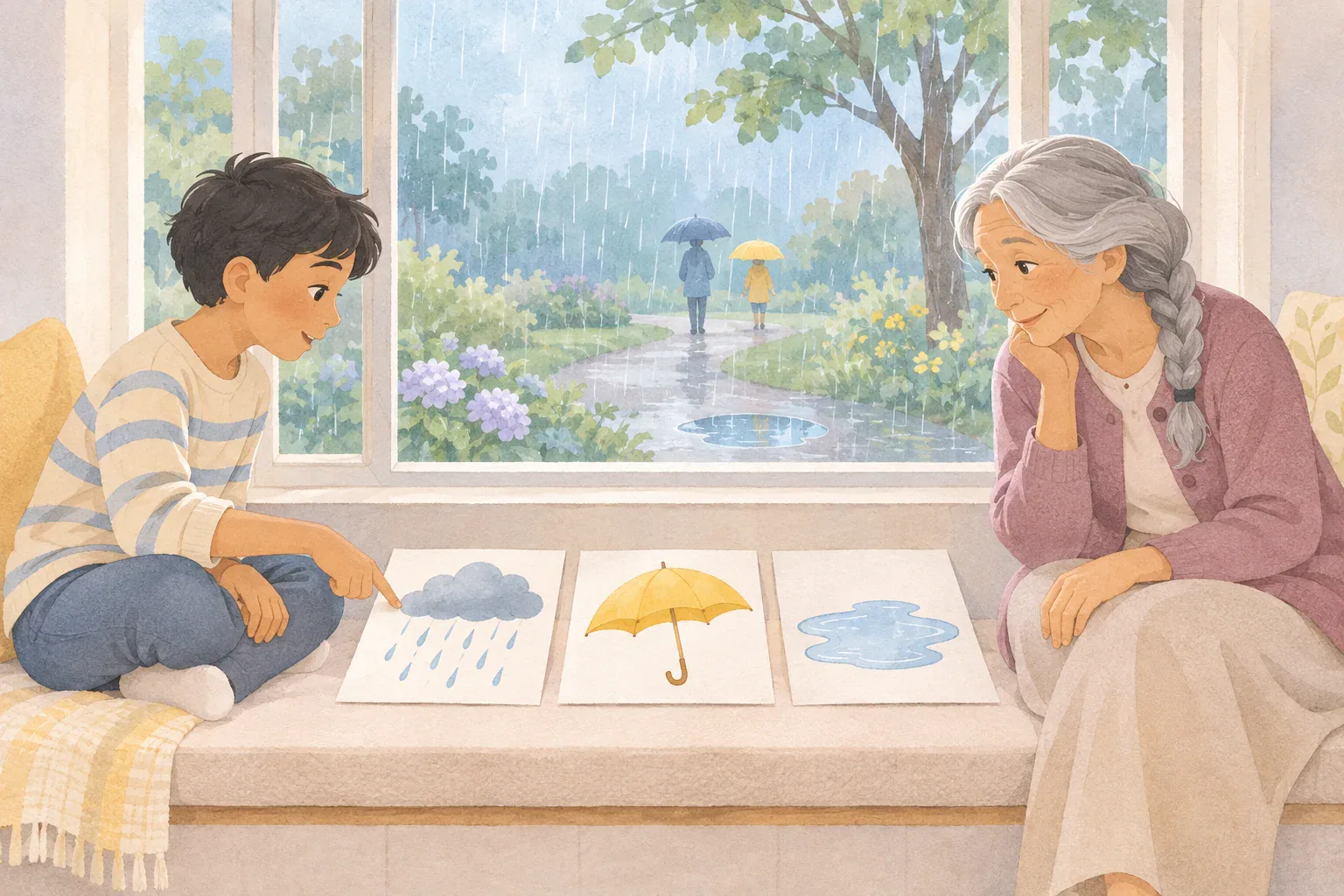
Allow about 15–20 minutes, or stop when the conversation has run its course. You need three large pieces of scrap paper, a pencil or broad marker, and space to move the pictures. Draw a rain cloud, a person carrying an open umbrella, and a puddle. Simple shapes are enough; adults can draw or describe the cards.
Keep the rain card aside at first. Have another sheet ready for drawing connecting arrows. There is no need for real umbrellas, water, an outdoor trip or a timed contest.
Play through the explanation
- Offer the made-up scene. Place the umbrella and puddle pictures together. Say: “In our story, people are carrying umbrellas along a garden path, and there are puddles on the path. Someone says the umbrellas made those puddles. What do you think?” Give your child time to respond without announcing a correct answer.
- Separate the scene from the claim. Ask your child to describe only what the story tells them. “People have umbrellas” and “there are puddles” fit. “The umbrellas caused the puddles” adds an explanation that the scene alone has not established. Try: “We have a description and an idea about why. Let’s keep those separate.”
- Bring in the missing picture. Reveal the rain card. Invite your child to arrange the three pictures to show a possible explanation. They might put rain above the other two: rain can prompt people to carry umbrellas, and rainwater can collect in low places on the path. Draw one arrow from rain toward each of the other pictures.
- Ask what the arrows mean. Agree that an arrow stands for a proposed causal explanation. It is not proof. Say: “Our picture makes the idea easy to discuss. We would still need evidence about what actually happened on that path.” A neat diagram does not turn a guess into a finding.
- Change something in your imagination. Remove the umbrella card. Ask: “If the same rain fell and nobody brought an umbrella, could puddles still form?” Then remove the puddle card: “Could someone carry an umbrella when this particular path has no puddles?” These questions help examine the explanation; imagined answers are not experimental results.
- Choose a useful next question. Ask: “What would help us decide how these puddles formed?” Possibilities include finding out whether it rained, whether a sprinkler was running, and where the water came from. Finish with one careful sentence: “Seeing umbrellas and puddles together does not, by itself, show that the umbrellas caused those puddles.”
Leave room for a good objection
A child may point out that wet umbrellas drip and can make small puddles. Accept it: “Yes. That could happen. We need to know which puddle and how the water got there.” The aim is not to defend an absolute rule that umbrellas can never contribute water. It is to show why a scene containing two things does not establish the direction or mechanism of a cause.
Likewise, rain does not mean every person uses an umbrella or every surface develops puddles. Your drawing leaves out details. Ask your child to name one missing detail, such as shelter or drainage, rather than trying to build a complete weather model.
The Australian Bureau of Statistics explains the distinction between correlation and causation: a relationship does not automatically establish cause and effect, and other factors may help explain it. Here, rain is a possible shared cause in our fictional scene.
Make the challenge fit your child
For ages 10–12: stay with the three pictures. Offer two arrangements to compare: umbrella → puddle, or rain → umbrella and rain → puddle. Ask your child to explain one difference in their own words. You can supply vocabulary after the idea is clear: “A shared cause is something that helps explain both.” They do not need to remember a technical term to take part.
For ages 13–18: add a second invented claim: “On afternoons when more people wear coats, the school lights are switched on earlier. Coats must make the lights come on.” Have your teen sketch a shared-cause possibility, such as darker, colder weather, and list information that could challenge it. Are the lights on a fixed timer? Is it actually colder on those days? What would comparing the same time on different days reveal?
Then consider another possibility: could one event influence the other in the reverse direction, or could a small pattern be coincidence? These are possible explanations to investigate, not answers to assume. UC Berkeley’s teaching material on correlation and causation describes these different causal possibilities. Learning to ask about them is a starting point, not a substitute for collecting and assessing evidence.
Keep participation comfortable
Let your child move cards, point, speak, type or direct your movements. Use large, high-contrast pictures, written labels, or spoken descriptions according to preference. Read one question at a time and pause. Drawing skill, reading speed and quick answers are not requirements. With siblings, let each offer an arrangement before anyone comments.
Keep the activity indoors and on paper. Never test an explanation by withholding safety equipment, changing medicines or exposing anyone to risky weather. If your family wants a separate, harmless experiment, use the planning steps in planning a fair test at home.
Close by asking: “What did we know, what did we suggest, and what would we check?” Caregivers who want to apply the same distinction to real research can read how to assess a parenting headline that says “causes”. For today, a useful outcome is a more precise question—and permission to revise an explanation.
Sources and further reading
- Australian Bureau of Statistics: Correlation and causation — relationships, cause and effect, and other explanatory factors.
- UC Berkeley: Correlation and Causation — common causes, causal direction and coincidence.