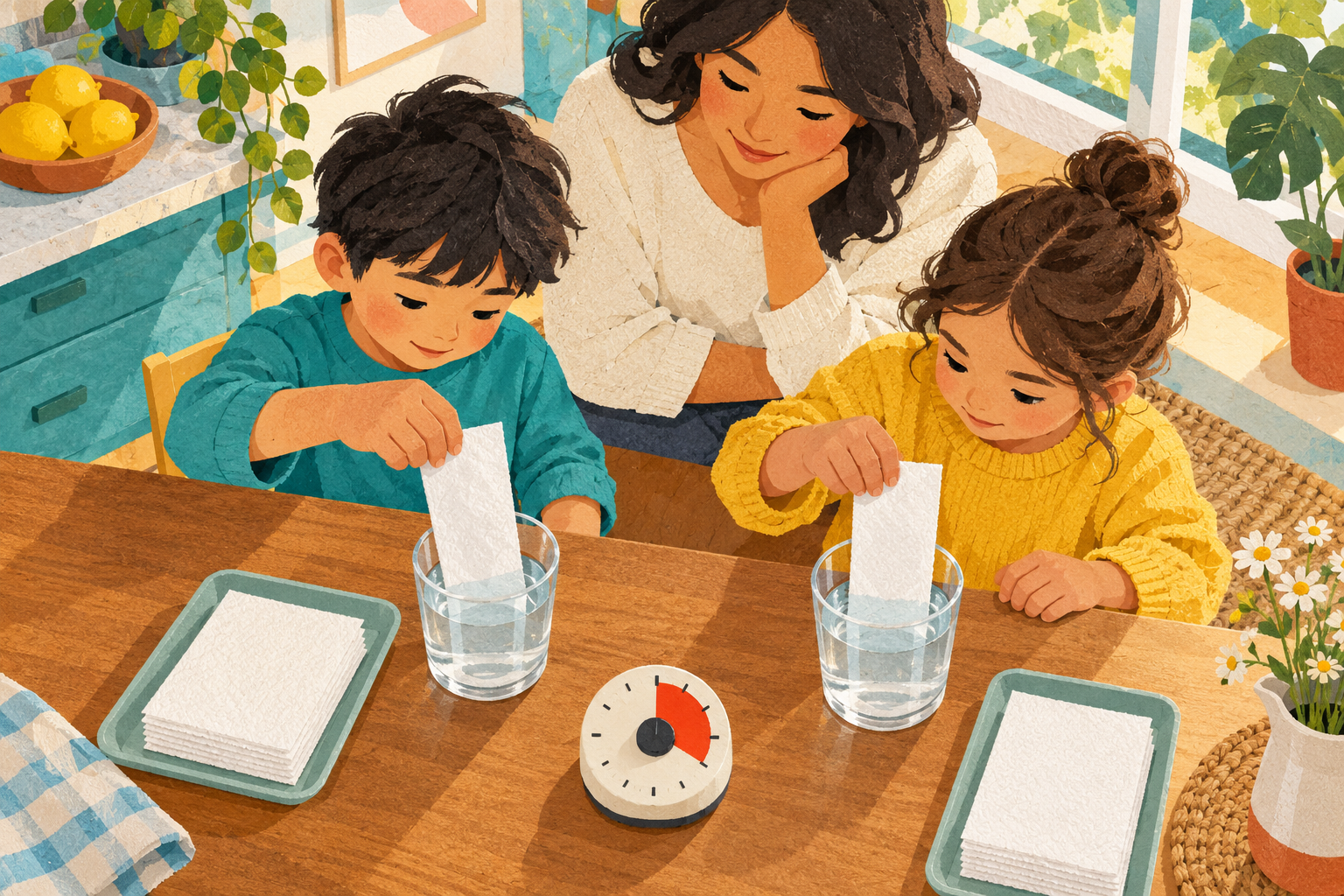
“Which paper towel is strongest?” “Does warm water dissolve this faster?” “Which paper aeroplane shape flies farther?” A child’s ordinary question can become a fair test without worksheets, lab coats or a parent delivering a science lecture. The important part is not producing an impressive experiment. It is learning how to make a comparison that can answer the question.
England’s science curriculum describes fair and comparative testing as recognizing what needs to change, what variables need to be controlled and what observations or measurements will answer the question. At home, that can be translated into four child-friendly decisions.
1. Make the question testable
Start with “I wonder…” and narrow it. “Which paper towel is best?” is too broad. Best at what—absorbing water, resisting tearing, costing less or cleaning a spill? A testable version is: “Which of these two towels absorbs more water when the pieces are the same size?”
Check that the question is safe, practical and answerable with materials you already have. Avoid tasting unknown substances, mixing household chemicals, using flames, handling hot water or testing products on people or animals. An adult should manage scissors, glass and any electrical equipment.
2. Name change, keep and measure
Draw three quick columns:
- Change: the one factor you deliberately make different—the towel brand, plane design or water temperature.
- Keep the same: conditions that could otherwise distort the comparison—piece size, amount of water, launch point, throwing person or container.
- Measure or observe: the result you will record—millilitres absorbed, distance travelled, time taken or a carefully defined observation.
Children often want to change several exciting things at once. Ask, “If both the paper and the size change, will we know which one caused the difference?” You do not need perfect control; you need enough consistency to discuss what the result can and cannot show.
3. Predict and explain
Before testing, invite a prediction and a reason: “I think A will absorb more because its surface looks thicker.” A prediction is not a promise and should never earn praise for being correct. Afterward, compare the evidence with the prediction. Unexpected results often create the best next question.
If your child says “I don’t know,” offer concrete choices: “Do you predict A, B or about the same?” They can draw the prediction instead of writing it.
4. Run, record and repeat
Agree on the procedure before beginning. For a paper aeroplane comparison, mark one launch line, choose one thrower, use the same room and measure from the line to the first landing point. Record each attempt rather than remembering only the longest flight.
Repeat when practical. Repetition helps reveal whether one result was unusual, but it does not make a home activity perfectly controlled. Three short trials can be enough to start a useful conversation. If results vary widely, ask what changed unnoticed.
A complete example: the ice-cube question
Question: “Does an ice cube melt faster on a metal tray or a wooden board?” Change the surface. Keep cube size, starting time, room and location as similar as possible. Measure the time until each cube has melted, or photograph both at equal time intervals. Predict first, then observe without touching or moving one cube more than the other.
At the end, say what the test supports: “In our test, the cube on metal melted first.” Do not jump to “Metal always melts ice faster everywhere.” Discuss limitations: Were the cubes exactly equal? Were both surfaces the same temperature? Would repeating give a similar result?
Let the child own the reasoning
Adults can handle safety and help organize materials, while children choose the question, identify a factor, make a prediction and decide how to record. A child who finds writing difficult can use tally marks, photos, drawings or voice notes. A child with limited mobility can direct the setup, operate a timer or interpret results.
Finish with three prompts: “What did we notice?”, “How fair was our comparison?” and “What would we change next time?” No elaborate display is required. The conversation is the learning.
For more open-ended investigation, try four build-and-test challenges. To support the reasoning around any activity, use five everyday thinking questions.