By EdCaptain editorial desk · Published
“Let’s work together” can still leave one child doing all the thinking. Try giving two partners different information instead: each knows something the other needs, and the task cannot be finished from either person’s sheet alone.
This pretend picnic puzzle is for ages 6–12. Two children can play, or a caregiver can be one partner. It uses made-up places and conditions, not advice about a real outing. The shared question is simple: Where can three pretend people each have a dry seat?
Make two small information sheets
You need scrap paper and a pencil, plus three larger pieces of paper for place cards. Allow about 15 minutes, without a countdown. Adults can prepare everything by hand; no printing, cutting or special equipment is necessary.
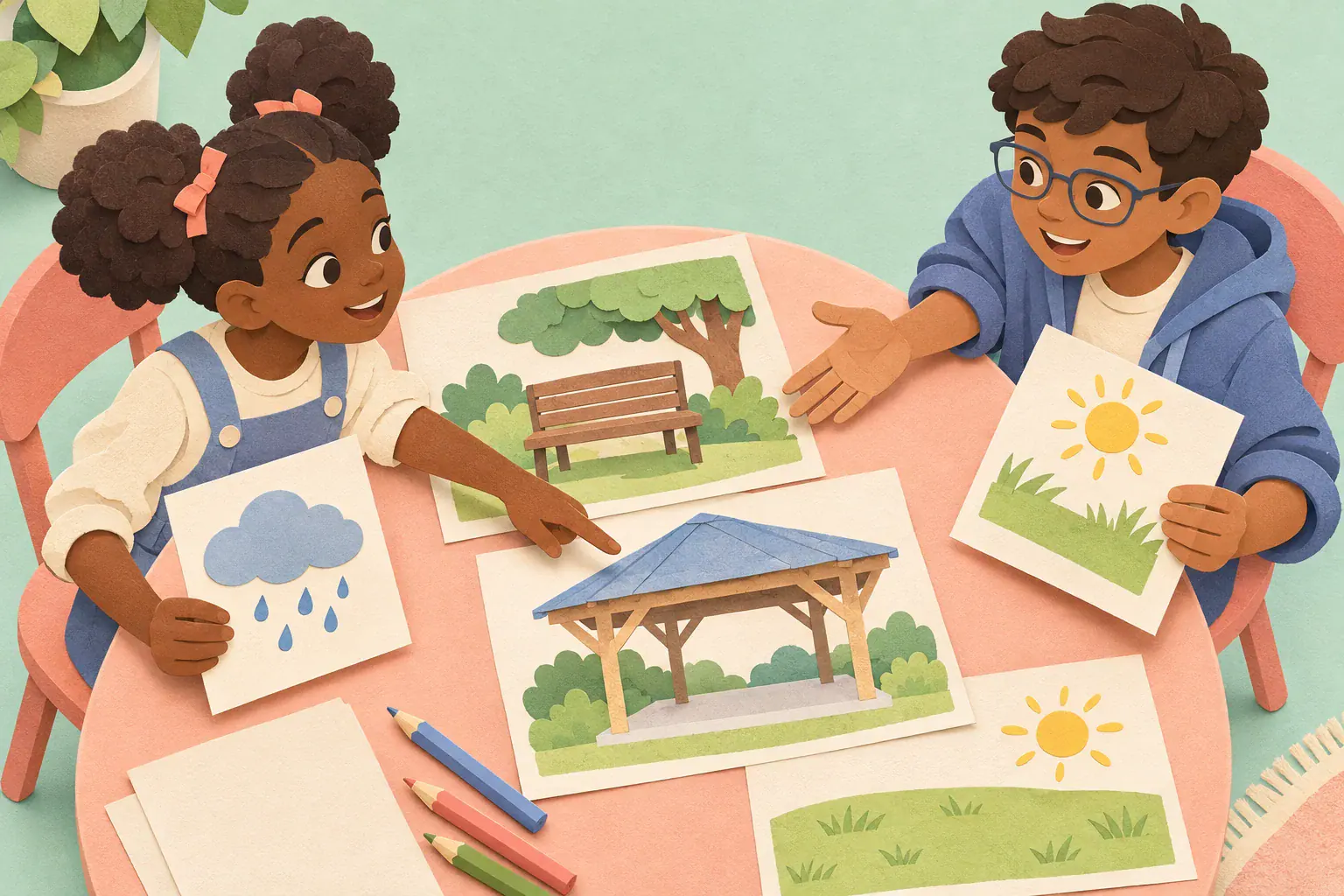
Draw or write these three names on the shared place cards: Sunny Lawn, Garden Bench, Picnic Pavilion. Explain that every fact in the puzzle is invented. A real bench or pavilion might be quite different.
Give one partner the seat sheet:
- Sunny Lawn: four seats.
- Garden Bench: two seats.
- Picnic Pavilion: four seats.
Give the other partner the condition sheet:
- Sunny Lawn: all its seats are wet.
- Garden Bench: all its seats are dry.
- Picnic Pavilion: all its seats are dry.
Write the goal where both can see it: “Choose one place with at least three seats, all dry.” In this puzzle, people do not share seats, move seats between places or dry the wet ones. Those boundaries keep the question clear; they are not rules for real picnics.
Exchange facts, then choose together
- Preview each sheet privately. Help each child understand their own information before starting. A caregiver can read it quietly or provide pictures. The sheets start separately so the partners have something to exchange, not because anyone must keep a secret.
- Model one useful question. Try “What do you know about the Garden Bench?” rather than guessing a place immediately. The reply can be spoken, signed, typed, pointed out or shared through AAC. Each partner needs a way to receive the other’s information.
- Record facts in the shared space. Put the seat count and wet/dry condition beside each place card as they are exchanged. Either partner can write, draw or direct the adult to record. Ask before handling someone else’s sheet or device.
- Check both requirements. For each place, ask: “Does it have room for all three? Are all those seats dry?” A favourite place does not win by being named first. The answer must fit both pieces of information.
- Explain the choice from both sheets. Invite each partner to contribute one relevant fact. “The pavilion has four seats” and “Its seats are dry” together explain why it works. One person can also point to the relevant entries while another reads them.
- Reveal and verify. Put both sheets where everyone can examine them. Check that nothing was missed or copied incorrectly. If the first answer changes, update it without awarding blame or losing points. There is no individual winner.
Check the answer without turning it into a test
The Picnic Pavilion is the only place that meets both conditions. Sunny Lawn has enough seats, but they are wet. Garden Bench has dry seats, but only two. The pavilion has four dry seats, enough for three people.
Notice why both sheets matter. The seat sheet alone leaves two possible places: lawn or pavilion. The condition sheet alone also leaves two: bench or pavilion. Exchanging information identifies their overlap.
If a child suggests taking a towel or adding a chair, acknowledge the sensible real-world idea: “That could change an actual picnic. For this puzzle we’re choosing from the seats described.” If they would rather invent a different solution, finish checking the original first, then agree on new rules together.
The structure draws on the British Council’s explanation of information-gap activities. Partners exchange missing information to complete a task, with opportunities to clarify and rephrase. This family puzzle is an original example, not a tested programme or a promise of improved communication.
Adjust the challenge, not the child
For ages 6–9: use large drawings, written numbers with matching seat marks, and clear wet/dry pictures or words. Explain unfamiliar words such as “pavilion.” An adult can read every entry and write the shared record. Start with one place at a time, and let a child show the answer without speaking. If comparing two requirements is too much today, combine the sheets and explore them openly.
For ages 10–12: after solving, invite the pair to make a second version. Keep the three places but change the seat numbers or conditions. Before another pair tries it, check every place against both requirements. Is there exactly one answer, several, or none? Also check that neither sheet gives away a unique answer on its own. If it does, change a fact so both partners’ information is needed.
Swap information roles for the next round. With more children, make several pairs rather than one large team with two busy readers and several spectators. Each pair can work at its own pace.
When the exchange gets stuck
If one partner rushes ahead, return to the shared question: “Which fact do we still need from your partner?” If a message is unclear, offer “I heard the number. Which place was that for?” rather than repeatedly saying “What?” EdCaptain’s guide to conversation turn-taking offers ways to preserve a thought while another person contributes.
Keep all communication supports available. Separate information must not mean inaccessible information: enlarge sheets, read them aloud, translate, move closer, or show a sheet when that is the clearest route. The point is to exchange meaning, not enforce speech or memory. See collaborating across communication differences for more options.
Use paper only; no food, water, outdoor travel or real seating test is needed. Stop if play becomes frustrating or mocking. Finish with two questions: “What did your partner know that you needed?” and “What helped you understand it?” Those answers tell you more about the exchange than how fast the pavilion was chosen.
Sources and further reading
- British Council TeachingEnglish: What is an information gap activity? — exchanging information, clarification and rephrasing.