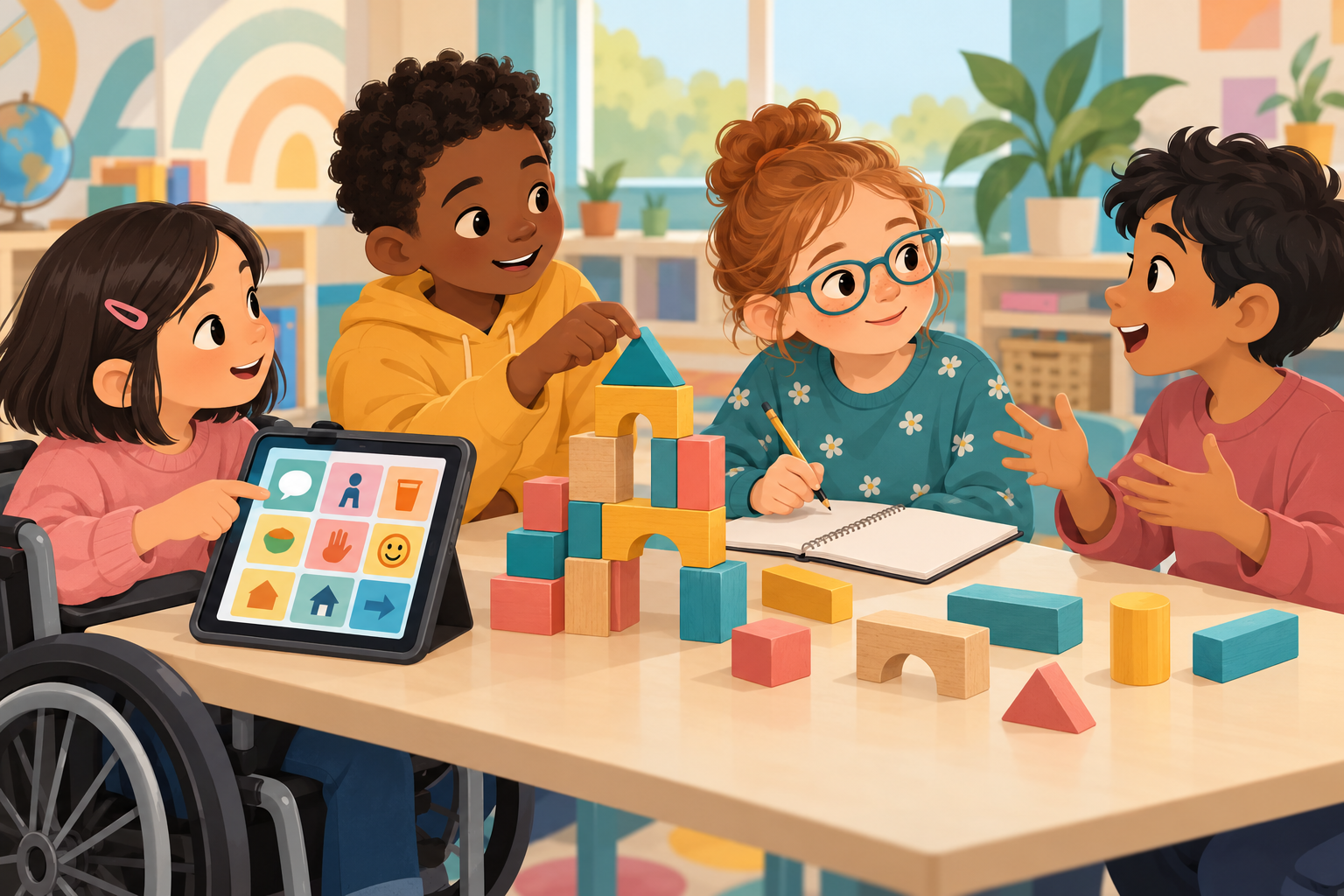
Children do not all communicate in the same way or at the same speed. One child may speak rapidly, another may type, sign, gesture, point to symbols or use an augmentative and alternative communication (AAC) device. Inclusive collaboration is not asking one child to imitate everybody else. It is designing the task so each person can understand, contribute and influence the outcome.
Start with access, not assumptions
Ask the child or family what supports communication; do not guess from a diagnosis, device or brief interaction. Make sure the person can reach and use their communication system throughout the activity. An AAC device is a voice, not a toy for peers to press and not something to remove for convenience or discipline.
Teach peers to address the child directly. If an adult is present, the question still goes to the child: “Which colour do you choose?” Then wait for their response.
Build in wait time
Silence is not an empty space that must be rescued. Formulating a message, finding symbols or coordinating speech may take time. A useful group habit is: ask once, count quietly, and keep an attentive posture. Do not finish the person’s sentence unless they ask for that help.
If the message is unclear, try, “I understood the first part. Can you tell me more?” or “Did you mean A or B?” Offer choices without reducing every conversation to yes/no questions.
Make the plan visible
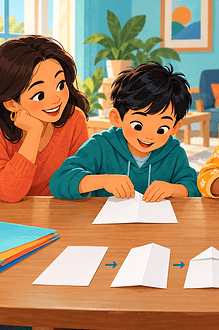
Use pictures, written steps, objects, demonstrations or a simple checklist alongside spoken instructions. Put the shared goal where everyone can refer to it. Clear roles—builder, recorder, chooser, checker—reduce the amount of rapid negotiation and make contributions visible.
For younger children, place role pictures on the table. School-age groups can use a turn board. Tweens and teens can agree on a shared document, chat channel or visual task board, while making sure no participant is excluded by the chosen technology.
Use a multi-mode round
- State one small question.
- Give private thinking time.
- Invite responses by speech, device, sign, writing, drawing, pointing or demonstration.
- Summarise each idea without ranking the communication mode.
- Ask the group to choose or combine ideas.
This prevents the fastest speaker from becoming the automatic decision-maker. It also teaches that communication is about meaning, not performance.
Teach respectful peer language
- “Take your time.”
- “I’ll wait while you finish.”
- “I’m not sure I understood. Can I check?”
- “Would you like help, or do you want to do it yourself?”
- “Let’s put all the ideas where everyone can see them.”
Avoid baby talk, public praise for ordinary communication, imitation of speech differences, or talking about the child as if they are absent. Curiosity is welcome when it is respectful and the child can decline to explain.
Intervene when access becomes tokenism
A child has not been included merely because they were present or assigned to hold materials. Check whether their ideas can change the plan. If peers routinely ignore, rush or override them, stop and reset the process: “We have not heard Jordan’s choice yet. The decision waits.” Repeated exclusion or teasing needs adult action, not just another social-skills lesson.
Debrief the system
After the task, ask everyone: “Which communication choices helped us?” and “What created a barrier?” Focus on the environment and group habits rather than making one child responsible for teaching everybody. Adjust the next activity—more preview, fewer simultaneous voices, a visual plan or longer response time.
Try these skills in Building Together, The Give-Only Puzzle, or a shared group task with clear roles.