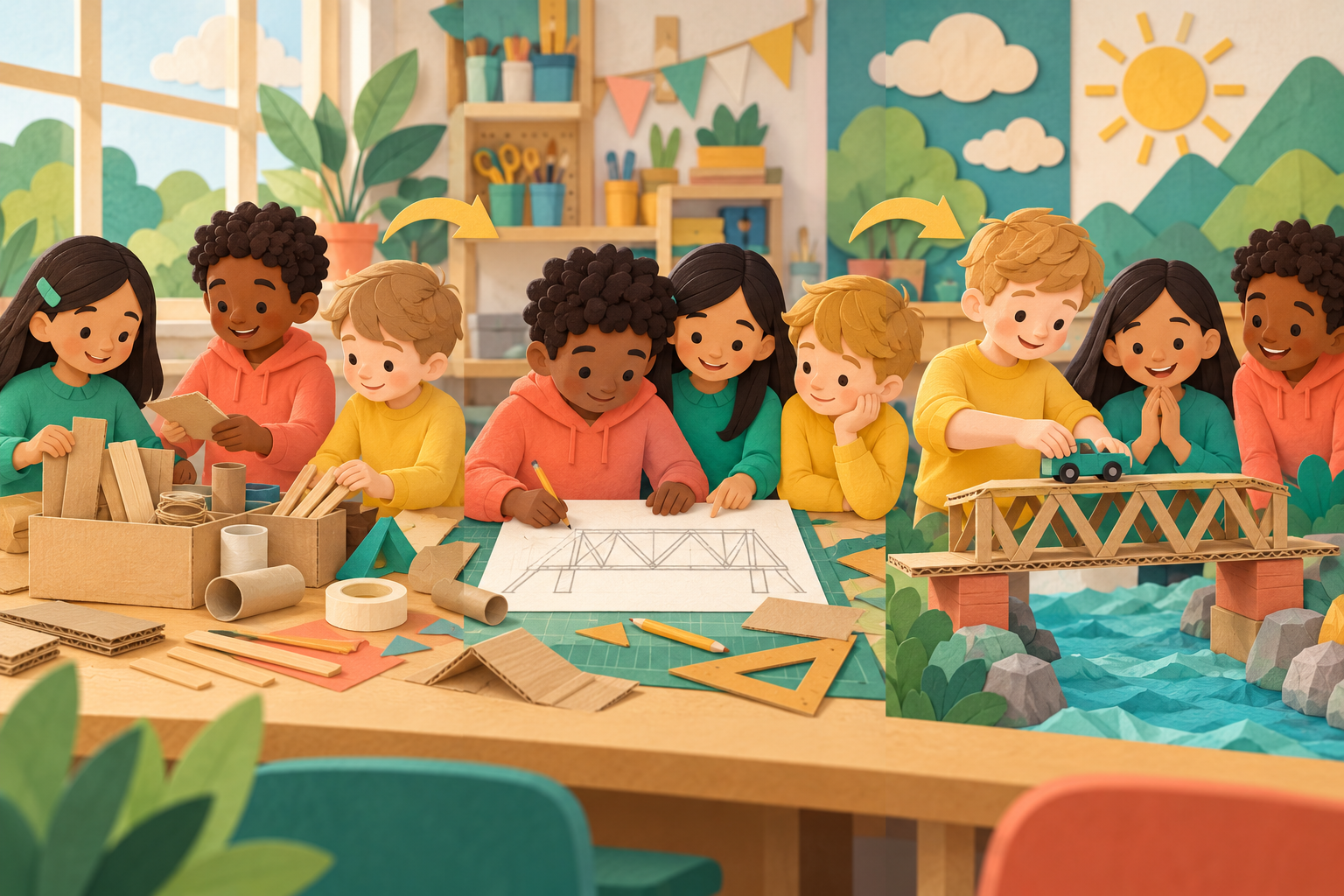
Put several children around one project and they do not automatically become a team. One child may grab the materials and make every decision, another may agree without contributing, and a third may drift away because the only available role does not fit. Telling them to “work together” names the outcome but does not provide a structure.
CAST’s Universal Design for Learning guidance recommends clear team goals, roles, expectations and responsibilities while recognizing the value of interdependence. It also emphasizes multiple ways to communicate. At home or in an informal group, a two-minute planning huddle can translate those principles into action.
Begin with one shared finish
Ask every child to help complete the sentence: “When we are done, we will have…” A tower that stands for ten seconds, a poster with three sections, a snack prepared and the kitchen cleared, or a video with an introduction and ending are visible finishes.
If children are aiming at different outcomes, role cards will not solve the conflict. Agree on the finish first, including any adult safety limits, time and materials.
Create meaningful roles
Roles should describe responsibility, not status. Useful examples include:
- Materials lead: gathers, distributes and keeps track of items.
- Idea collector: invites each person’s suggestion and records it in words or pictures.
- Builder or maker: carries out the agreed step, with help where needed.
- Checker: compares progress with the goal and notices safety or missing parts.
- Reporter: explains the group’s result and what they changed.
Do not give one child “leader” while others receive narrow service jobs. More than one child can make, and the idea collector should not decide which idea wins.
Match access, then rotate power
Offer roles in several forms. A child who finds writing hard can photograph steps or arrange picture cards. A child who communicates without much speech can point, select, demonstrate or use a device. A child with limited mobility can be the designer, timer, checker or director of a setup—not merely an observer.
Ask privately or openly, depending on the group: “Which role lets you contribute today?” Then rotate roles at a natural checkpoint so one confident child does not own the most influential work throughout. Rotation should not force a child into an inaccessible task; adapt the role rather than removing participation.
Use a one-minute decision rule
When several ideas compete, let each child state the idea in one sentence. The group names the shared criteria—safe, within time, uses available materials and meets the goal—then chooses, combines or tests ideas. If two options remain, run a tiny trial instead of arguing abstractly.
An adult can say, “I hear two workable plans. What could we test in three minutes?” Avoid selecting the fastest child’s idea simply because it arrives first.
Call a reset before taking over
Agree on a neutral reset phrase such as “team pause.” At the pause, ask:
- What have we completed?
- Whose idea or work have we not heard yet?
- Do the roles still fit?
- What is the next shared step?
Keep the reset brief. It is a repair tool, not a trial. If one child is dominating, describe the behaviour: “You are holding all the pieces and making each choice.” Then return a specific responsibility: “Please pass the pieces to the materials lead and ask for one idea before building.”
Coach language children can borrow
Provide sentence starters: “Can you show me your idea?”, “I agree with this part and want to change…”, “We have not heard from…”, “Which role do you want?”, and “Let’s test both.” Model a calm tone and reflective listening.
For siblings, avoid assigning permanent identities such as “the organized one” or “the creative one.” Those labels can harden the same power pattern across projects.
Reflect on the collaboration, not just the product
At the end, ask each child to name one contribution from someone else and one change that helped the team. Also ask whether any role lacked real influence. A beautiful product made by one child while others watched is not evidence of successful collaboration.
If the task becomes unsafe, humiliating or chronically hostile, stop and separate the children. Collaboration practice should not require a child to endure bullying or repeated exclusion.
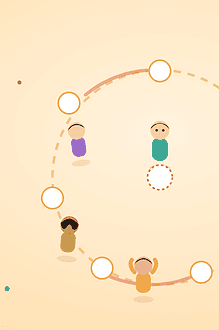
Groups can also practise cooperation through the Human Knot or the Shape the Star puzzle.