A child bursts into a conversation because the thought feels urgent, they are excited, they fear forgetting, or they have not yet learned how to read the pause. Repeating “don’t interrupt” identifies the rule but does not teach what to do with the idea while someone else is speaking.
Turn-taking is part of back-and-forth communication. The American Academy of Pediatrics notes that shared play can practise verbal and nonverbal exchanges, while Harvard’s serve-and-return work describes responsive exchanges as important for early communication and social skills. The practical aim is not a perfectly quiet child. It is a conversation in which people can contribute and be heard.
Teach the replacement action
Choose one family signal for “I have something to say.” A young child might place a hand gently on the adult’s forearm; the adult places a hand over theirs to mean “I know you are waiting.” Another child might hold up one finger, place a small “save my thought” token nearby or jot one word on paper.
Practise when nobody is rushed. One person speaks for twenty seconds while the child uses the signal. The speaker acknowledges it nonverbally, finishes the sentence, then says, “Thank you for waiting. What did you want to add?” The promised turn matters; otherwise the signal becomes another form of dismissal.
Make turns visible
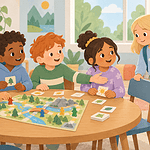
Some children benefit from a talking object at dinner or during a family meeting. Keep turns short and allow passing. In play, roll a ball back and forth, add one line each to a drawing or build a story one sentence at a time. These activities let children feel the rhythm of exchange without a lecture.
Do not require eye contact as proof of listening. A child may listen better while looking away, moving or using a fidget. Define the skill by the exchange: waiting briefly, noticing the other person’s message and taking a turn.
Use a brief in-the-moment response
When an interruption happens, protect both speakers:
- Acknowledge: “I can tell you have an idea.”
- Boundary: “Maya is finishing her sentence.”
- Preserve: “Touch my arm or write one word so you can remember.”
- Return: “Now it is your turn.”
Keep the correction calm and short. Public scolding makes the moment bigger and can turn eagerness into shame. If the child is interrupting to report danger, injury or an urgent need, they should speak immediately; teach what counts as urgent.
Model the rule yourself
Adults interrupt children too. If you do, repair it: “I spoke over you. Please finish.” Pause before offering advice, summarize what you heard and check that you understood. Children learn the pattern from the conversations around them, not only from instructions.
At busy times, state expectations in advance: “I need two minutes to finish this call. If it is not urgent, use our signal and I will come to you when the call ends.” Then follow through.
Adapt rather than assume
A preschooler may manage only a very short wait. Use quick games and immediate turns. School-age children can practise entering a group conversation with phrases such as “Can I add something?” or waiting for a breath or topic change. Children who communicate with a device or need extra processing time may require longer pauses and explicit protection of their turn.
Frequent interruption can have many explanations, including developmental stage, excitement, language differences, attention needs or difficulty reading social cues. Do not diagnose from one behaviour. If communication or attention concerns occur across settings and affect relationships or learning, discuss specific observations with the child’s teacher, pediatrician or another qualified professional.
Avoid silencing strategies
Do not make a child wait so long that the conversation always moves on, mock the length of their stories or praise only quietness. Avoid forcing an apology before the child is calm. The message should be: your idea matters, and other people’s ideas matter too.
Notice progress in small units
Name the exact skill: “You used the signal and waited until I finished that sentence,” or “You asked Sam a question before adding your story.” If the child forgets, reset and practise once more. Turn-taking grows through many short, successful exchanges.
For more support, try starting smaller when conversations feel difficult and the cooperative Shape the Star group puzzle.