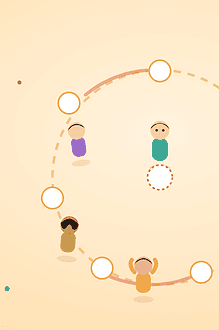
A quiet child may have plenty to contribute and still freeze when everyone turns toward them. They may need more processing time, prefer a different communication method, be new to the group or simply dislike performing on demand. Calling “Let’s hear from someone who hasn’t spoken” can be well meant and still feel like a spotlight. Participation grows more reliably when the path into the group is predictable and flexible.
Ask what makes contribution easier
Talk privately, not just before the event. Offer choices: “Would you rather know the question ahead of time, speak to one person first, write your idea, or take a practical role?” Do not assume silence means fear or lack of knowledge. The child may be listening, choosing carefully or communicating in a way the group has not noticed.
Preview the shape of the activity
Uncertainty adds work. Explain who will be there, what the group is trying to do, how turns happen and whether anyone can pass. For a classroom project, preview the first question. For a playdate, describe the opening activity and a place the child can take a break. A simple map of the event can free attention for participation.
Offer roles with real value
Groups often reward the fastest speaker. Broaden the roles:
- materials organiser or timekeeper;
- idea recorder or illustrator;
- person who summarises at the end;
- researcher who checks one detail;
- photographer or demonstration partner where appropriate;
- speaker who shares a jointly prepared sentence.
These are not consolation jobs. Make each role essential to the shared goal, and rotate roles so “quiet child” does not become a permanent identity.
Use a contribution ladder
Begin with the smallest workable step: tell an idea to a trusted partner. Next, let the partner introduce it—“Maya and I wondered whether…” Then the child might read one prepared line, answer by pointing, or respond to a direct but pre-agreed question. The next step should be chosen with the child, not announced as a surprise challenge.
For ages 3–5, a child might place a picture choice in the centre or show the group a block. Ages 6–9 can rehearse a sentence with an adult or peer. Tweens may send a note to the group leader. Teens can negotiate roles and communication channels themselves.
Make “pass” a real option
A pass is useful only if adults do not punish it with disappointment or immediately ask, “Are you sure?” Agree on a return path: “You can pass now and add your idea on the board later.” This lowers the threat while preserving an invitation to contribute.
Coach the group, not only the child
Ask other children to leave a pause after questions, avoid finishing someone’s sentence and respond to the idea rather than the volume. Use round-robin thinking time before open discussion so quick talkers do not occupy every opening. Pair work before whole-group sharing helps everyone formulate an idea.
Children who use AAC, gesture, sign, writing or other modes need time and access to those tools. Treat their message as part of the conversation, not an extra demonstration after the “real” discussion has ended.
Debrief without grading confidence
Afterward ask, “Which part made it easiest to join?” and “What would you change next time?” Avoid “Why didn’t you talk more?” Notice preparation, a useful note or a well-timed question. The goal is agency and connection, not a louder personality.
If a child wants to participate but persistent anxiety, speech difficulty or distress blocks them across settings, speak with their school and an appropriate qualified professional. Support should expand access, not force exposure without consent.
Related options include Puppet Tales, friendly games for new playmates, and sharing roles in a group task.