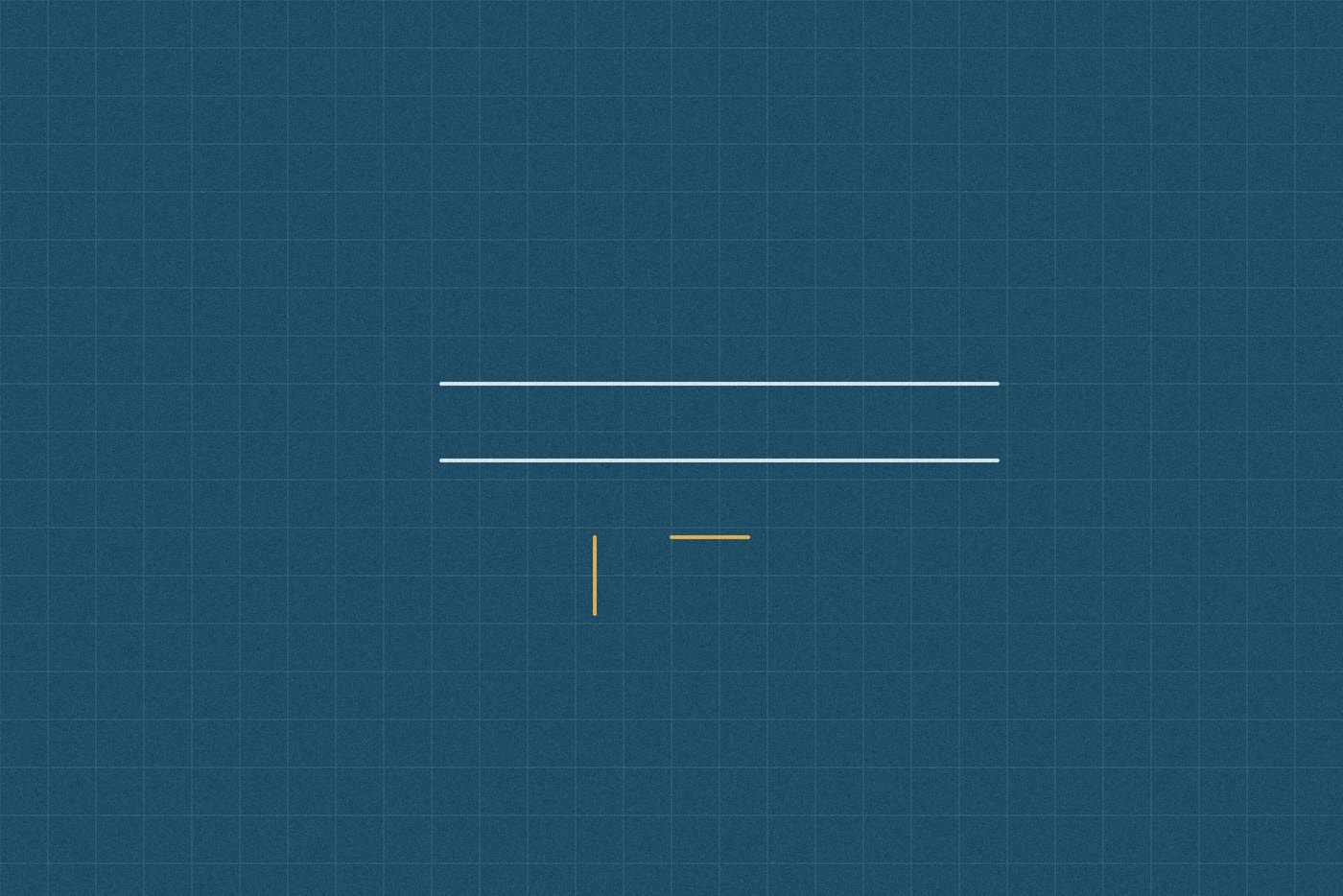
A ruler, a set square, and two lines that either run alongside each other forever or cross at a perfect right angle. Parallel and Perpendicular Lines is a short, satisfying drawing activity that teaches two genuinely useful geometry terms through actually drawing them correctly, rather than just defining them.
What you need
A ruler. A set square (a right-angled triangular drawing tool), or anything else with a reliable right-angle corner, a book, a piece of card cut square, works as a substitute. Paper and a pencil.
How to play
Drawing parallel lines. Explain simply: parallel lines are lines that always stay exactly the same distance apart and never meet, however far they’re extended. Place the straight edge of your set square against the ruler and draw a line along one of its edges. Then, keeping the ruler perfectly still, slide the set square to a new position along it and draw a second line along the same edge. The two lines drawn this way will be perfectly parallel. Ask your child to find examples of parallel lines around the house: the two edges of a door, the lines on ruled paper, the rails of a shelf.
Drawing perpendicular lines. Explain that perpendicular lines are lines that cross each other at a perfect right angle, ninety degrees. Draw a straight line, then place one edge of the set square along it, with the other edge pointing straight up from a chosen point on the line. Draw a second line along that second edge. Where the two lines meet should look exactly like the corner of a square. Ask your child to spot perpendicular lines around the house too: the corner of a table, a door meeting the floor, a window frame.
Putting both together
Once each skill is comfortable on its own, challenge your child to draw a simple shape using only parallel and perpendicular lines, a rectangle is the obvious one, since every rectangle is built entirely from two pairs of parallel sides meeting at perpendicular corners. Ask them to check their own drawing: are the opposite sides actually parallel? Do the corners actually look like right angles?
Why it works
Parallel and perpendicular are words children hear fairly often, in maths class, in casual conversation about streets or shelves, without necessarily having a precise sense of what distinguishes one from the other. Actually drawing both, carefully, with a tool that enforces the correct relationship, builds a much more exact, lasting sense of the difference than simply being told the definitions ever manages on its own.
This is also a nice, calm activity in its own right, closer to careful drawing than to a maths drill, which makes it a good choice for a child who finds more fast-paced number games overwhelming but enjoys a slower, more deliberate kind of focus.
A ruler, a set square, and a few careful lines on paper produce, by the end, a page of genuinely correct geometric drawing, not just a definition recited back. That hands-on precision tends to be exactly what makes the underlying idea, same distance apart forever, versus meeting at a perfect right angle, stick.