Set up a pretend radio call-in show, hand your child the title of “expert,” and watch them work through a tricky problem by solving someone else’s version of it first. The Expert Call Show gives a child real distance from their own difficulty, which often makes it considerably easier to think clearly about it.
Why this matters
Children frequently find it easier to solve a problem that belongs to someone else than to tackle the same problem when it’s framed as their own, the emotional weight of “this is my issue” tends to get in the way of clear thinking. Putting a child in the position of answering a caller’s question, rather than being asked directly, lets them access their own good ideas without the usual pressure.
What you need
Nothing required, though a toy phone or play microphone adds to the fun. A video camera if you’d like to record it.
How to play
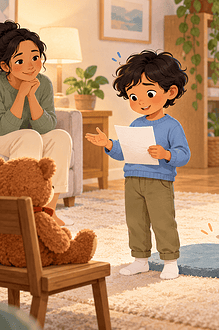
Set up a simple pretend talk show, with your child as the expert guest and you as the host. Introduce the show and the day’s topic, something connected to a challenge your child has actually been facing, framed generally rather than naming them directly.
Explain that a caller is on the line with a question for the expert, then change your voice and become the caller, describing a problem similar to your child’s own, but happening to a younger, invented child instead. Let your child, as the expert, answer the question and offer advice.
Continue with a few different calls, all circling the same underlying issue from slightly different angles, letting your child work through genuine solutions each time as the expert.
If they get stuck
If your child can’t find an answer to a particular caller’s question, it’s fine to suggest they “consult” an imagined helper, a wise animal, a wizard, anyone, for ideas, which keeps the game going without putting them on the spot. You can also gently offer a thought yourself, framed as something the expert might also consider.
Variations
Some children enjoy a talk-show format better than a call-in one, where your child hosts and you’re the guest, discussing whatever topic they choose to steer the conversation toward. Either way, keeping a recording, if your child is comfortable with that, can be a nice thing to revisit together later.
Why the distance matters
A child answering as “the expert” for someone else’s problem is quietly solving their own, without ever having to say so directly, and that distance is exactly what makes the advice flow more freely than it would in a straightforward conversation about their own difficulty.
A pretend microphone, a made-up caller, and a child confidently handing out good advice is a playful way to let them discover they already have more good answers inside them than a direct question would ever have drawn out.