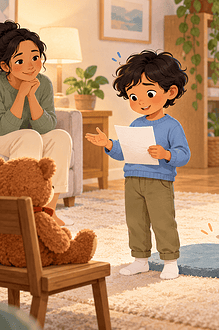
“Your drawing has wonderful colors.” “No, it’s terrible.” “You played that piece beautifully.” “I only got lucky.” Children sometimes push compliments away because attention feels uncomfortable, they fear sounding boastful, or they do not believe the praise. Others repeat the compliment loudly or turn it into a competition because they are still learning how to hold positive attention.
Receiving a compliment is a small social skill, not a test of humility or self-esteem. A child can acknowledge kind words without agreeing with every detail, shrinking themselves, or proving they are better than someone else.
Teach the simplest complete response
The basic response is two words: “Thank you.” That is enough. It acknowledges the speaker’s intention without requiring a speech, eye contact, a return compliment or public self-evaluation.
Offer optional additions:
- “Thank you—I worked hard on that part.”
- “Thank you—I enjoyed making it.”
- “Thank you—Sam helped me with the rhythm.”
- “Thank you—that means a lot coming from you.”
A child who communicates differently can nod, sign thanks, type, smile or use another agreed response. Courtesy does not have one physical form.
Explain why denial creates an awkward loop
When someone says, “I like your story,” and the child answers, “It’s awful,” the other person often feels they must argue harder. The conversation becomes a contest over the child’s worth. Teach: “You do not have to feel fully confident. You are accepting that they chose to say something kind.”
If the compliment feels inaccurate, a neutral response still works: “Thank you for saying that.” The child is not signing a certificate of perfection.
Make room for discomfort
Ask what makes compliments hard. Possibilities include:
- being watched;
- worry about peers calling them a show-off;
- praise that feels exaggerated or public;
- not trusting the speaker;
- feeling pressure to repeat the success;
- family or cultural norms about modesty;
- body-related comments they did not invite.
The solution is not always more praise. A child may prefer private, specific feedback. They are also allowed to set a boundary around personal remarks: “Please don’t comment on my body,” or simply leave and tell a trusted adult if the attention feels unsafe.
Practice without putting the child on display
Use toys, characters or quick role-play. Give three kinds of compliment and let the child try one response:
- Effort: “You kept working when the model fell.”
- Skill or result: “Your explanation was clear.”
- Character in action: “You made room for someone else to speak.”
Then switch roles. Let the child notice which compliments feel sincere and which feel vague. This also teaches them to give grounded compliments rather than rank people.
Share credit without erasing yourself
Children sometimes believe modesty means giving away all credit. Teach an “and” response: “Thank you—I practiced, and my teacher helped.” Both can be true. In group work: “Thank you—our team planned it together.” Sharing credit should be accurate, not compulsory self-erasure.
Likewise, accepting a compliment does not require comparison. “Thank you” is complete; there is no need to add, “I’m better than everyone else.” Grounded confidence can recognize a strength while leaving room for other people’s strengths.
Change how adults praise
Children find compliments easier to trust when adults are specific and proportionate. “You used two examples, so I could follow your argument” gives information. “You are a genius” creates a large identity to defend. EdCaptain’s Praise That Helps offers practical alternatives.
Do not flood a reluctant child with praise to “boost confidence.” Ask what kind of feedback they prefer and allow neutral observation. Healthy self-esteem grows in a climate of respect, affection and room for individual differences—not through constant applause.
Adapt by age
Ages 3–5: model the exchange in play: “Nice tower.” “Thank you!” Do not correct every shy glance or hidden face.
Ages 6–9: practice one sentence and one non-speaking option. Talk about the difference between accepting praise and bragging.
Ages 10–12: discuss peer pressure and why denying strengths may feel socially safer. Rehearse a calm response that does not invite debate.
Teens: respect cultural style and privacy. Explore why public recognition, appearance comments or online praise may feel different. Let them choose whether to reply publicly, privately or not at all.
Connect compliments to a balanced self-view
A compliment is one person’s observation, not the whole story. Encourage children to hold strengths and growth areas together: “I am becoming more confident at presentations, and I still need help organizing my notes.” EdCaptain’s Skills I Have, Skills I’m Building makes that balance concrete. For broader confidence habits, see Six Everyday Ways to Build Healthy Self-Esteem.
If a child rejects all positive feedback, speaks about themselves with persistent worthlessness, withdraws from ordinary life, or shows other signs of significant distress, consult a pediatrician or qualified mental health professional. A response script can ease a social moment; it cannot resolve deeper distress by itself.
The goal is quiet ownership, not a performance: hear the kind words, choose a comfortable acknowledgment, keep an accurate share of the credit, and move on without becoming smaller or bigger than anyone else.