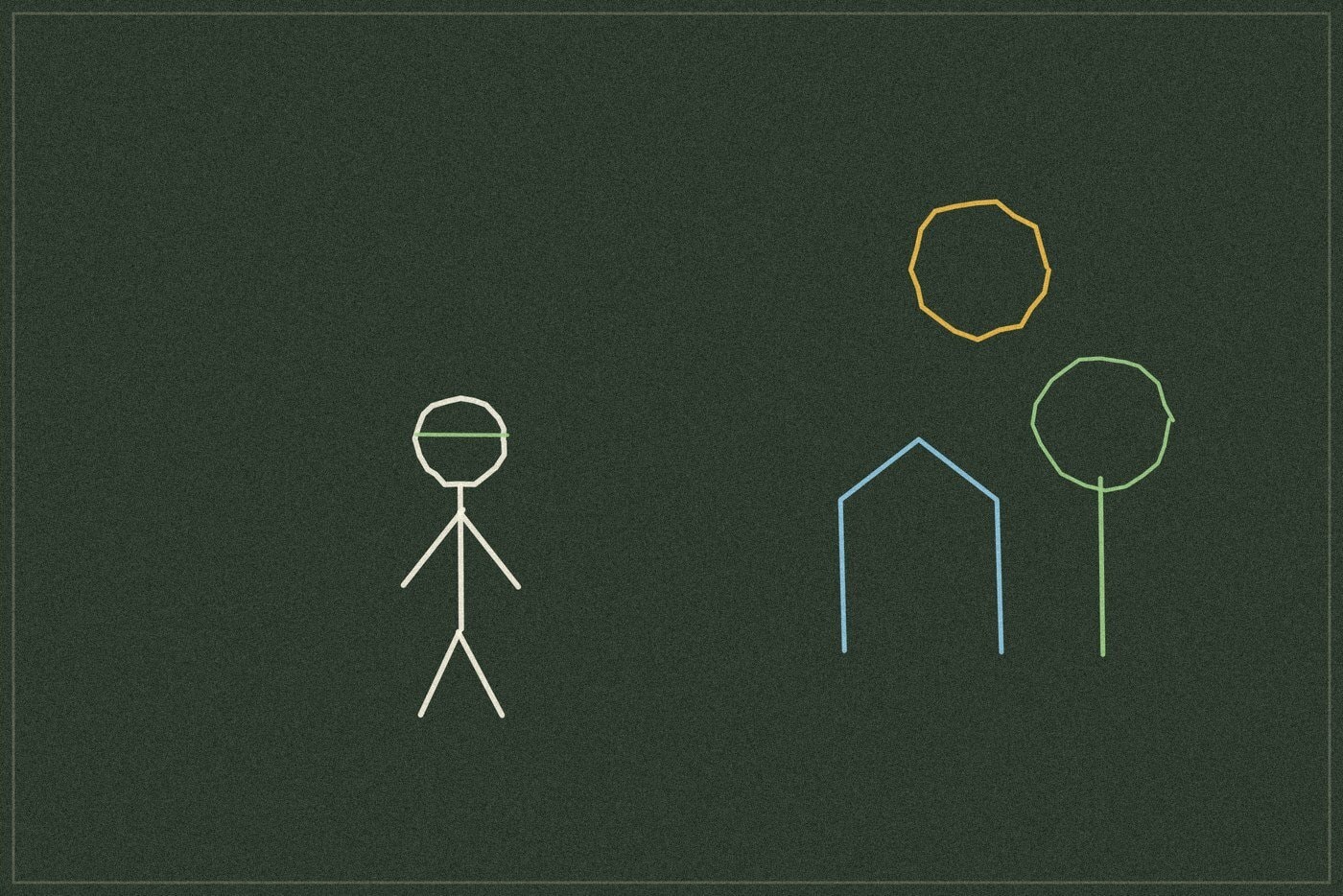
Paper, something to draw with, and a simple instruction: close your eyes, and draw your happy place. What comes out is rarely tidy, and that is exactly the point. For children who find it hard to talk directly about how they feel, a pencil in hand often unlocks something words alone cannot reach.
What you need
Paper and crayons, pencils, or any safe drawing materials. Optionally, a few natural objects collected from outside (leaves, small stones, flowers) if you want to extend the activity into a simple collage.
How to run it
If there is space and time, start with five minutes outside, inviting children to collect one or two small natural objects they are drawn to, which they can later use in their drawing or set aside as a keepsake.
Back at the table, ask everyone to begin drawing freely, first in complete silence. After a minute or two of silent drawing, ask them to close their eyes and keep drawing for another short stretch, without looking at the page.
Give the actual prompt clearly: draw your favourite place, or a happy memory, somewhere or something that makes you feel good. Let them add as much detail as they want, in whatever way feels natural, using words, extra materials, or simply more colour.
There is no wrong way to do this drawing. Some children will produce something detailed and recognisable. Others will produce something that looks like scribbles and colour, which is just as valid an outcome.
The conversation afterward
Keep this part genuinely optional and low-pressure, more an invitation than an expectation:
- Is there a story behind your drawing you’d like to tell us?
- What colours did you reach for? How did using them make you feel?
- Was it easier or harder to draw with your eyes closed?
- Can drawing something like this help you feel better on a hard day?
Why the eyes-closed step matters
Drawing with eyes closed removes the self-consciousness that often comes with trying to make something look “right.” Children who are normally hesitant to draw, worried their picture will not look good enough, tend to loosen up considerably once the pressure of a tidy, accurate result is removed entirely. What comes out is often more honest, and more revealing of an actual feeling, than a carefully controlled drawing would have been.
What this is actually building
For children who find it hard to put feelings into words directly, and most children fall into this category at least sometimes, drawing offers a genuine alternative channel. A happy place drawn on paper becomes something concrete to point at and talk around, rather than requiring a child to generate the right words from nothing. It also, quite simply, gives children practice at the small, real skill of creating something and then choosing whether and how to share it, which builds a kind of confidence that pure verbal sharing does not.
Displaying the finished drawings, with each child’s own choice about whether to put theirs up, turns an individual activity into something the group shares in together, and tends to make a classroom or family space feel a little warmer and more personal afterward.
A note on staying with happy places
Keep the prompt firmly focused on a happy place or positive memory, rather than inviting children to draw difficult or painful events from their life. That heavier version exists in some trauma-support training materials, but it depends on a trained facilitator being present to properly hold whatever comes up, which is not something to attempt in an ordinary classroom or family setting. If a child’s happy-place drawing touches on something that seems to carry real sadness underneath it, follow up with them individually and gently, rather than opening it up in front of the whole group.
Adapting it
For very young children who are not yet confident drawing representationally, simply colouring freely while thinking about something that makes them happy captures the same spirit. For a family version, everyone, adults included, drawing their own happy place at the kitchen table together often becomes a genuinely enjoyable shared activity in its own right.