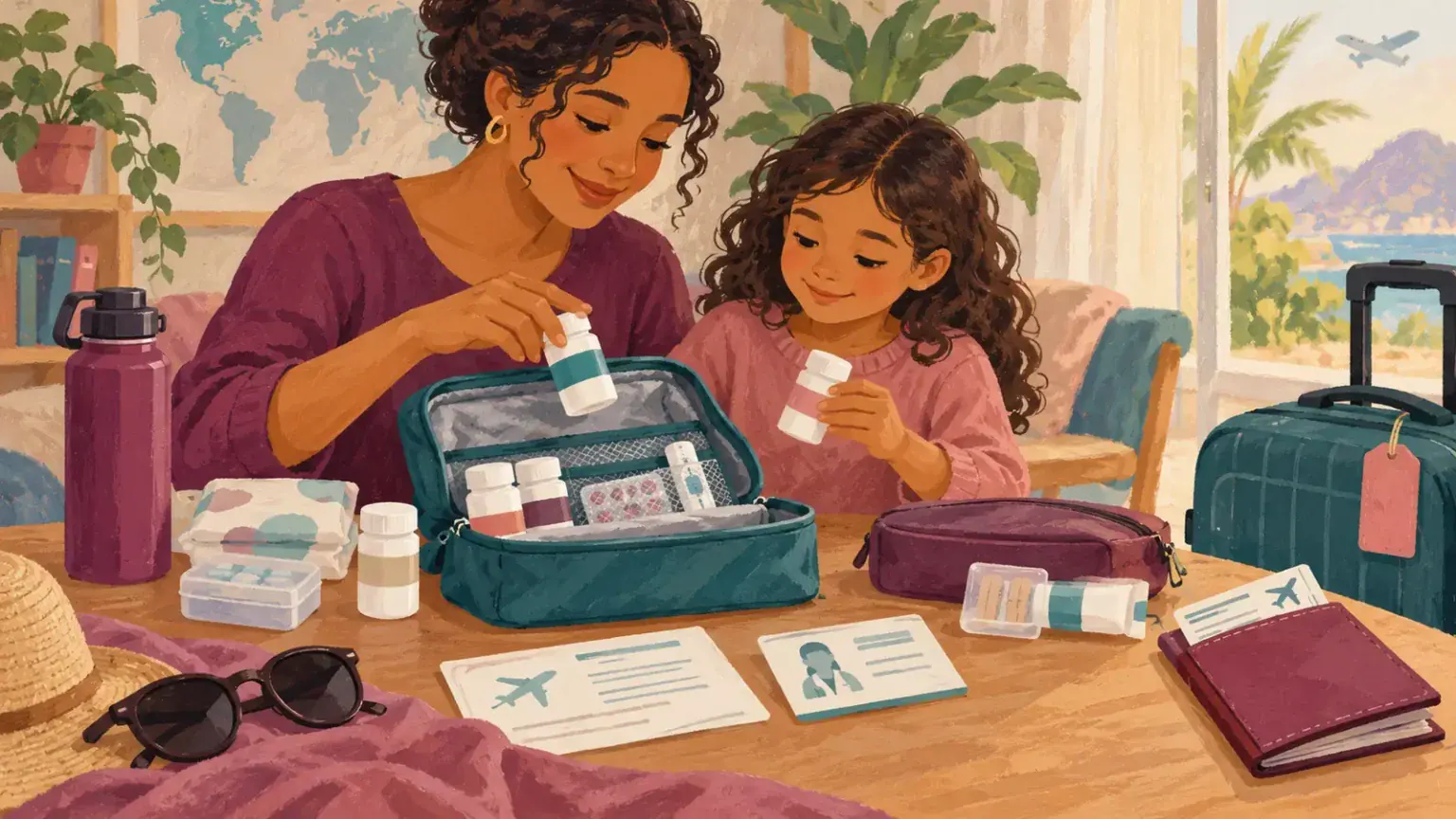
Travel disrupts the place, time and people around a child’s usual medicine routine. A written plan is safer than assuming someone will remember every dose after a delayed flight or late arrival. Start early enough to speak with the child’s clinician and check the rules for every destination and transit country.
Review the trip with the clinician
Share the itinerary, length, time zones, expected activities and access to refrigeration or healthcare. Ask whether the child needs routine or travel-related vaccination, extra supply, a timing adjustment, an emergency action plan or a letter explaining medicines and devices. Do not change doses or schedules based only on a time-zone calculator.
CDC advises a pre-travel health review, especially for international travel and children with chronic conditions. Start several weeks ahead where possible; some requirements and vaccine schedules need time.
Check the law, airline and security rules
A medicine available at home may be restricted elsewhere. Check official embassy or government information for the destination and every layover. Ask the airline or security authority about liquids, needles, cooling packs and medical equipment. Carry documentation required for controlled, injectable or refrigerated medicines.
Keep medicines identifiable
CDC recommends original labelled containers and copies of prescriptions that include generic names. Pack enough for the trip plus a reasonable delay, as agreed with the clinician and permitted by local rules. Put essential medicines in carry-on baggage rather than relying on checked luggage. Keep them under the responsible adult’s control and away from children who could take them unsupervised.
Create a one-page list with the child’s name, allergies, conditions, medicine name, strength, usual schedule, clinician contact and what to do in an emergency. Do not post this information visibly on luggage. Store a secure digital copy and give a copy to another responsible adult.
Plan storage before leaving
Ask the pharmacist or manufacturer about temperature, light and moisture. A household refrigerator, hotel minibar and insulated pouch are not automatically equivalent. Use an appropriate thermometer or validated travel container if advised. Never freeze a medicine unless instructions permit it, and do not place it against ice without guidance.
If a medicine looks damaged, becomes too hot or cold, leaks, or is lost, contact a pharmacist or clinician rather than guessing whether it remains effective.
Share the routine without duplicating doses
When two adults are involved, name one person for each dose and record it immediately. A simple note can include time given, amount and initials. Do not ask a young child to confirm whether they already received medicine. Older children can participate according to their established self-management plan, but travel is not the moment to transfer responsibility suddenly.
Know where care is available
Identify suitable care near the destination and understand insurance or payment arrangements. Carry emergency numbers. Seek urgent help for breathing difficulty, severe allergic symptoms, altered consciousness, a serious dosing error or any sign identified in the child’s care plan.
A broader road-trip safety plan helps integrate stops and supplies. If another caregiver will take over, adapt the one-page caregiver plan.
Reconcile everything after the trip
When you return, place medicines back in their usual secure storage and check what was opened, exposed to heat or used. Do not pour travel containers together or keep a duplicate pouch where someone could accidentally give an extra dose. Dispose of expired or damaged medicine through an approved local route; do not flush or bin it unless official instructions say to do so. Update the written list if the clinician changed anything during travel, and note which documents or storage tools should be prepared earlier next time.