Medicine errors often happen during ordinary, busy moments: two adults both give a dose, a kitchen spoon replaces the measuring syringe, or a cold product duplicates an ingredient already given. A small household system makes the safe action the easy action.
Store medicines up, away and locked
Keep prescription and non-prescription medicines, vitamins and supplements in a locked place children cannot see or reach. “Child-resistant” packaging is not childproof. Return each product to storage immediately after use rather than leaving it beside the bed, in a handbag or on the kitchen counter.
Keep medicine in its original labelled container. Avoid transferring pills to food jars or loose bags. Store visitors’ bags safely too, and remember that creams, eye drops, nicotine products and supplements can also harm a child.
Pause for a four-point label check
- Right child: confirm the medicine is intended for this child.
- Right product: read the active ingredient, not only the brand name.
- Right amount: follow the label or current written clinical instructions.
- Right time: check the last recorded dose before giving another.
Products with different names can contain the same active ingredient. Do not combine cough, cold, pain or fever products unless a pharmacist or clinician has checked them together. Never use another person’s prescription.
Measure liquid medicine in millilitres
Use the oral syringe, cup or spoon supplied with the medicine or recommended by a pharmacist. Kitchen teaspoons vary in size and are not accurate dosing tools. Read the scale at eye level and confirm whether the instruction says mL. If the device markings, concentration or dose are unclear, stop and ask a pharmacist rather than estimating.
Explain to children that medicine is medicine, not sweets, even if it tastes sweet. Give it in good light and without rushing. Avoid mixing a dose into a full cup or meal unless a pharmacist says it is suitable; if the child does not finish, you will not know how much they received.
Create one shared dose record
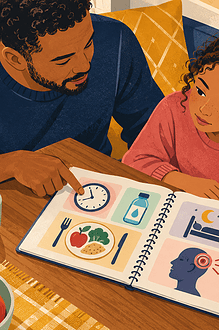
Use paper on the fridge or one shared phone note. Record the child’s name, product, active ingredient, amount, time and the adult’s initials immediately after each dose. During a handover say, “The last dose was recorded at 2:15,” rather than “I think it was after lunch.”
A shared note works best when it sits inside a routine everyone already uses. If family systems have slipped during illness or travel, restarting routines after a break offers a low-pressure reset. Keep routine health tasks calm and predictable. If toothbrushing has become another rushed battleground, the steps in reducing toothbrushing battles use the same idea of clear cues and limited choices.
If something may have gone wrong
If a child may have swallowed medicine, received too much or taken the wrong product, contact your local poison information service or emergency service immediately. Have the container with you. Do not wait for symptoms and do not make the child vomit unless a qualified professional instructs you to do so.
Call emergency services for breathing difficulty, collapse, seizure, severe drowsiness or any immediate danger. After the incident, improve the storage or record system without blaming the child or caregiver; shame makes it harder to report mistakes quickly.