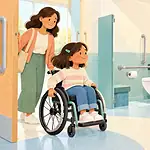
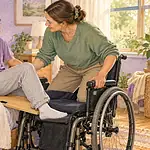
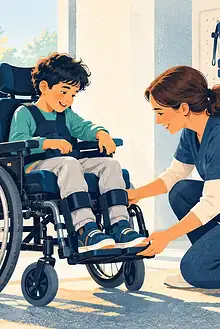
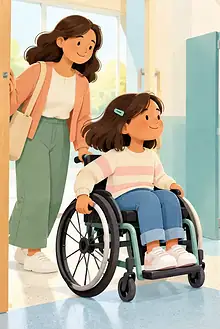
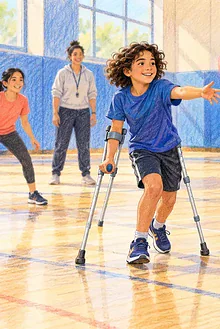
A first independent bus or train trip is not one skill. It is a chain: finding the stop, asking for a ramp, positioning a mobility aid, managing payment, noticing the destination and coping when the expected route changes. Rehearsal lets a child learn that chain without the pressure of a school bell or appointment.
Check the journey, not just the vehicle
Start with a short, low-stakes route at a quiet time. Check the path to the stop, kerbs, surfaces, lifts, platform gaps, wheelchair spaces and the final route from the arrival point. Contact the operator with the dimensions and type of mobility aid if required. Ask whether assistance must be booked, how a ramp or lift is requested, and what happens when a lift is unavailable. Rights and procedures differ by place, so use the local operator’s current information rather than assuming another city’s rules apply.
If the child is still choosing equipment, the guide to wheelchair and mobility-aid assessment explains why daily environments matter. Never lift a child or heavy device onto transport unless trained people and approved procedures make that safe.
Give the child a route card
Create a small card or phone note with only useful details: route number or line, direction, boarding point, destination, backup stop, trusted contact and the words the child wants to use. Do not display a diagnosis or unnecessary personal information. A younger child might use photos of landmarks; an older child may prefer a checklist hidden behind the lock screen.
- Find the correct stop and a safe waiting position.
- Signal or request the accessibility feature.
- Say where you are going and what help is useful.
- Board at the child’s pace; secure or position the aid as instructed.
- Notice two landmarks before the destination.
- Exit, move away from the door and confirm the next step.
Practise language for predictable snags
Useful scripts are brief: “Please deploy the ramp.” “I need the wheelchair space.” “Please ask before touching my walker.” “The lift is closed; what accessible route can we use?” Role-play a driver who cannot hear, a crowded space and a missed stop. The goal is not to frighten the child but to make the next move familiar.
Adults can model calm escalation: repeat the request, ask for a supervisor or station assistant, record the vehicle or service details, and use the operator’s complaint channel later. Do not expect the child to debate access rights while everyone is watching.
Fade support in small pieces
On the first trip, the adult may lead every step. Next time the child can request the ramp. Later they can track the stops or speak to staff while the adult stays nearby. Decide beforehand when the adult will step in—for example, traffic danger, an unsafe gap, harassment or equipment trouble. Pair transport practice with the child’s school access plan if the route is used for education.
End with two questions: “Which step felt easy?” and “What should we change before the next trip?” A successful rehearsal is not a perfectly independent journey; it is a journey that produces clearer information, more control and a workable backup.
Pack for recovery, not for every disaster
A small journey kit might include water, weather protection, a charged phone, essential medication under the family’s usual plan, a compact repair item recommended by the device provider, and the operator’s contact. Avoid overloading the mobility aid or hanging bags where they affect stability. Agree what the child will do if separated: stay in a safe visible place, contact the named adult, and ask identifiable staff for help. For adolescents travelling with friends, discuss how peers can support without steering, pushing or speaking for them. Review the route card when timetables, stations or the mobility aid change. Independence grows when the child can predict both the normal sequence and the safe response to one change—not when adults disappear before the route is reliable.
Review confidence as well as route knowledge
After several trips, ask which parts the child wants to lead and which still need support. Some children may confidently request a ramp but find crowds or sudden announcements hard to manage. Others may navigate well but need help positioning a chair safely. Treat these as separate skills. Practise at different times only when the earlier version feels manageable, and keep an adult close enough to intervene without speaking first. If the child experiences harassment, refusal of access or an unsafe deployment, prioritize leaving danger and getting support. Record facts afterwards and use the operator’s official process. A transport lesson should never require the child to tolerate disrespect in order to demonstrate independence.