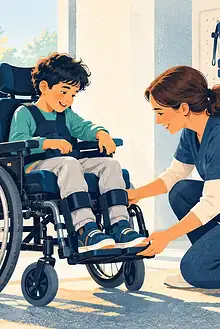
Transfers can look routine while carrying real risk. A method that worked last year may no longer fit after growth, surgery, pain, fatigue or a change in equipment. The safest rule is simple: do not invent a lift from a video or copy another family. Ask a physiotherapist, occupational therapist or trained moving-and-handling professional to assess the child in the actual places where transfers happen.
Start with the child’s role
Before moving, ask: “What do you want to do yourself?” and “Where should I help?” A child may be able to place their hands, lean forward, move one foot, operate a brake or count down. Those actions are not decorative; they are part of control and skill. Use the same agreed words each time: “Ready, steady, move” is more predictable than grabbing without warning.
The broader principle in supporting real choices without taking over applies here too: offer decisions the child can genuinely make, while adults keep responsibility for safety.
Write the method where helpers can use it
A child-specific plan should name the starting and finishing positions, wheelchair and furniture setup, brakes and footplates, equipment, number of trained helpers, the child’s contribution and the stop signal. Include what must never happen. Staff should receive hands-on training and demonstrate competence; a paragraph in a school file is not training.
- Clear clutter, wet floors, pets and loose rugs.
- Place the destination before starting so nobody twists mid-transfer.
- Use only assessed equipment, at the correct height and position.
- Protect tubes, straps, skin and clothing from catching.
- Stop if the child reports pain, dizziness, fear or a change in ability.
Never pull on arms, lift under the armpits or use a mobility aid as a handle unless the child’s professional plan specifically describes a safe action. Transfer boards, hoists and stand aids require fitting, maintenance and individualized instruction.
Keep consent active
Explain who will help and why. Close doors or screens. Ask permission before touching clothing, straps or the child’s body, and speak directly to the child even when another adult is present. If urgent danger requires immediate action, explain afterwards what happened. For everyday care, rushed routines are not a reason to drop consent.
Use a clear stop signal that works for the child’s communication—spoken word, gesture, eye movement or AAC message. If communication is sometimes hard to interpret, the guide on making communication easier offers practical ways to slow down and confirm meaning.
Review before a near miss becomes an injury
Request reassessment after growth, a fall, new pain, surgery, skin damage, equipment change, increased effort or repeated loss of balance. Also review when a caregiver develops back pain or begins avoiding the recommended method because it feels unworkable. Sudden weakness, severe pain, head injury, breathing difficulty or inability to move as usual needs prompt clinical advice; an emergency requires local emergency services.
A good transfer is not the fastest transfer. It is repeatable, comfortable, dignified and understood by the child and every trained helper.
Make the plan portable across settings
Home, school, respite care and trips often use different furniture and space. Ask the professional whether each environment needs its own instructions rather than assuming the home method transfers. Keep the current plan available to trained helpers, note the date of review, and remove outdated versions so nobody follows an old technique. When a substitute or relative is not trained, choose a safe alternative instead of giving a rushed verbal lesson. The child should never have to protect an adult’s feelings by agreeing to an uncertain lift. Families can also practise a calm phrase: “That is not my transfer plan; please get someone trained.” Praise the child for accurate safety information, even when it slows the schedule.
Teach new helpers to listen before they touch
A competent helper should be able to describe the plan, prepare the space, ask the child, use the agreed equipment and stop safely. They should not learn by trial and error on the child’s body. Include relief staff and transport staff where transfers occur, and schedule refreshers after long gaps. If the child’s movements vary with fatigue, pain or time of day, write the safe alternatives rather than expecting one method to fit every moment. After a transfer, check comfort, clothing, foot placement, straps and access to communication or call controls. Invite the child to correct the helper. Being corrected is part of safe care, not disrespect.