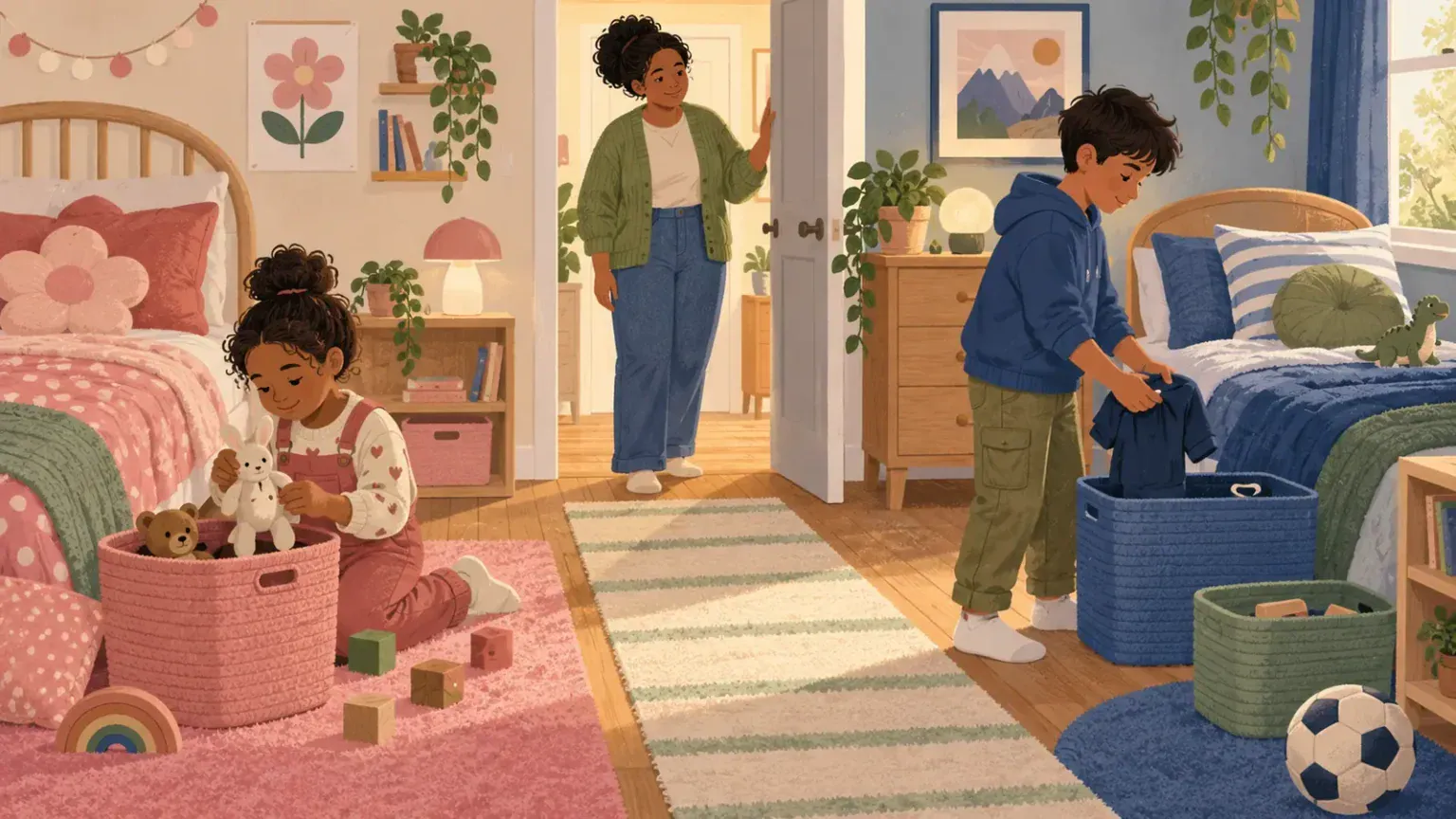
In a shared bedroom, “clean your room” can become a recurring argument because the room is both one space and several people’s responsibility. One child may care more about order, notice mess earlier or be quicker at tidying. Without a clear plan, that child can end up doing the work—or policing a sibling all evening.
A better chart divides the room into personal zones, shared zones and adult-owned problems. It gives each child a finish line while keeping parents responsible for supervision, storage and conflicts children cannot solve alone.
Draw the room, not the argument
Sketch a simple map together. Label each bed or sleep area, clothing storage, school-item spot and any shelves that belong to one child. Then circle genuinely shared areas such as the floor path, a play surface or a shared bookcase.
Ask factual questions: “Whose items live here?” “Who can reach this shelf?” “What needs to stay clear for safety?” Avoid turning the map into a list of who is messier. The aim is to make ownership visible.
Give personal zones personal responsibility
Each child resets their own zone to an agreed basic standard. That standard should be concrete: dirty clothes in the hamper, floor path clear, school bag on the hook. It does not have to reflect one child’s preferred level of neatness.
If a child needs pictures, fewer steps or adapted tools, build those into the plan. The guidance on an accessible chore chart can help separate meaningful contribution from identical performance.
Rotate shared zones carefully
Choose one or two short shared jobs: return shared books, clear the central floor or put game pieces in the right box. Rotate those jobs on a predictable schedule, perhaps weekly. Keep the job size roughly comparable, but do not force identical tasks when abilities differ.
Use a neutral marker such as a clip or magnet to show whose turn it is. The child who is off duty does not supervise. If the job is incomplete, an adult follows up. Siblings should not be asked to issue warnings, inspect each other’s work or assign consequences.
Create a “not mine” basket
Place one small basket in the room for items found in the wrong personal zone. A child can move a sibling’s item into the basket instead of throwing it, hiding it or starting an argument. At the daily reset, each person empties their own things.
Limit the basket’s size and purpose. It is not a dumping ground, and it should never hold medicines, food, wet items, valuables or anything dangerous. Adults handle those immediately.
Use a ten-minute room reset
- Start at the same predictable time.
- Each child works on their personal three-step list.
- The assigned person completes the shared-zone job.
- An adult checks the safety basics, not every aesthetic detail.
- Stop when the agreed finish line is reached.
Music, a visual timer or parallel adult tidying can help, but avoid turning the reset into a race between siblings. Speed differences easily become another comparison. If repeated reminders are the problem, use the approach in building one chore habit.
Name what adults still own
Adults provide enough storage, remove broken furniture, manage mould or pests, arrange safe sleeping spaces and intervene when belongings are damaged or privacy is ignored. Children cannot solve an overcrowded room by trying harder.
Adults also set boundaries around borrowing, changing clothes and quiet time. A room chart is about household work; it is not permission for one sibling to control another’s body, possessions or access to rest.
Repair predictable conflicts
When both children claim the same mess belongs to the other, pause the blame. Sort the items together once, then improve the system: two labelled hampers, separate hooks or a clearer shared bin. If one child repeatedly leaves work for the other, address that child privately rather than holding a courtroom in the bedroom.
The principle from being fair without being identical is useful here. Each child needs a genuine contribution and a fair amount of support, not a perfectly matched list.
A shared room will still look lived in. Success is not a showroom. It is a space where children know what belongs to them, what is shared and when an adult needs to step in.