Household contribution should not depend on standing, speaking, reading, lifting or working at the same speed as everyone else. An accessible chore chart starts with the child’s abilities and interests, then changes the task, tool, timing or support.
- Separate the purpose from the traditional method
- Build an access check for each task
- Create energy choices
- Use visual steps without making the chart childish
- Teach with adjustable support
- Protect dignity and sibling fairness
- Review the environment when a task fails
- Offer more than one valued role
- Describe support without deficit language
- Sources and further reading
The goal is meaningful participation, not making every family member perform an identical job. Personal care and therapy goals are not automatically chores, and a child should not have to earn essential support.
Separate the purpose from the traditional method
If the purpose is “help prepare the table,” the method might be carrying plates, placing napkins, choosing seats on an AAC device, checking the visual list or telling someone what is missing. If the purpose is pet care, one child might measure food while another opens a container.
Ask the child which role feels useful. Avoid assigning only pretend work while everyone else has real ownership.
Build an access check for each task
- Can the child reach the materials?
- Is the task safe from their seated or standing position?
- Are instructions available as pictures, objects, audio, text or demonstration?
- Does the task require fine motor, strength, memory or sensory tolerance that can be supported?
- Is there enough time without rushing?
- What help can the child request?
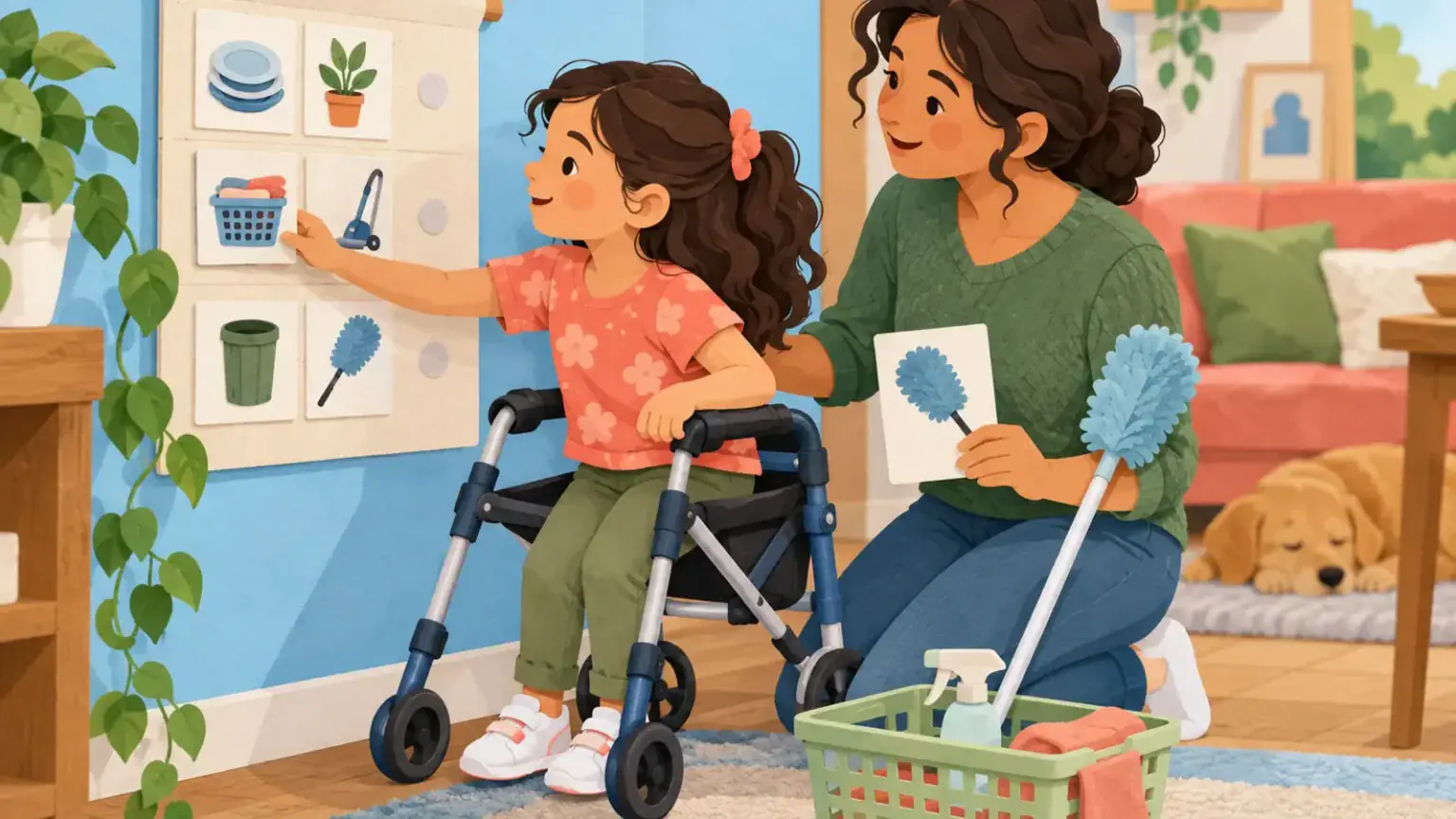
Simple changes may include a lightweight basket, long-handled tool, pre-opened container, nonslip mat, lower shelf, labelled bins or a “finished” box. An occupational therapist or other professional may help with individual access and safety.
Create energy choices
For variable fatigue, pain or health, make green, amber and red-day options. A green-day task might be folding a full basket. An amber option might be matching socks while seated. A red-day contribution might be choosing the laundry cycle with a partner or taking a rest with no make-up debt.
The system should not require the child to prove pain or exhaustion. Adults remain responsible for ensuring the household runs.
Use visual steps without making the chart childish
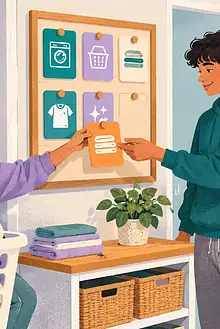
Photograph the actual tools and locations, or use simple symbols. Keep the sequence short and place it where the task happens. Teens may prefer a phone checklist, calendar reminder or shared app. Use the child’s established AAC and language.
Teach with adjustable support
- Show the complete task once.
- Practise one step at a time.
- Offer the least intrusive prompt that works.
- Pause long enough for the child to act.
- Reduce or restore support based on the day.
Independence is not the only successful outcome. Cooperative completion can be a real life skill.
Protect dignity and sibling fairness
Explain that fair roles fit people’s needs; they do not have to look the same. Do not disclose a child’s diagnosis or body details to justify the chart. Give every child valued work, rest and leisure.
Review the environment when a task fails
Before calling the child unmotivated, check sensory load, pain, unclear steps, tool access, transition difficulty and timing. Change one variable and try again. Persistent difficulty across home and school may be worth discussing with the child’s health or education team.
Use EdCaptain’s guide to building one chore habit, the explanation that fair is not always identical, and the now-and-next board for difficult transitions.
Offer more than one valued role
A child should not be permanently assigned the only task adults believe they can do. Rotate within an accessible menu: checking supplies, matching items, choosing a sequence, wiping a reachable surface, directing a partner or confirming completion. Choice supports ownership without pretending every option is possible every day.
If a task involves chemicals, heat, blades, heavy lifting, water, pets or outdoor risk, adults must assess safety and supervise appropriately. Adaptive tools reduce barriers but do not remove the need for safe instruction.
Describe support without deficit language
On the chart, write “with picture steps,” “with partner,” or “seated option,” rather than labels such as easy, baby or special. Ask before displaying personal adaptations to visitors. The chart belongs to the household, not to an audience.