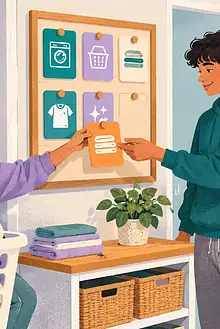
A chart labelled only with children’s names can make chores look like something adults impose rather than work that keeps a home running. A whole-family contribution chart shows that everyone participates, while adults retain responsibility for safety, care and the overall household load.
- Map the work before assigning it
- Create four chart columns
- Assign by ability, time and safety
- Separate chores from punishment
- Teach before expecting independence
- Decide how reminders work
- Review in a short family meeting
- Keep rewards in perspective
- Make completion visible without creating a scoreboard
- Plan for busy and low-energy weeks
- Sources and further reading
The chart should clarify ownership, not display who is “good.” Do not use it to shame, rank siblings or reveal private care needs.
Map the work before assigning it
List visible tasks such as dishes, laundry, pet care and rubbish. Then add the less visible steps: noticing supplies are low, planning meals, arranging repairs, remembering appointments and checking that a task is finished. Children can take appropriate pieces, but adults should not hand them responsibility for family finances, medication, sibling parenting or adult emotional wellbeing.
Create four chart columns
- Task: one clear outcome.
- Owner: the person who remembers and completes it.
- Support: who helps, teaches or provides access.
- When finished means: a concrete description or picture.
“Kitchen reset” is vague. “Plates in dishwasher, table wiped, food stored” is clearer. Use photos or symbols for children who benefit from visual information.
Assign by ability, time and safety
Age lists can provide ideas, but children develop differently. A preschooler may carry napkins; a school-age child may sort laundry; a teen may cook a simple meal with agreed supervision. Consider disability, school workload, sleep, cultural practices and the tools available.
Adults should put their own work on the chart too. That does not require listing every private responsibility; enough visibility shows that contribution is shared.
Separate chores from punishment
Cleaning a deliberate mess can be a logical repair. Assigning toilets because a child talked back turns useful household work into humiliation. Keep regular responsibilities predictable and address behaviour with a separate, proportionate response.
Teach before expecting independence
- Adult demonstrates while naming the steps.
- Adult and child do the task together.
- Child leads with help available.
- Child completes it and requests a check if needed.
- The family reviews whether the assignment still fits.
Do not redo the task theatrically in front of the child. Give one specific piece of feedback and notice effort, initiation or problem-solving.
Decide how reminders work
Use a routine anchor, visual cue or one agreed reminder. Avoid continuous commentary. If a task repeatedly stalls, inspect the system: unclear steps, inaccessible supplies, an unrealistic time, or too many responsibilities.
Review in a short family meeting
Once a week, ask what felt fair, what was confusing and what needs to rotate. Fair does not mean identical. A child with fewer tasks may have a harder school week or a responsibility that takes more effort.
Allow reasonable swaps, but do not leave one reliable family member holding every disliked task. Adults make the final safety and workload decisions.
Keep rewards in perspective
Families differ on allowance. Be clear about which contributions come with belonging to the household, which extra jobs may be paid, and which personal care tasks are not purchased. Never withhold food, affection, education or essential access.
Start with one useful chore habit without nagging, review the plan in a 20-minute family meeting, and use Make Invisible Family Work Visible for the adult share.
Make completion visible without creating a scoreboard
Family members can move a symbol to “done,” but avoid points that compare people with different time and abilities. If someone covers a task during illness or a deadline, record the temporary swap and decide when the regular plan resumes.
Adults should acknowledge when their own assigned task is late. A simple “I missed the shopping list; I’ll repair it tonight” models accountability more effectively than insisting adults are exempt from the chart.
Plan for busy and low-energy weeks
Create a minimum version of the chart: hygiene, food safety, essential dishes, pet needs and clear walkways. Optional polishing can wait. Children should not absorb an adult workload crisis; adults decide which standards change and where outside help is needed.