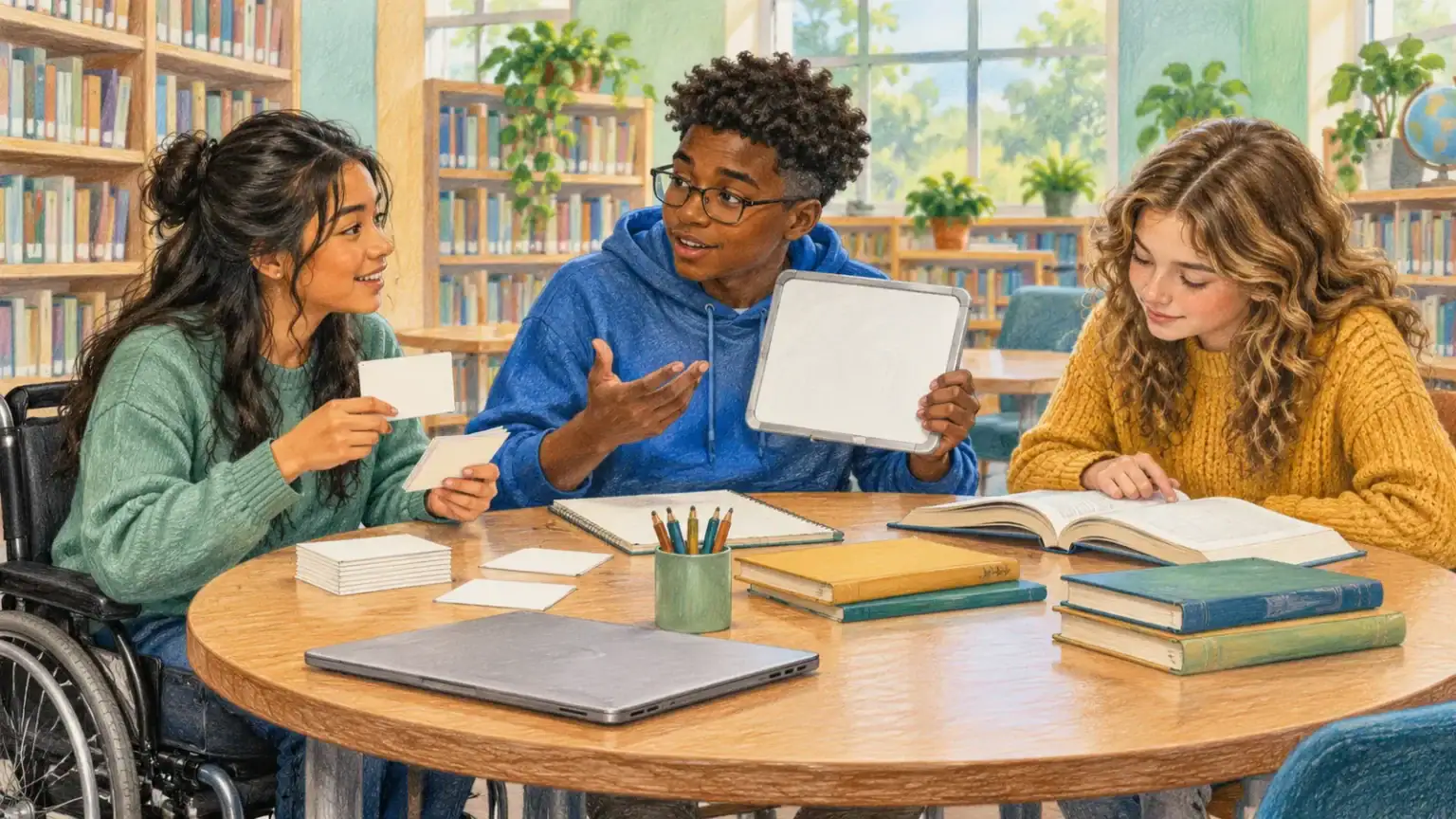
A study group can expose gaps, improve explanations and make revision feel less lonely. It can also turn into two hours of chat while one person does the work. The difference is usually structure. A useful group agrees on a narrow outcome, gives everyone a role and spends more time retrieving and explaining than looking at notes.
Choose the right size and purpose
Three to five students is usually manageable. Invite people who can be respectful and roughly agree on what the session is for; they do not need identical grades. Choose one or two topics, not an entire subject. “By the end, each of us can explain photosynthesis and answer four questions” is clearer than “revise science.”
Share the topic and materials in advance. Each person can bring two questions: one straightforward and one that reveals a common confusion. Students who need more processing time then have a fair chance to prepare.
Use a 60-minute structure
- Five minutes—agree the finish line. Name the topic, end time and one product, such as a set of checked questions.
- Ten minutes—silent recall. Everyone writes what they know without notes. This prevents the most confident speaker from shaping every answer.
- Twenty minutes—explain and challenge. Take turns explaining. Listeners ask, “Why?”, “What is the evidence?” or “Would that always be true?”
- Fifteen minutes—individual questions. Each person attempts a fresh problem or paragraph alone, then compares methods.
- Ten minutes—check and plan. Use reliable notes, mark schemes or teacher guidance. Each student records one next step.
This combines collaboration with the active recall described in retrieval practice. The group is not a substitute for individual thinking.
Rotate simple roles
A facilitator keeps the group on the question. A timekeeper protects the ending. A checker makes sure disputed claims are verified. A participation monitor notices who has not had space. Rotate these roles so the same student is not always teaching, organising or staying silent.
The Education Endowment Foundation advises that collaborative learning should be deliberately designed and focused on purposeful interaction. That means “work together” is not enough. The task should require each person to contribute and make their thinking visible.
Make it inclusive
Agree that people may pass once, ask for a question to be repeated or write before speaking. Use a shared digital document only if it helps access; otherwise devices can wait. If travel, fatigue or sensory load is a barrier, a short online session with cameras optional may work better. Do not photograph or circulate someone’s work without permission.
Prevent common failures
- If one person lectures, switch to timed turns and individual attempts.
- If answers are copied, require everyone to explain the reasoning in their own words.
- If discussion drifts, place unrelated questions in a “later” list.
- If the group keeps reinforcing an error, check an authoritative source or ask a teacher.
- If comparing scores increases stress, remove scores from the meeting and focus on processes.
Past papers can provide a shared task, but use them in stages rather than making the group sit a full paper together; see the practical past-paper guide.
End with an individual commitment
Each student should leave with one specific action: relearn a formula, practise a paragraph, ask a teacher about a disputed point or schedule a retest. Add that action to a realistic revision timetable. If a group repeatedly leaves members confused, excluded or more anxious, change the format or stop. Studying together is one option, not an obligation.
Choose a safe place
Meet in a public library, school space or another location everyone and their caregivers consider appropriate. Agree arrival and finish times, transport and online-safety expectations. The group should never pressure a member to share passwords, private messages or personal documents.