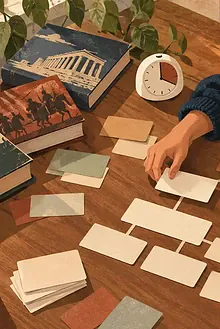
A student can genuinely want to prepare for exams and still avoid opening the book. The gap is not always laziness. The task may feel vague, enormous, boring or tied to fear of finding out how much they have forgotten. Arguing about motivation usually makes that first step heavier. A more useful goal is to make starting small, visible and repeatable.
Find the point where the start gets stuck
Ask one neutral question: What is the first moment that feels difficult? The answer might be choosing a subject, finding materials, deciding what to do, putting away a phone or worrying about getting an answer wrong. Name the obstacle without turning it into a verdict. “The first five minutes feel unclear” is solvable; “you never try” is not.
If the whole week needs organising, build a realistic revision timetable separately. For today, choose one action that can be completed before the brain starts negotiating: open the correct page, write three questions, or answer one flashcard.
Use a ten-minute launch
- Choose one narrow target. “Revise biology” is too broad. “Draw the heart from memory, then check it” gives the session an edge.
- Prepare the landing space. Put the book, paper and pen in reach. Move the phone to a named place rather than repeatedly resisting it.
- Set a short timer. Ten minutes is long enough to begin and short enough to feel possible.
- Do something active. Close the notes and recall, solve, label or explain. Retrieval practice reveals what needs attention more clearly than rereading.
- Stop or continue deliberately. At the timer, the student may finish, take a break or choose another ten minutes. Keeping that choice makes the start feel safer next time.
Lower friction before asking for willpower
Keep a small “ready to begin” kit: pens that work, blank cards, calculator, water and the current topic list. Store school files in predictable folders. If deciding drains energy, write tomorrow’s first task at the end of today’s session. The next start then begins with an instruction rather than a fresh decision.
Match the start to the student. A younger pupil may want a caregiver nearby for the first five minutes. An older teenager may prefer a silent check-in by message. A student who finds written planning difficult could choose between two spoken options. The support should remove a barrier, not take control of the work.
What parents can say
Try: “Would it help to pick the first tiny task together?” or “Do you want company while you start, or space?” Avoid threats, comparisons and surprise inspections. Praise a specific process—“You began with the question you were avoiding”—rather than claiming the work was easy.
If the student stalls, shrink the task again. Read the question only. Highlight the command word. List what is known. Beginning is the skill being practised. Once underway, use past papers in manageable stages instead of jumping straight into a full timed paper.
When avoidance signals more than a habit
Pause and listen if revision repeatedly brings panic, tears, sleeplessness, hopeless statements or physical distress. Keep expectations proportionate and contact the school, a GP or another qualified professional when wellbeing is being affected. Urgent safety concerns need urgent local help. A short start routine can support ordinary avoidance; it is not treatment for anxiety or another health condition.
Make the next start easier
End by leaving a visible cue for tomorrow: the next question on top, the needed book open at a marked page, or a note that says exactly what to retrieve. Record one sentence about what worked. This is not a productivity contest; it is evidence that the student can begin again. After several days, lengthen sessions only if the current routine is sustainable.