A marked practice paper can become either a score to worry about or a map of what to do next. An error log makes the second outcome more likely. It is not a notebook of failures. It is a short record of patterns: what went wrong, why it happened, what will repair it and when the student will test that repair.
Keep the log small enough to use
A table with five columns is enough: question or topic; error type; what I thought; repair action; retest date. Record only mistakes that teach something. A one-off slip can be corrected on the page. A repeated misconception, missed command word or weak method deserves a place in the log.
Use the log after a manageable section of practice, not after hours of marking. If a student is new to exam questions, the staged approach in how to use past papers without overwhelming them can help.
Sort errors by cause
- Knowledge gap: the fact, vocabulary or example was not known.
- Misconception: the student confidently used an incorrect idea or rule.
- Method gap: they knew the content but not the steps needed to apply it.
- Question-reading error: a command word, unit, condition or part of the question was missed.
- Execution slip: the method was sound but arithmetic, copying or timing went wrong.
The category is a hypothesis, not a label. Compare the answer with trustworthy notes, a mark scheme or teacher feedback. If the reason is still unclear, write a question to ask rather than guessing.
Give every entry a repair
“Revise this” is too vague. Match the action to the cause. For a knowledge gap, retrieve the answer from memory on three later occasions. For a misconception, write the incorrect idea beside the corrected explanation and create an example that separates them. For a method gap, study one worked example, cover it, then complete a similar problem. For a reading error, circle command words during the next set. For an execution slip, add a checking step.
This turns feedback into action. The Education Endowment Foundation describes effective feedback as information that helps learners improve the task, process or self-regulation—not a judgment about the person. Parents can reinforce that by saying, “What does this mistake tell us about the next step?” rather than, “How did you get that wrong?”
Retest, do not just review
An entry closes only after a fresh attempt. Use a similar question two or three days later, without the corrected answer in view. If it works, mark the entry “secure for now” and revisit it in mixed practice. If not, choose a different repair or ask for help. This active check is more informative than another read-through; see the guide to retrieval practice instead of rereading.
A weekly ten-minute review
Once a week, count patterns rather than total errors. Are many marks lost through vocabulary? Does timing cause unfinished final questions? Do several topics depend on the same weak foundation? Pick one pattern for the next week. A long, perfect-looking log that is never revisited is less useful than six honest entries that shape the next session.
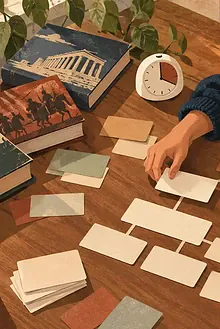
For students who dislike tables, use colored cards: one color for knowledge, one for method and one for question-reading. A voice note can also work if writing is a barrier. The important pieces are cause, repair and retest.
Protect confidence
Keep scores separate from identity. The log should include successful repairs so progress is visible. Stop if review becomes punitive or exhausting; choose a smaller sample and return later. Before the exam, the log can guide a realistic timetable, but it should not become an endless list of everything imperfect.