Rereading can feel fluent because the page supplies every cue. Exams usually ask a student to produce or apply knowledge without that page. Retrieval practice closes the notes and asks the brain to bring information back. The value is not a score; it is the combination of effort, accurate checking and another attempt later.
Choose a small, specific target
Do not begin with “everything in chemistry”. Select five key terms, one process, a formula family or the causes of one event. Make sure the student has learned the material before testing recall. Retrieval is practice after teaching, not a substitute for explanation.
Recall in more than one form
- write everything remembered on a blank page;
- draw a diagram from memory;
- answer short questions without notes;
- explain a process aloud to another person;
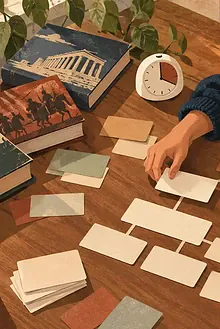
- rebuild a sequence using shuffled cards.
The method should match the knowledge. A formula needs application in problems; an essay concept needs connections and examples, not only a flashcard definition.
Check quickly and accurately
Open a reliable source or mark scheme soon after the attempt. Use a different colour to add missing ideas and correct errors. Do not merely count right answers. Label why an answer failed: knowledge missing, question misread, method incomplete or careless transcription. Each cause suggests a different next step.
Respond to errors with teaching
If an answer is wrong, revisit the explanation or worked example before trying a near-match question. Copying the correct answer once is not enough. Ask the student to explain why the correction works, then close the source and reproduce it. Keep the emotional message clear: an error found during practice is useful information.
Space the next attempt
Return after a delay—perhaps tomorrow, several days later and again the following week—rather than repeating the same card ten times in one sitting. Mix older and newer topics so the learner must choose the right idea. Record only enough to know what should reappear; an elaborate tracking system can consume the revision time.
Avoid common traps
Do not make every retrieval session timed, public or competitive. Do not use trick questions to expose the student. Flashcards fail when the answer is guessed from the card’s shape or first word, so shuffle and vary prompts. If repeated recall produces the same error, pause and reteach rather than demanding more attempts.
Try a fifteen-minute cycle
Spend five minutes recalling, four checking, four correcting and two deciding what returns next time. Finish with one success the student can name and one precise target. Parents can quiz only if the student agrees and the tone stays calm. The goal is increasingly independent use, not adult surveillance.
For broader family support, read five ways to support a child during exams. A one-week sleep pattern log can help a family notice routines without surveillance. If study repeatedly becomes conflict, use the home-learning reset to protect the relationship.
Make prompts that require thinking
A good prompt is specific enough to check but open enough to require recall. Replace “Read chapter four” with “Name three causes and connect each to one consequence.” Replace a copied definition with an example, a non-example or a diagram to label from memory. Keep answers on the reverse or in a separate key so checking is immediate. Every few sessions, retire cards that are consistently easy and rewrite vague ones. Include occasional application questions so isolated facts connect to problems. If a student can recite an answer but cannot explain it, the next task should be explanation and example, not faster repetition. Quality of recall matters more than the size of the flashcard stack.