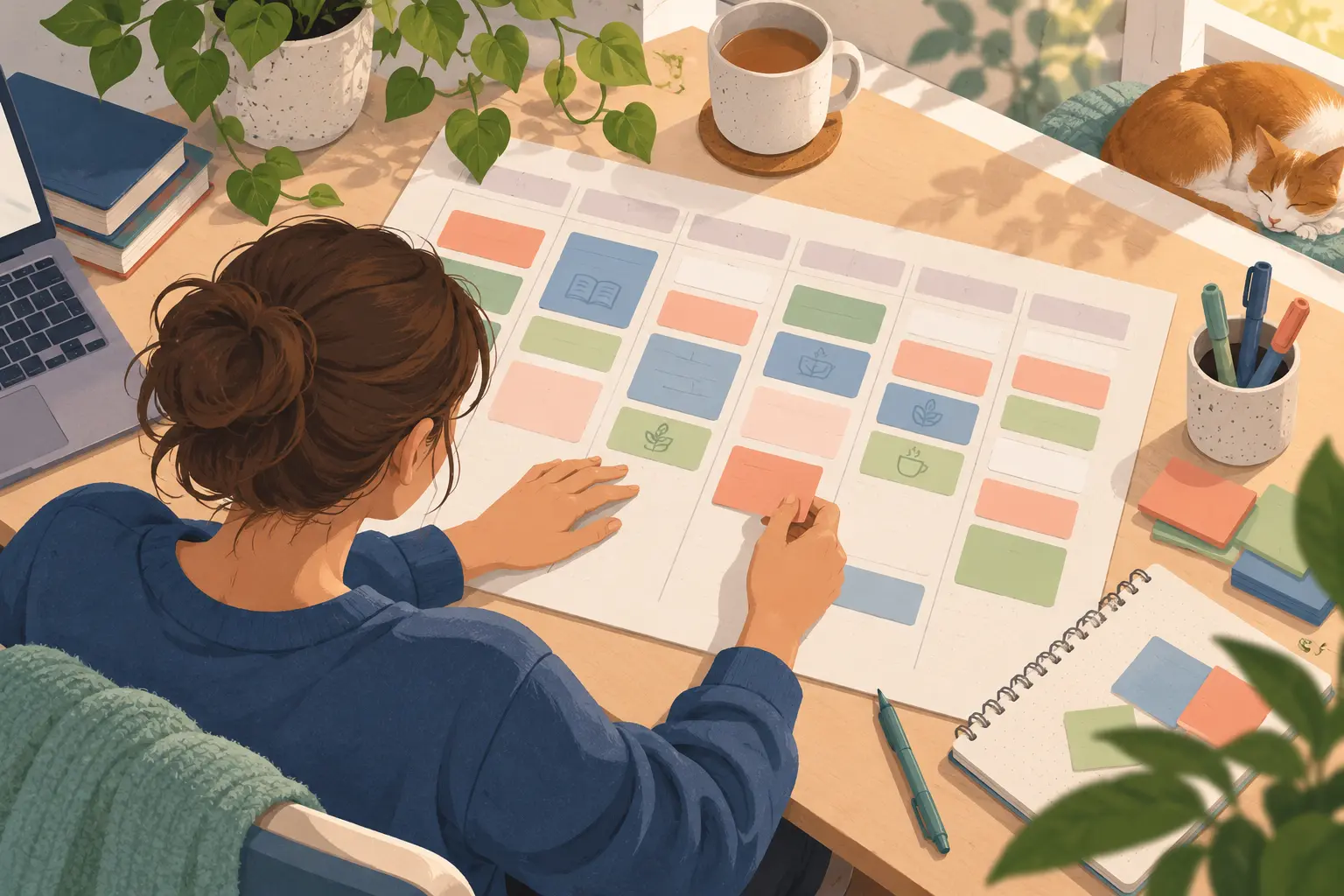
A revision timetable fails when it describes an imaginary student with unlimited energy and no ordinary life. A useful plan begins with the hours that genuinely exist, protects sleep and breaks, and names what the student will do—not merely the subject they hope to “revise”.
Put fixed commitments on the page first
Add school, travel, meals, caring responsibilities, regular activities and bedtime. Mark periods when concentration is usually low. What remains is the revision budget. If only forty minutes are available on Tuesday, planning three hours creates failure before the week begins.
List topics, not just subjects
Write the examination date and break each subject into small areas: “fractions with unlike denominators”, “causes of the conflict” or “compare two poems”. Mark each as secure, developing or unclear using recent work, teacher feedback or a few sample questions. This makes priorities visible without pretending every topic needs equal time.
Turn blocks into clear actions
“Biology, 5–6” still leaves a decision at the hardest moment. Write “Draw the cell process from memory, check it, then answer two application questions.” Mix retrieval, worked examples, practice questions and correction. Rereading can support understanding, but it should not be the only action.
Use a manageable rhythm
Try twenty-five to forty minutes of focused work followed by a genuine short break, adjusting for age and need. Some students work better in shorter bursts; others need time to settle into complex problems. The timer serves the learner, not the reverse. Stop a block at a sensible point and record the next step.
Add three kinds of space
- Buffer: one unscheduled block for work that takes longer.
- Recovery: meals, movement, friends, hobbies and sleep.
- Choice: a block where the student selects from two useful tasks.
A timetable with no slack will break after one difficult day. Do not repay a missed session by removing sleep.
Review weekly rather than policing daily
At the end of the week, ask what was completed, what was useful and what was unrealistic. Move priorities based on evidence, not guilt. Parents can help remove obstacles, find a quiet place or print materials, but the student should increasingly own the plan. Avoid hourly monitoring or comments that equate results with worth.
Make a minimum version for hard days
Choose a ten-minute action: recall five key ideas, correct one problem or organise tomorrow’s materials. The minimum keeps the routine alive without pretending exhaustion is laziness. If stress, low mood or anxiety is severe, persistent or affecting everyday life, speak with school staff and seek qualified health support.
For broader family support, read five ways to support a child during exams. A one-week sleep pattern log can help a family notice routines without surveillance. If study repeatedly becomes conflict, use the home-learning reset to protect the relationship.
Build the first week in pencil
Plan only seven days, not the whole exam season. Give the hardest current priority two short appearances on different days, place one easier confidence task nearby and leave at least one buffer block. Before each session, write the exact first action on a card so the student can begin without renegotiating the plan. At week’s end, circle sessions that happened and star those that produced useful learning. Do not copy missed blocks into every free space. Instead ask why they failed: too vague, too long, wrong time, missing materials or excessive fatigue. Change one condition for week two. A timetable becomes reliable through revision, not through stricter decoration.
Keep the plan visible: Use one page, not several apps and colour systems. The student should be able to see today’s first task, tomorrow’s priority and the next rest period at a glance. Simplicity reduces planning time and makes honest adjustment easier.