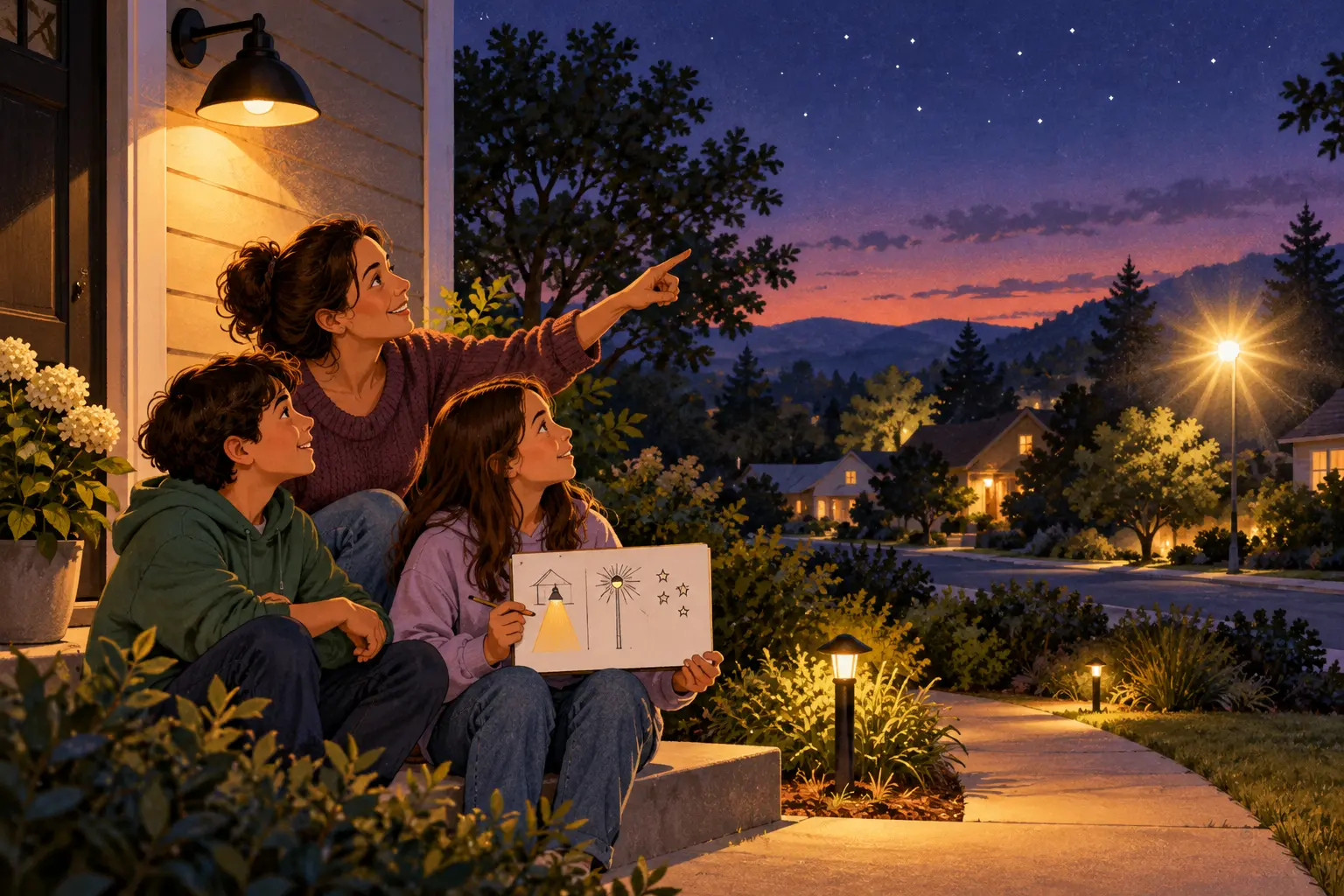
An outdoor light can help people see a step while also sending glare into eyes, windows or the sky. A family night-light audit teaches children to notice the difference between useful lighting and wasted spill. It is an observation activity: nobody climbs, covers a fitting or touches wiring.
Choose the right time and place
Begin at dusk from your own doorway, balcony or another adult-approved spot. Keep paths and entrances safely lit. Children stay with an adult and never walk into a road or dark unfamiliar area. Do not stare directly at very bright lamps, trespass or photograph neighbours’ homes.
Make four observation boxes
- Purpose: what does this light need to illuminate?
- Direction: does most light point down, sideways or up?
- Glare: does the bright source make nearby details harder to see?
- Spill: does light cross into a window, garden or sky where it is not needed?
Older children can add colour—warm amber or cooler blue-white—and time. A phone camera is not a precise light meter and may automatically brighten the scene, so sketches and written observations are often more honest.
Walk the view, not the wiring
- Let eyes adjust for several minutes while remaining in a safe, lit position.
- Identify one useful light, such as a path lamp.
- Notice whether its source is visible or shielded.
- Look for light on the ground versus light above the fixture.
- Turn away from the house and count only clearly visible stars in one small patch of sky, if conditions allow.
Cloud, haze, moonlight and nearby buildings affect how many stars appear. One count cannot measure total light pollution. Use it as a repeatable observation, not a rating of the neighbourhood.
Compare without making the area unsafe
An adult may switch off one nonessential home light briefly while everyone remains stationary. Compare glare, shadows and what is visible. Immediately restore lighting needed for steps, entrances, accessibility, security or caregiving. Never cover a hot fixture or improvise a shield.
Suggest adult actions
Possible questions include: Could a timer reduce light when nobody is outside? Would a properly designed shield direct light toward the path? Is a warm-coloured lamp suitable? Does a neighbour-facing light need repositioning? A landlord, electrician or qualified installer may need to make any change.
Think about people and wildlife together
Lighting choices balance navigation, disability access, security, sleep, neighbours, energy and nocturnal wildlife. Avoid a simplistic “dark is always better” rule. The goal is the right amount of light, in the right place, at the right time.
Connect the observation with a family star wheel, an energy detective walk after this article is published, or the sound-map activity. If those new links are not yet live, use the existing family Moon journal instead.
Write one proportionate recommendation
Finish with: “Keep…, change…, ask about…”. For example, keep the path light, ask about shielding the bright wall lamp and change the timer after adults review safety. A balanced recommendation is more useful than demanding darkness.
Discuss what better lighting would mean
After the observation, separate comfort, safety and sky visibility. A light can be important for steps or an entrance yet still create glare when it shines sideways or into a window. Children can sketch a shielded fixture, a lower-brightness option, or a timer idea, but only an adult or qualified professional should decide whether equipment can be changed. Never cover a hot lamp, climb to a fixture, open a fitting or touch wiring.
Repeat the audit from the same safe spot on another clear evening if you want to compare conditions. Clouds, the Moon and nearby vehicles can all change what is visible, so one night is not a verdict on the whole area. If the concern is a shared or public light, record the location and the practical issue—such as glare into a bedroom—then let an adult contact the owner or responsible service. The aim is thoughtful lighting, not darkness at the expense of safety.