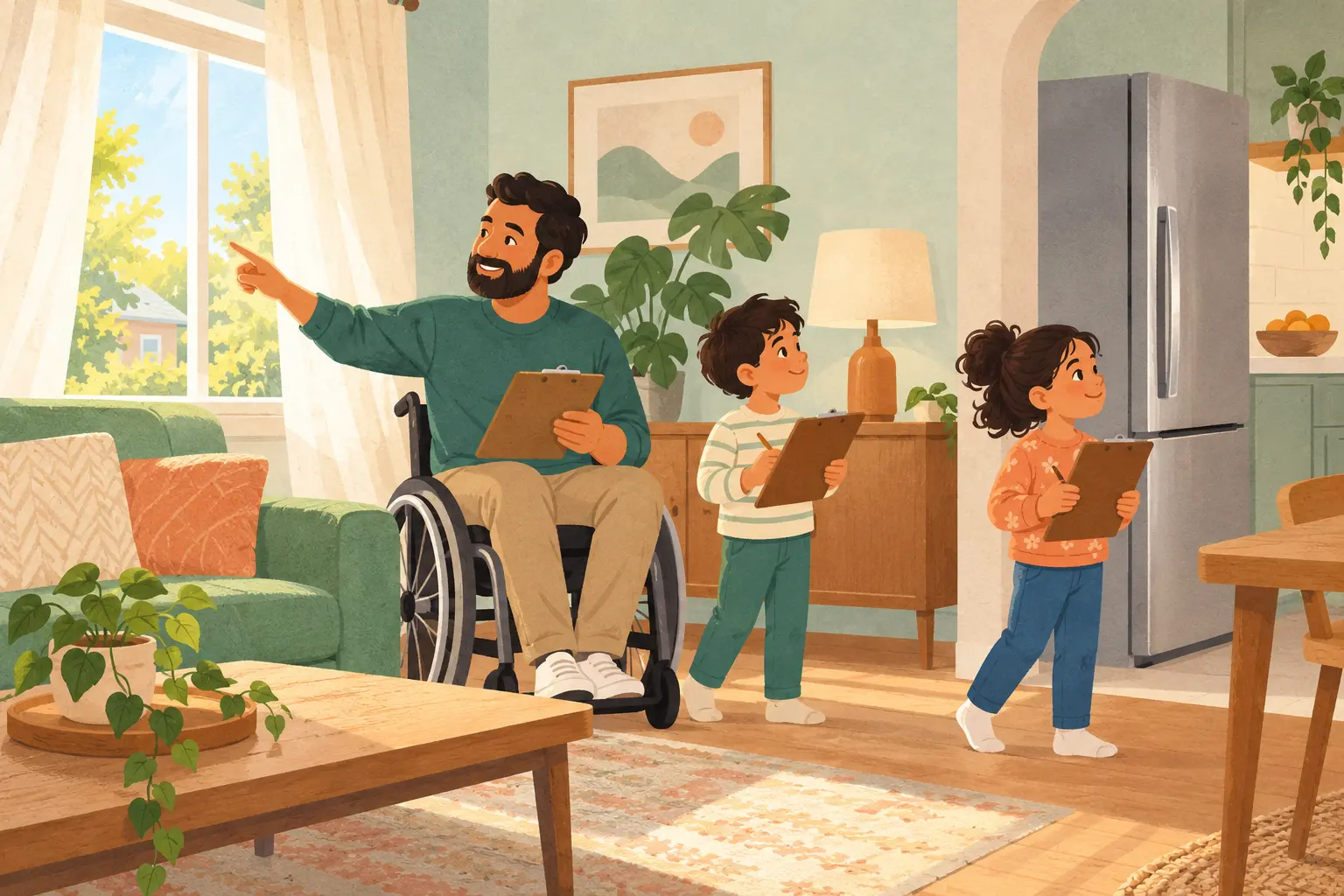
A home energy detective walk gives children a real job without making them responsible for the household bill. The family looks for simple patterns—lights glowing in an empty room, daylight blocked by curtains or a device left on when nobody needs it—then chooses one manageable habit to test. This is an observation activity, not an electrical inspection.
Set the safety boundary first
Children should not touch sockets, plugs, power strips, electrical panels, hot appliances or damaged cords. They should never move a refrigerator, climb to a light fitting or investigate equipment outdoors in wet weather. An adult handles switches and appliances. Any warmth, sparks, burning smell, buzzing or damaged wiring is a reason to stop and contact a qualified adult or professional.
Make a simple detective sheet
- Room or area
- What is using energy?
- Is anyone using it now?
- Could daylight, shade or a closed door help?
- Adult action, child reminder or no change?
Ages 6–9 can draw pictures. Older children can note the time and compare routines on a school day and weekend. Do not copy account numbers or photograph private documents. The aim is to notice behaviour, not to calculate exact savings from one walk.
Take a ten-minute walk
- Begin in one shared room while the home is in its ordinary state.
- Look for a lamp on in daylight, a screen playing to nobody, or a door left open while heating or cooling is running.
- Check whether curtains can safely provide useful light or shade.
- Notice devices that adults intentionally leave on, such as a router, refrigerator, medical equipment or security light. Mark these “needed.”
- Finish after three rooms so the activity stays focused.
Avoid turning everything off for the sake of the game. Food refrigeration, health devices, smoke alarms, security systems and equipment updating or charging for a reason may need continuous power. Ask before acting.
Choose one habit, not ten
Circle one pattern that is frequent, safe and within family control. It might be opening curtains before switching on a lamp, turning off an unused television or closing a cooled room’s door. Write the habit as a cue: “Last person out checks the light.” Decide who will notice it and when.
Try the habit for seven days and use a simple tick mark. If it does not happen, redesign the cue rather than blaming someone. Put a reminder near the room entrance, pair the check with bedtime or assign it to the person already doing another task.
What this walk can and cannot show
A checklist can reveal habits, but it cannot diagnose insulation, faulty wiring or appliance efficiency. Weather, building design, household size and local energy supply all matter. A professional assessment may be appropriate for major decisions. Children’s observations are useful questions for adults, not repair instructions.
Connect the idea
Compare energy habits with a family food-waste audit, where one small system change matters more than blame. The container-garden activity helps children notice sunlight and shade, while the clean-up and recycling games explore how household choices affect materials.
Finish with a family question
Ask: Which energy use supports health, comfort or safety? Which use happened only from habit? What change can adults make easier? Revisit the sheet after a week. Keep the habit if it works, modify it if it is annoying or unrealistic, and stop if it reduces safety or accessibility.
Turn the walk into a useful family decision
After the walk, put every observation into one of three columns: “we can change this today,” “an adult can check this later,” and “leave it alone.” A light left on in an empty room may fit the first column. A draughty window, an appliance that feels unusually hot, or a damaged switch belongs with an adult and should not be touched. This sorting step keeps the activity practical without making a child responsible for household bills or repairs.
Choose just one habit for the next week, such as switching off an unused light or closing the refrigerator promptly. Make a simple seven-box tracker and mark the habit once each day. At the end, ask what made it easy or hard. The goal is careful observation and a realistic routine, not a promise about a precise amount of energy or money saved.