
By EdCaptain editorial desk · Published
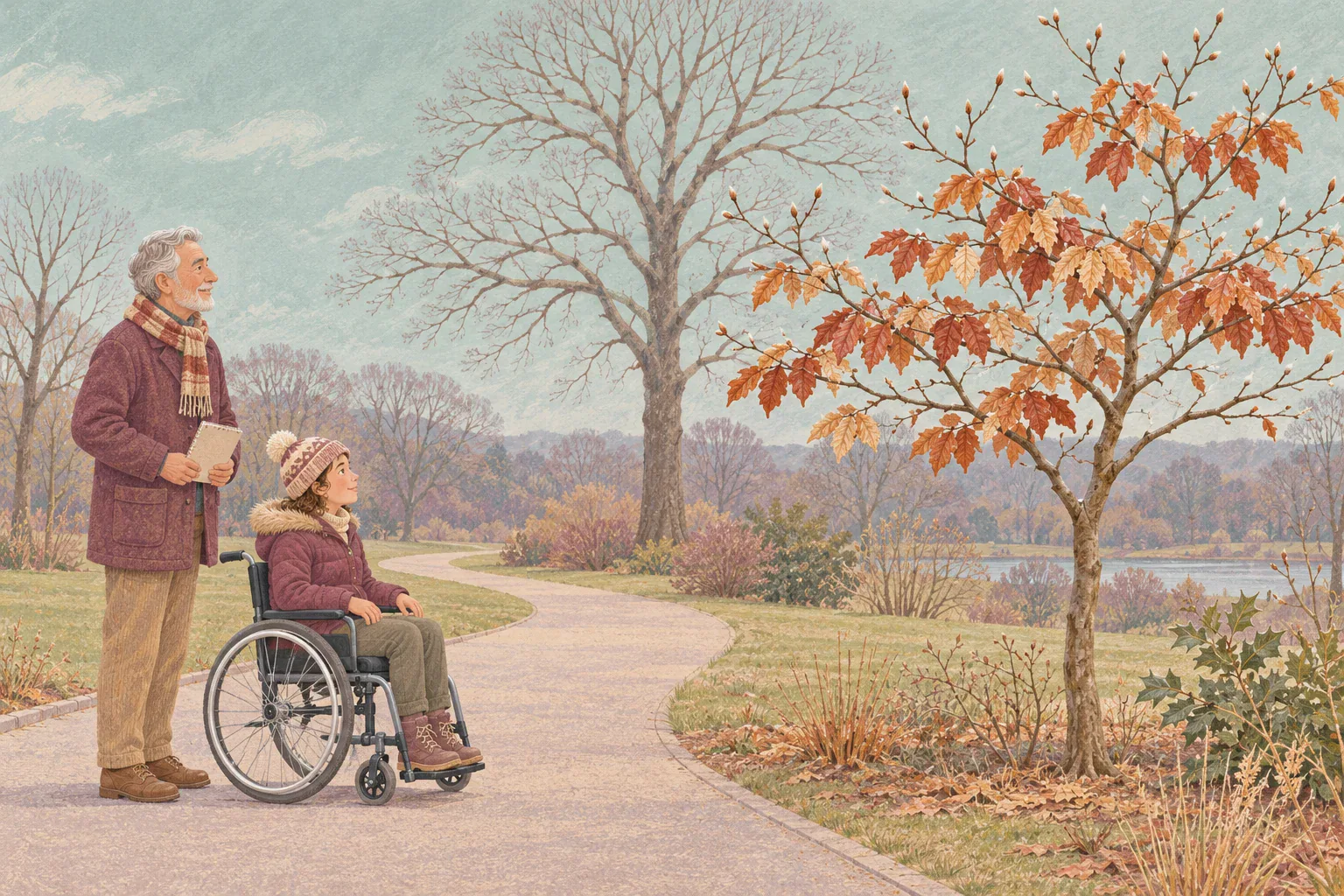
A small tree rattles with dry brown leaves while the taller trees nearby are bare. Your child asks whether it forgot to drop them—or whether it has died. In places with a cold winter, this can be a familiar feature of some oaks and beeches.
The name is marcescence: dead leaves remain attached instead of falling promptly. A dead leaf does not, by itself, mean the whole tree is dead. It also does not prove the tree is healthy. The season, type of tree and wider condition matter.
For children aged 6–12, the puzzle makes a good reason to revisit one tree, notice where leaves remain and distinguish an explanation from a guess. This is an observation activity, not a tree-health test. Use it when you actually encounter the pattern locally; winter and leaf-fall schedules differ around the world.
The leaf has finished, but its attachment remains
In many deciduous trees, seasonal leaf shedding involves a separation zone where the leaf stalk joins the twig. Changes there allow the leaf to detach. In marcescent foliage, that separation is delayed, leaving the dry leaf attached longer.
The University of Georgia Extension explanation describes how brown leaves on beeches and some oaks can persist until new spring growth helps release them. That does not mean every retained leaf waits for the same day or that every oak behaves alike.
Try: “The leaf is no longer a working green leaf, but the place where it attaches has not let go yet.” If your child wants the long word, say it together—mar-CESS-ence—then return to what they can observe. Remembering the label is optional.
Do not pull a leaf to demonstrate the attachment. Its resistance would not tell a child how the microscopic separation process works, and tugging can disturb the plant. A sketch is enough.
Still leafy is not the same as evergreen
A tree carrying withered brown leaves through winter is doing something different from a tree retaining living green foliage. The word “evergreen” does not mean that individual leaves live forever; it describes keeping foliage rather than becoming completely leafless in the usual seasonal way.
Illinois Extension’s guide discusses marcescence as an exception to the simple picture of every deciduous tree standing bare in winter. Young beeches and oaks often retain leaves, but there are mature trees that do so too.
That gives a child two questions instead of one: “Are these leaves green or withered?” and “Are they attached or fallen?” Colour and attachment describe different features. Neither question alone identifies the species.
Make a record of the pattern, not a collection
Bring: scrap paper or a notebook, a pencil, suitable clothing and, if wanted, a camera used by an adult. A window view or an accessible path works. You need no collecting bag, pruning tool or magnifier held against the branch.
An adult chooses a place where everyone can stay comfortably on permitted ground. Avoid traffic, water edges, slippery surfaces and visibly damaged branches; postpone an outing in strong wind or other unsafe weather. Do not climb, shake branches or move wildlife to get a better view.
- Choose one recognisable tree. Use a public tree label if there is one. Otherwise call it Tree A. Record the date and a simple identifying landmark without posting a home address or a child’s routine.
- Look at the whole shape. From a safe distance, note whether brown leaves appear mostly low down, high up or throughout the visible crown. If part is hidden, mark it “not visible” rather than filling in the gap.
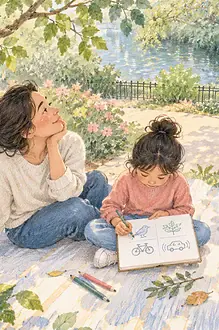
- Sketch one visible area. Draw a few branches and the approximate positions of leaf clusters. You are recording a view, not counting every leaf. Add “dry-looking brown leaves still attached” rather than “dead tree.”
- Plan a return. Revisit from the same place when convenient—perhaps the next week and later near the local growing season. Keep the old page so you can compare what was actually recorded.
If another nearby tree is bare, make a separate note. That is an interesting comparison, but two trees may differ in species, age and exposure. It is not a fair experiment proving that one factor caused leaf retention.
What might keeping the leaves do?
This is where a satisfying story can run ahead of the evidence. Researchers have proposed that retained leaves may discourage browsing animals, protect buds or affect when nutrients return to the soil. These are possible explanations, not a single settled reason that applies to every tree.
A 2026 University of Hamburg research account describes investigations into the phenomenon and its possible benefits. It reports marcescence more often in small, young trees and nearer the base than in the tops of trees. Your family may notice a similar pattern, or you may not.
Say: “Scientists have ideas about what the leaves might help with. Our notebook can describe this tree, but it cannot prove why the pattern exists.” Avoid saying the tree deliberately keeps a winter coat, unless you make clear that this is a story rather than a botanical explanation.
Keep everyone part of the noticing
For ages 6–9, use three simple descriptions: attached, fallen and cannot see. An adult can write down the child’s words or make an outline for them to add leaf marks. Ask, “What changed since our first picture?” without requiring a count or a species name.
For ages 10–12, add separate spaces for observation and possible explanation. “More leaves remain on low branches” is an observation; “they protect buds from animals” is a hypothesis. Invite the child to say what further evidence would be needed to investigate that idea.
Choose a seated viewing point, enlarge an adult’s photograph, describe the branches aloud or let a partner draw under the child’s direction. If rustling sounds are uncomfortable, observe through a closed window or use photographs. As a variation, compare the first and latest drawings without looking at the dates, then explain which clues suggest an order.
When the brown leaves are a different question
Do not use marcescence to explain every brown leaf in every season. Unexpected browning or a concern about a particular tree needs local identification and advice. Tell the landowner or ask an appropriate local horticultural service or qualified arborist rather than testing the bark, cutting twigs or treating the tree yourself.
The five-minute sound map offers a way to notice leaf rustle alongside other sounds. For a wider picture of living things in one place, try the family mini BioBlitz. Neither requires disturbing the leaves to make the observation count.
Sources and further reading
- University of Georgia Extension: how some trees retain dead leaves.
- Illinois Extension: winter leaf retention and variation between trees.
- University of Hamburg: research into marcescence and its possible benefits.
Read our editorial policy and review methodology.