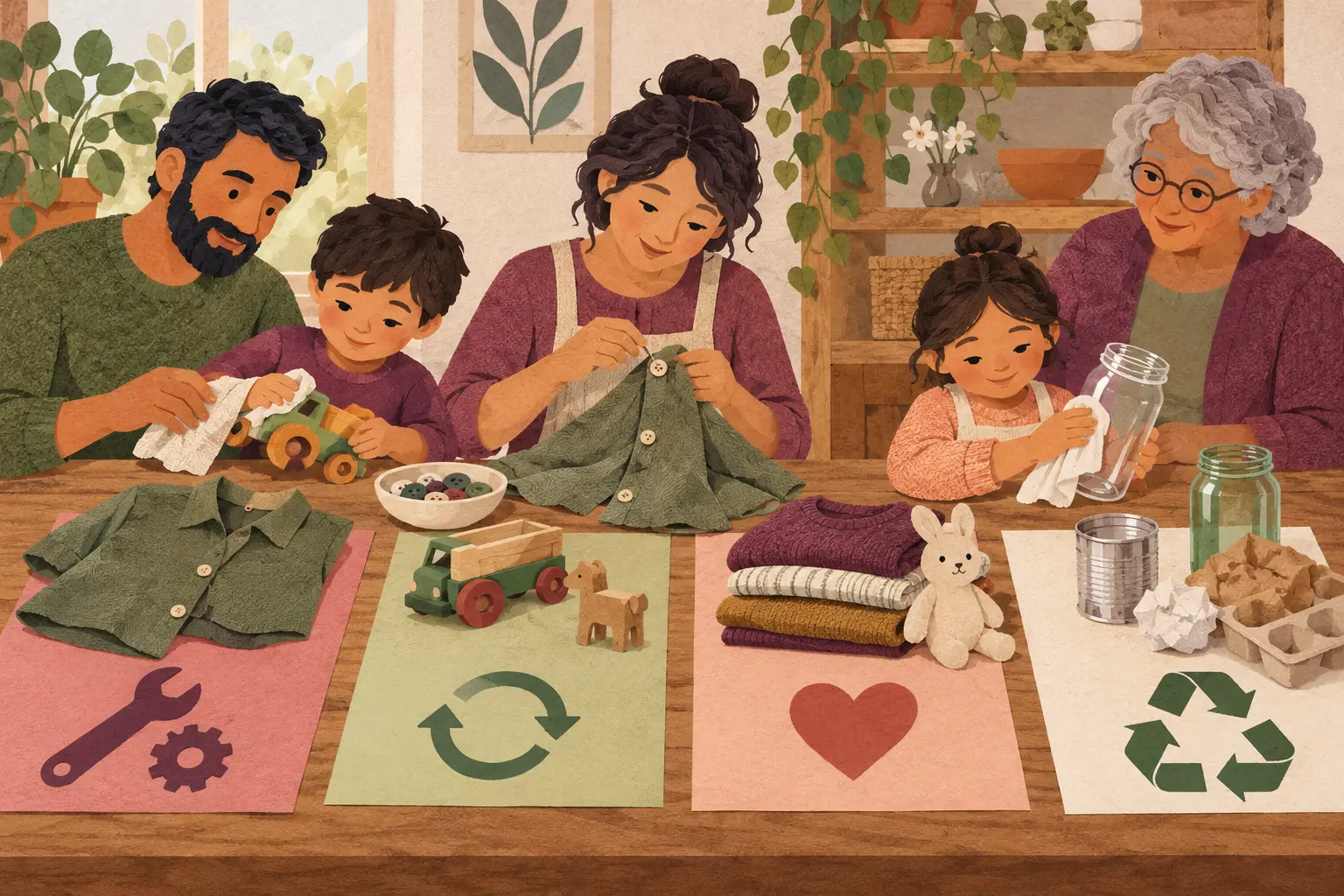
Broken does not always mean rubbish, but “repair everything” is not a safe or realistic family rule either. A repair-or-reuse clinic teaches children to pause before disposal and ask four questions: Can it be fixed safely? Can it serve another purpose? Could someone else use it? What does our local system accept?
Choose low-risk items
Good candidates include a shirt missing a button, a book with a loose paper cover, a washable jar, a wooden toy needing cleaning or craft supplies that can be sorted. Exclude electronics, batteries, medicines, cosmetics, gas equipment, damaged helmets, child restraints, mouldy items, cracked food-contact containers and anything involving sharp metal, chemicals or structural safety.
Set up four decision areas
- Repair: a safe, known fix will restore use.
- Reuse: the item can serve again as it is or with a simple change.
- Donate or share: it is clean, complete and genuinely useful.
- Recycle or dispose locally: an adult checks current rules.
Use picture symbols rather than assuming everyone reads the same labels. A fifth “not sure yet” space prevents rushed decisions.
Inspect before acting
- Name the item’s original purpose.
- Look for dirt, missing parts, sharp edges, cracks or recalls.
- Ask whether the repair affects safety.
- Estimate the materials, tools, skill and time needed.
- Choose the safest route and record who is responsible.
Children can wipe a washable surface, match buttons, sort pieces or practise a stitch on scrap cloth. An adult controls needles, strong adhesives and tools. A qualified repairer should handle electrical, pressurised, fuel-burning or safety-critical products.
Try one visible repair
A loose button makes the process easy to see. Check that the garment is clean and the button suitable. The adult demonstrates threading, knotting and secure stitches; an older child may participate according to ability under direct supervision. Count the repair complete only when the adult tests it. Store needles immediately.
Reuse without creating clutter
A jar is reusable only if it is clean, intact and appropriate for the new purpose. Do not reuse non-food containers for food, and do not turn every package into a craft supply. Decide where the item will live and when it will be reviewed. Useful reuse has a plan; postponed rubbish does not.
Donate respectfully
Ask whether you would feel comfortable giving the item directly to someone you know. Donation centres should not receive stained, unsafe, incomplete or broken goods unless they explicitly accept them for material recovery. Check local rules before travelling.
Link the clinic with the family food-waste audit, My Plastic Parcel and recycling games for children. The shared lesson is to reduce and reuse before relying on a recycling bin.
Record the outcome
Finish three items rather than sorting the whole house. Note what happened a month later: Was the repaired object used? Did the donation route accept it? Did the repurposed container have a real job? Evidence from this small review can improve the next decision without making children responsible for family consumption.
Use a clear decision ladder
For each object, ask in order: Is it safe to handle? Is a repair simple and reversible? Could it be repurposed without creating a hazard? Is it clean and useful enough to donate? If none apply, what local recycling or disposal route accepts it? Children can clean a jar, sew a loose button with close supervision, or sort craft materials. Electrical appliances, batteries, medicines, sharp tools, pressurised containers and damaged safety equipment stay with an adult and may need specialist disposal.
Add a “pause shelf” for objects that need research rather than an instant decision. Label each item with a review date so the shelf does not become permanent clutter. At the end, count decisions—not kilograms supposedly diverted from landfill—and ask which choice preserved the item’s usefulness longest. A repair that costs more or is unsafe is not a failure; responsible disposal can be the best outcome.