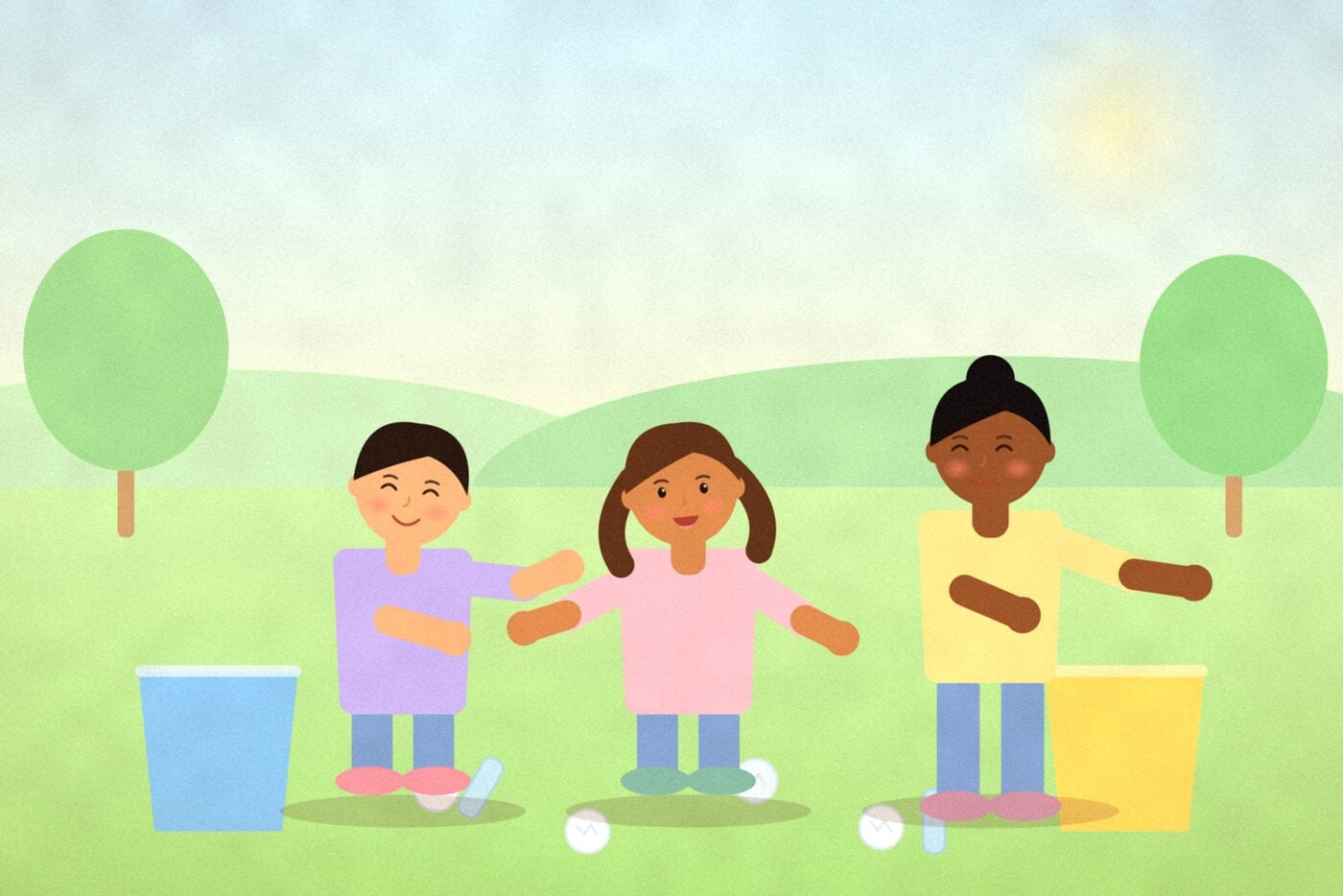
Age guide: 4 to 9 years. Needs a bit of space and two or more players.
Children often care about the environment more than we expect. These three relay games turn recycling, litter and saving water into something they can do with their bodies. Each takes about ten minutes and leaves you with a talking point. For a quieter activity about plastic, see noticing waste and choosing one change.
Safety first
- Use only clean, dry items as “rubbish”: crumpled paper and empty plastic bottles with the caps off and washed. Avoid glass, cans, sharp edges and food waste.
- Real litter outdoors can be sharp or dirty. Children should not pick it up without an adult, gloves and a litter picker.
- Wash hands afterwards.
- Never leave a young child alone with a bucket of water, even a shallow one. Mop up spills straight away so nobody slips.
1. The sorting race
You need: two buckets, labelled “paper” and “plastic”, plus crumpled paper and clean plastic bottles.
Scatter the paper and bottles around the play area. Split into two teams. One team collects paper and the other collects plastic. Each child carries only one item at a time and puts it in the right bucket. Time it, then try again to beat the time. Afterwards, ask: “What happens to the paper and plastic after we put them in the right bin?”
2. Litter bug clean-up
You need: bags of crumpled paper, two bins and two or three teams.
Explain that a litter bug is someone who drops rubbish instead of using a bin. One or two players pretend to be litter bugs and drop crumpled paper around the room. Teams line up behind their bin. On “go”, the first person in each team runs out, picks up one piece, brings it back, puts it in and goes to the end of the line. Carry on until the floor is clear. Chat about how it feels when a park is covered in rubbish.
3. Save the water
You need: two buckets, a plastic cup for each child, tape and a start line.
Fill one bucket and mark the water level with tape. Put an empty bucket 3 to 4 metres away and mark the same line. Each child, in turn, fills a cup, carries it without spilling and pours it into the empty bucket. Return to the back of the line. When all the water is moved, see how it compares with the line. How much was wasted? Talk about why we shouldn’t waste water. Do it outdoors, and keep a grown-up beside the buckets.
Keep talking
Ask, “What could we do at home?” Perhaps a bin for paper, a jug for rinsing vegetables, a spot for borrowed library books. Pick one change and try it for a week.