By EdCaptain editorial desk · Published
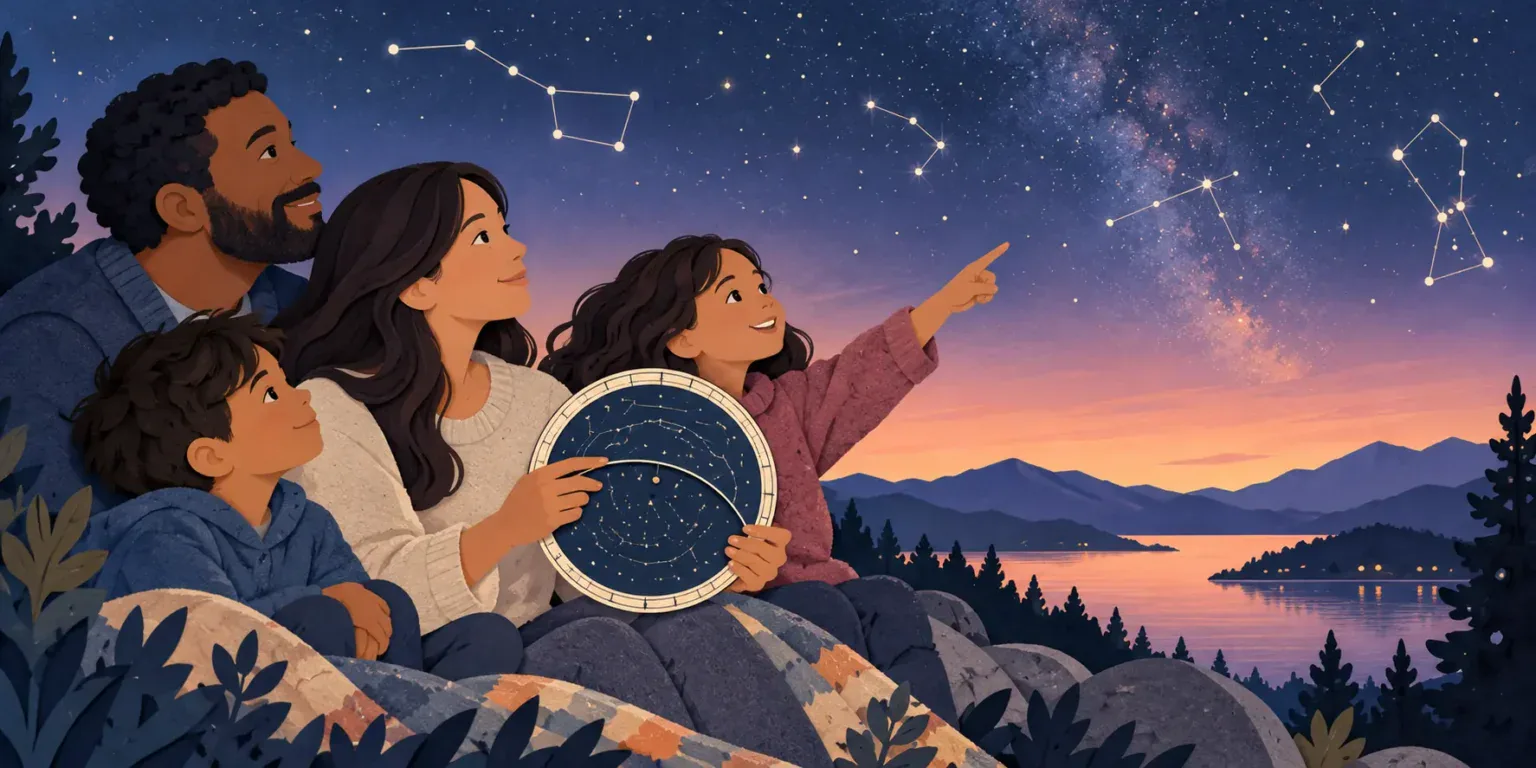
A star wheel, also called a planisphere, is a rotating sky map. Set it for a date and time and its window shows many of the constellations likely to be above the horizon. It will not reproduce every star or guarantee a clear view, but it gives a family a practical starting point for looking up together.
Gather the materials
- A printed star-wheel template appropriate for your latitude
- Light card, scissors, glue and a paper fastener
- A dim red-covered torch for outdoor reading
- A pencil and observation page
Latitude matters because people at different places on Earth see different parts of the sky. Use a wheel intended for your broad region and treat the result as a guide, not a navigation instrument.
Assemble the wheel
- Print the circular star map and its outer holder at the same scale.
- Glue thin paper pieces to card and let them dry flat.
- An adult cuts out the holder window and helps with tight curves.
- Place the star disc behind the window and join the centres with a paper fastener, keeping it loose enough to turn.
- Rotate the date to meet the planned viewing time.
Before going outside, find the horizon labels and notice that the wheel represents a curved sky on flat paper. Hold the wheel above you or orient its matching direction toward the real horizon. Turning it like an ordinary page can make east and west feel confusing, so pause and match one direction at a time.
Use one bright pattern as an anchor
Choose a constellation or asterism with several bright stars. First find the general direction, then compare distances and angles among the brightest points. Do not expect the lines drawn on a map to appear in the sky; people imagine those connections. Cultures have also made different stories and patterns from the same stars.
Record the date, time, viewing place, cloud cover and one pattern found. A “not visible” entry is useful if trees, buildings, haze or light pollution blocked the view. Never invent missing stars to make the observation look successful.
Questions that build spatial thinking
- Which stars are easiest to recognise, and why?
- Does the pattern look larger or smaller than it did on paper?
- What changes when you look an hour later?
- Which part of the wheel was hidden by your local horizon?
Ages 6–9 can match one bright shape and sketch it. Ages 10–12 can compare observations at two times. Teenagers can investigate how latitude or season changes visibility and distinguish constellations from informal asterisms.
Make the experience accessible
Use a large-print wheel and high-contrast markings. A child who cannot stay outdoors can help set the wheel, analyse a family photograph or compare records later. A child sensitive to darkness can observe from a lit doorway or begin at twilight. Let children describe patterns in their own words before introducing traditional names.
Safe, respectful skywatching
Choose a familiar place away from traffic, steep ground and isolated areas. An adult should supervise and check weather. Avoid shining bright lights at people or wildlife. Never point binoculars or a telescope near the Sun. If you use a phone app, lower the brightness and keep location sharing private.
Continue observing with a family Moon journal, explore changing viewpoints with the Moon-phase model, or add movement through Walk Like a Planet.
Plan a better observing session
Before going outside, choose one or two constellations that should be visible for your location, season and time. Let your eyes adjust away from bright lights, use a dim red-covered torch only when needed, and begin with a bright landmark rather than trying to match the entire wheel at once. Buildings, trees, clouds and light pollution may hide part of the chart; that is an observation, not a failed activity.
Record the date, approximate time, viewing direction and sky conditions. On another evening, return at a different time and notice what has shifted. The wheel is a guide to apparent positions in the sky, not a picture of the true distances between stars. Never use it to look at the Sun, and choose a secure viewing place away from roads, water and uneven ground.