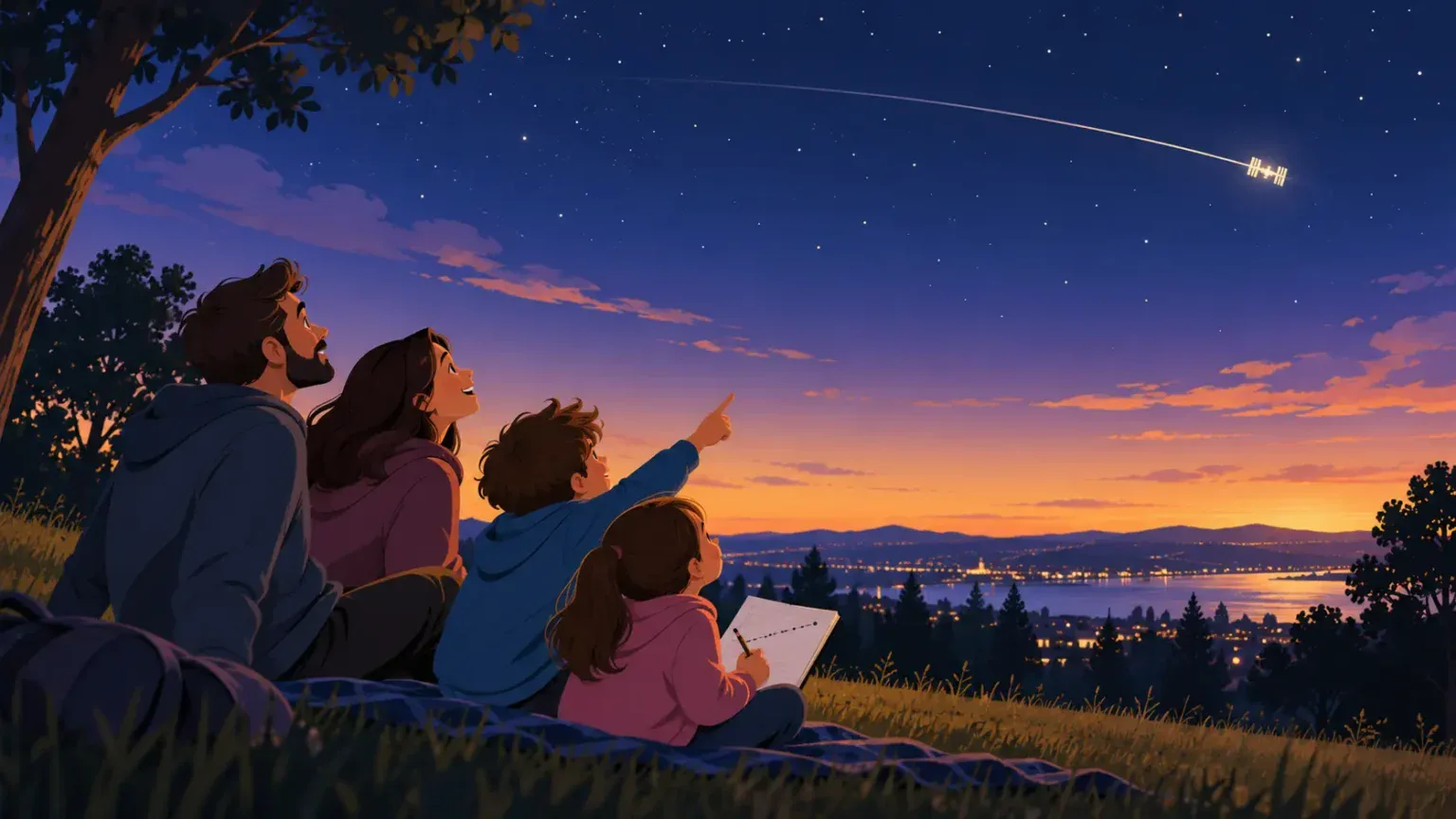
The International Space Station can appear as a bright, steady point moving across the dawn or dusk sky. It does not look like the detailed station photographs seen online. The excitement comes from knowing that the moving light is a crewed laboratory orbiting Earth.
Plan with current official information
- NASA’s Spot the Station website or app
- A watch or phone clock
- A safe viewing place with a broad horizon
- Notebook, pencil and optional compass
- Warm clothing or insect protection as needed
Pass opportunities depend on location and date, so never copy an old schedule. Check the official prediction shortly before leaving. Note the start time, direction, maximum height and end direction. Cloud can still block the view.
Know what to look for
The station often resembles a bright star that moves steadily and does not flash like a typical aircraft. It may brighten, fade or disappear as it enters Earth’s shadow. It crosses the sky in minutes, so arrive early and identify the start direction before the predicted time.
- Reach the viewing site at least ten minutes early.
- Find the start direction using landmarks.
- Let eyes adjust while keeping screens dim.
- At the predicted time, scan a small area rather than the whole sky.
- Once found, follow the point with unaided eyes and describe its path.
- Record the actual first sighting, brightest point and disappearance.
Compare prediction and observation
Draw an arc from one horizon landmark to another. Was the first sighting early, late or hidden by a building? Did the point fade before reaching the listed end direction? Differences can come from an obstructed horizon, clock error, cloud or reading the direction incorrectly. They do not mean the pass “failed.”
Questions for curious observers
- Why is the station visible when the ground is already dark?
- Why does it not appear on every evening?
- How is a steady ISS pass different from a blinking aircraft?
- What information would help another family find the same pass?
It shines by reflecting sunlight. Dawn and dusk often create the geometry where the station is illuminated while the observer’s sky is dark enough for contrast.
Adapt by age and ability
Ages 6–9 can watch and draw the path. Ages 10–12 can use compass directions and compare predicted time. Teenagers can investigate orbit, reflected light and why passes repeat differently. A child with low vision can listen to live descriptions, track time or use an accessible official app. A child who cannot reach the outdoor site can analyse the family record afterward.
Safety and privacy
Use a familiar, supervised place away from traffic, steep edges and isolated areas. Do not trespass for a clearer horizon. Keep phone location sharing private and carry a torch for the ground, aimed downward. Do not use telescopes near the Sun.
Prepare with a family star wheel, keep longer records in a Moon journal, or experience scale through the walkable solar system.
Make a reliable sighting plan
Use an official tracker or NASA’s Spot the Station information to check the date, local time, direction, maximum height and duration of a visible pass. Arrive early and identify the horizon direction in daylight if possible. The station usually looks like a bright, steady point moving smoothly across the sky; it does not show coloured aircraft navigation lights and may fade as it enters Earth’s shadow.
Conditions and predictions can change, so a missed pass is not a reason to stay outside unsafely. Observe from a familiar open place with an adult, away from roads, rooftops and dark water. Do not walk while looking upward. Record what you actually saw, including cloud and light pollution, then compare notes with the prediction. Binoculars are unnecessary and can make a fast-moving target harder to follow; never use optical equipment near the Sun.