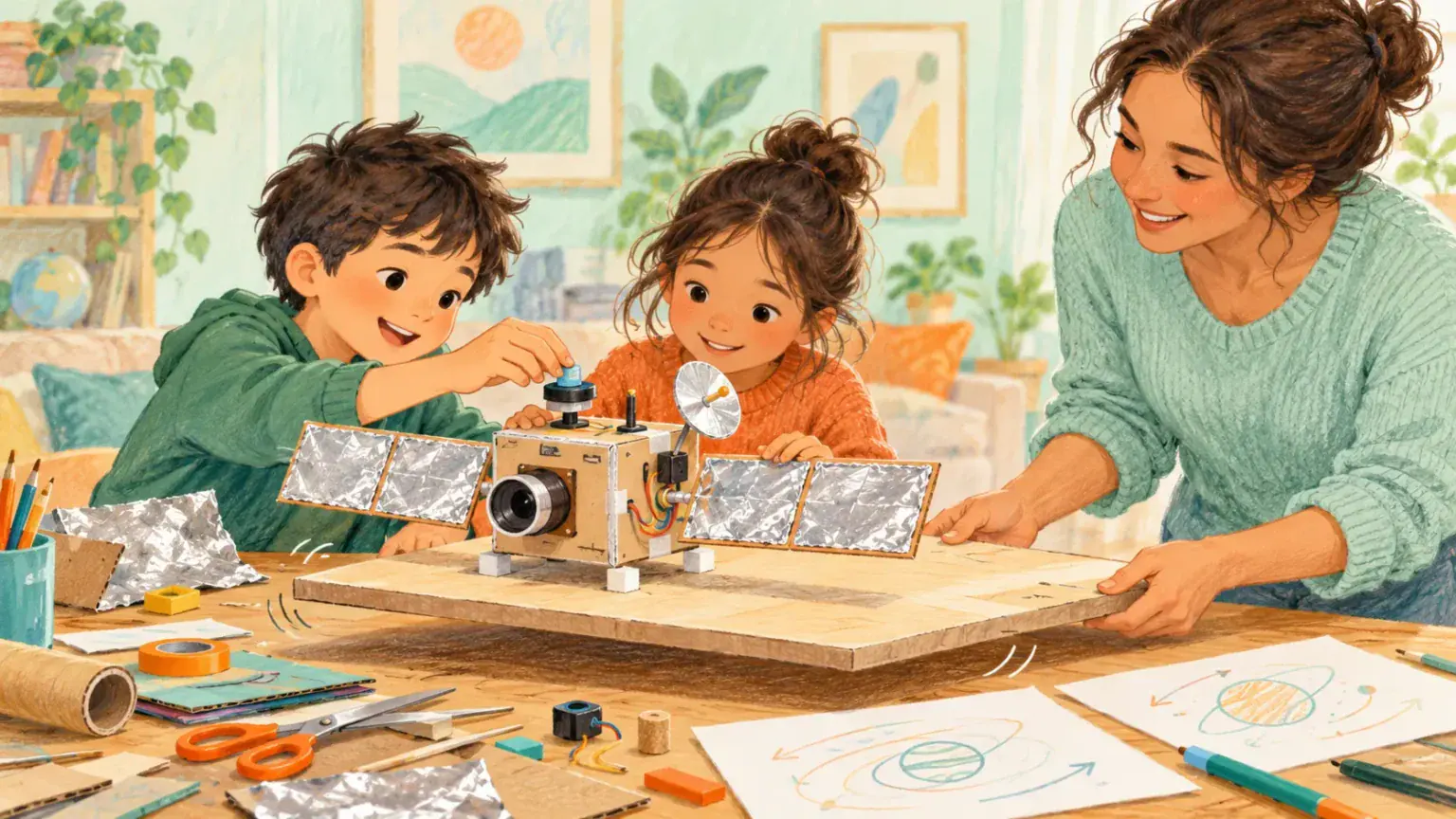
A satellite is not just a box with shiny panels. Its parts are chosen for a purpose: observing weather, communicating, navigating or studying another world. A family engineering challenge becomes richer when children first define the mission and then justify every component.
Set the design brief
- Clean cardboard cartons and tubes
- Card, foil, craft sticks, tape and reusable fasteners
- Small lids or paper shapes for instruments
- A firm tray for a gentle vibration test
- Mission card and test record
Choose one mission. A weather satellite might need an Earth-facing camera and power. A communications satellite needs antennas. A probe studying a distant planet may need different instruments and thermal protection. Craft pieces represent systems; they are not working electronics.
Design, build and explain
- Write the mission in one sentence.
- List three functions the satellite must perform.
- Sketch a design and label each system.
- Build a lightweight model, attaching parts intentionally.
- Ask the child to explain how every part supports the mission.
- Photograph or draw the first design before testing.
Run a launch-vibration test
Place the model on a tray. An adult moves the tray gently side to side for a fixed number of seconds. Use the same motion for each version. Check whether parts loosen, block one another or change position. Avoid violent shaking; the purpose is comparison, not destruction.
Record pass, partial pass or redesign needed for each criterion. The child chooses one improvement, such as a wider attachment point or lighter panel, and tests again. Changing several features at once makes it harder to know which improvement helped.
Add realistic constraints
Offer a size limit, material budget or mass score. Require a clear field of view for the camera and a panel that can “face” a lamp representing the Sun. Constraints create useful trade-offs: a large panel may collect more model “power” but be harder to secure.
Age and access variations
Ages 6–9 can select a mission and explain three visible parts. Ages 10–12 can use a criteria table and test repeated trials. Teenagers can research orientation, communication delay or why real spacecraft need redundancy. Pre-cut components and loop tape help children with fine-motor differences. Roles can include mission scientist, designer, builder, test lead and recorder.
Keep claims grounded
Real satellites survive detailed environmental testing, launch loads, radiation, temperature extremes and vacuum. A cardboard vibration test models only one design idea. Ask, “What would engineers still need to test?” This prevents a successful craft from being mistaken for a flight-ready design.
Try more build-and-test challenges, compare evidence with the foil-boat redesign, or learn how scale changes space models in the walkable solar system.
Safety and cleanup
Adults handle sharp cutting and supervise small pieces. Avoid loose wire ends, button batteries and heavy objects. Keep the vibration tray on a low stable surface and reuse or recycle clean materials when finished.
Give the satellite a mission
A design becomes more meaningful when every part serves a stated purpose. Choose one imaginary mission—monitoring clouds, relaying messages or observing distant stars—and write three needs before building. A camera needs an unobstructed view; solar panels need exposure to light; an antenna needs a plausible direction; the structure must survive a gentle shake test.
After the first test, photograph or sketch the damage before repairing it. Ask whether the failure came from the idea, the joint or the test method. Redesign one feature and repeat under the same conditions. Cardboard panels and foil dishes represent spacecraft systems but do not work like real electronics. Avoid launching or dropping the model from height, keep elastic bands away from faces, and use only clean lightweight recycled materials. A child who prefers planning can lead the mission brief and test log rather than assembling small parts.