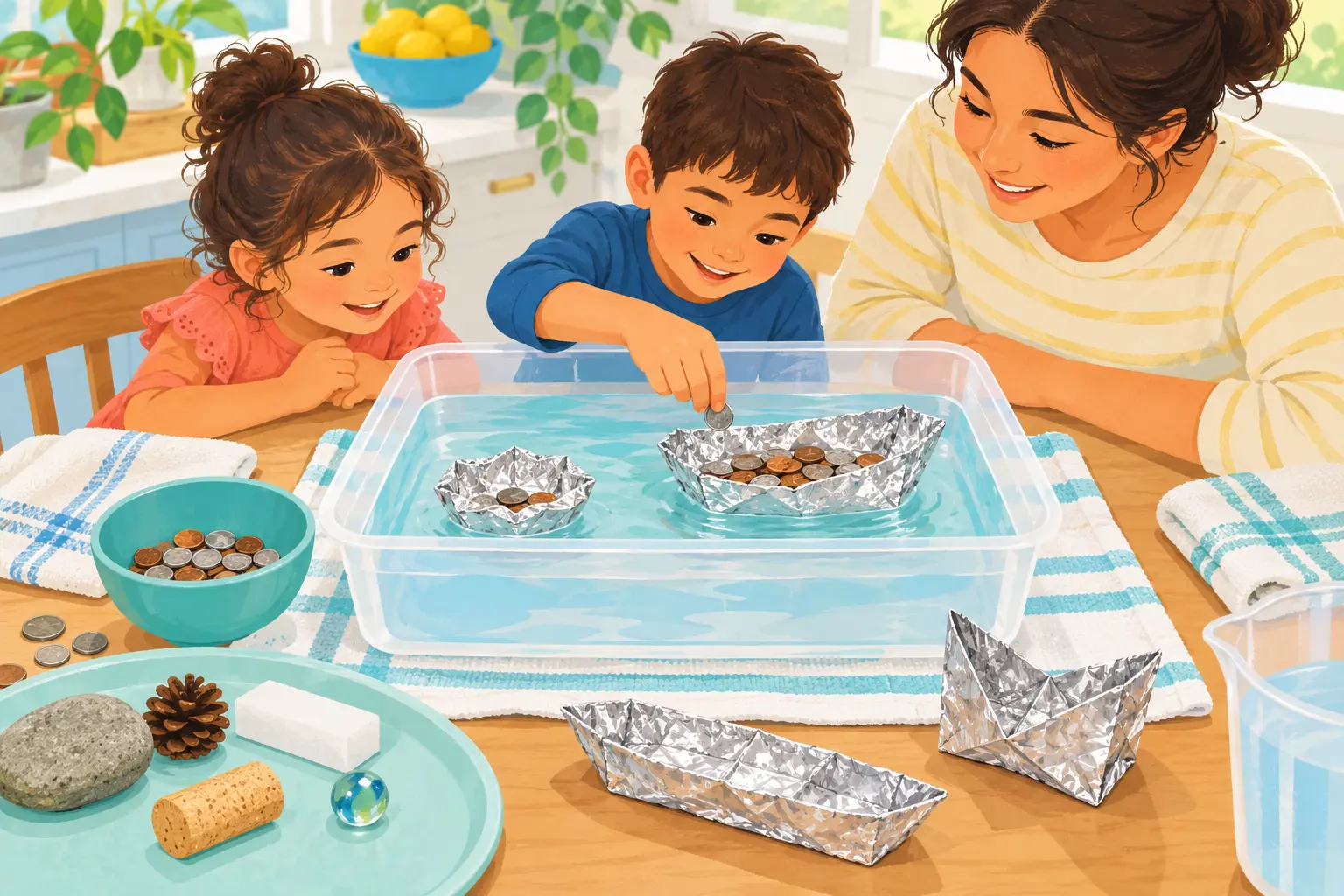
A rock can be lighter than a large wooden block and still sink while the block floats. A flat piece of foil may sink, yet the same foil shaped into a boat can carry coins. This activity replaces the rule “heavy things sink” with a better scientific habit: predict, test, redesign and explain what the evidence shows.
Materials
- A shallow clear tub or washing-up bowl
- Water and towels
- Six waterproof test objects such as a cork, stone, spoon, bottle cap, wooden block and rubber ball
- Two equal squares of aluminium foil per child
- Twenty to forty identical coins, washers or counters
- Paper and pencil, picture cards or a voice recorder for observations
Use objects too large to swallow for young children. Avoid batteries, electrical items, sharp metal and anything that water could damage.
Set up safely
Put the tub on a stable table or floor over towels and fill it only a few centimetres deep. An adult should remain within arm’s reach. Empty the tub immediately afterward; even shallow water is a drowning risk for babies and young children. Wash hands after testing objects that have been outdoors.
Part one: predict and test
- Look at each object without putting it in the water. Sort it under “think it will float,” “think it will sink” or “not sure.”
- Choose one reason for a prediction: material, shape, holes, trapped air or a comparison with something tested before.
- Lower each object gently from the same height. Do not throw it.
- Record what happens. If an object rests partly above the surface, count that as floating and draw what you see.
- Choose one surprising result and change the explanation. Scientists are allowed to revise ideas.
Do not force a universal rule from six objects. Mass, volume, shape, material and the surrounding liquid all matter.
Part two: build a foil boat
- Give everyone the same size sheet of foil. Shape it into a boat without adding material.
- Float the empty boat. If it leaks or tips, redesign before adding weight.
- Add identical coins one at a time, placing them carefully. Count the last coin the boat held before water entered or it sank.
- Dry the coins and use the second foil square for a new design.
- Change one feature—base width, wall height or coin placement—then test again under the same conditions.
NASA’s early-years aeronautics guide uses a similar foil-boat challenge to explore how design affects the weight a boat can support.
Ask evidence questions
- What changed between boat one and boat two?
- Where did water first enter?
- Did spreading the coins change stability?
- Was the best design also the tallest or most beautiful?
- What would we keep the same in another fair test?
Variations by age
- Ages 3–5: Test three large objects and count up to five counters with adult help. Focus on prediction language.
- Ages 6–9: Draw designs, record coin totals and change one feature at a time.
- Ages 10–12: Measure foil size, repeat each design three times and compare ranges rather than relying on one result.
Accessible participation
A child who cannot manipulate foil can direct a partner using choices: wider base, taller side, coins in the middle or spread out. Use large counters instead of coins, a non-slip mat, picture prediction cards or a switch-accessible voice recorder. The scientist is the person making and testing ideas, not only the person touching the materials.
Extend the investigation carefully
Older children can test the same boat in fresh water and salt water, keeping other conditions constant, but do not eat or drink experiment materials. They can also calculate average capacity across repeated trials.
Continue with tower and bridge build-and-test challenges, quick kitchen experiments or measurement games. The strongest result is not one winning boat; it is a child who can explain what changed and why another test is needed.