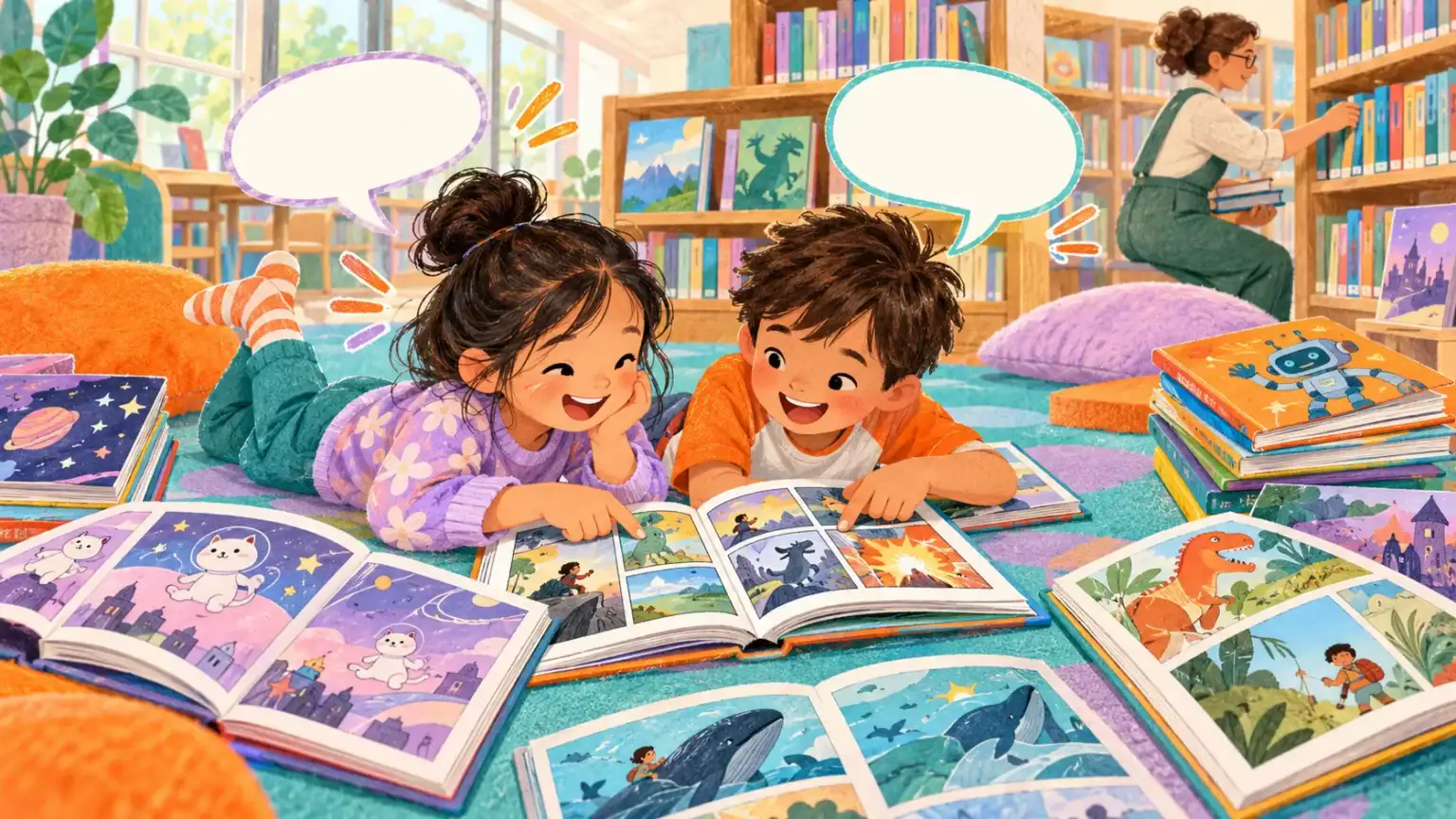
When a child chooses comics again, adults sometimes worry they are avoiding “real” reading. Comics and graphic novels ask readers to combine words, images, sequence, layout, facial expression and the unseen events between panels. They are a form with its own demands, not a reward to remove once prose improves.
Notice the reading work on the page
A reader must decide where to look next, connect dialogue to a speaker, infer time passing between panels, interpret visual symbols and combine illustration with narration. A nearly wordless comic can require complex prediction and perspective-taking. A dense historical graphic novel can carry challenging vocabulary and ideas.
The Library of Congress highlights comics and graphic novels across ages and genres, including history and nonfiction, and recommends experimenting with formats based on children’s interests.
Choose well without policing taste
Offer humour, fantasy, memoir, science, history, everyday school stories and wordless books. Check the age suitability of themes and images just as you would with prose. Let the child browse. A famous title that adults admire is not automatically the right match.
Do not require the comic to be “earned” by finishing a chapter book. That teaches the child that their preferred reading is inferior.
Learn the grammar of panels together
Open a page and ask one genuine question at a time:
- Which panel did your eye visit first, and why?
- What happened in the gap between these pictures?
- How do colour, shape or lettering change the mood?
- What does the character know that the reader knows—or does not know?
- Would the scene feel different if the panel order changed?
Answer too. This is shared noticing, not a hidden test. Blank speech bubbles, symbols and unusual layouts may carry meaning even when there is little conventional text.
Pair formats without creating a ladder
Compare a graphic adaptation with a prose version, a documentary or a primary source. Ask what each medium can show easily and what it must explain. The goal is not to prove the prose is better. A comic may reveal simultaneous action or emotion; prose may offer inner thought or extended description.
For nonfiction, check sources and distinguish an invented story from a factual account. The article on reading biographies critically can help with graphic memoirs and historical figures.
Create a short comic
Fold paper into four panels. The child chooses a tiny event: losing a key, making a snack or meeting an unexpected animal. Sketch the beginning, change, response and ending. Add only the dialogue needed. A child can photograph toys, use symbols or dictate captions if drawing or handwriting is difficult.
Reflect: Which information belongs in the picture? Which needs words? What must the reader infer? This makes visual storytelling visible without copying copyrighted characters.
Support struggling and multilingual readers
Images can provide context, but do not assume the format is automatically easy. Help with panel order, unfamiliar cultural references and dense layouts. Read dialogue together or use an audiobook edition when available. Multilingual comics can invite comparison of expressions and sound effects.
Adapt by age
- Ages 3–5: Use wordless sequences and ask the child to narrate what might happen between pictures.
- Ages 6–9: Follow panels, speech bubbles and visual clues; make a four-panel story.
- Ages 10–12: Compare viewpoint, pacing and fact versus fiction.
- Teens: Explore memoir, journalism, history, symbolism and whose perspective controls the frame.
Comics can sit beside novels, articles, audiobooks and picture books in a broad reading life. Use the reluctant-reader guide to widen choice, conversational reading questions to discuss a page, and picture-based storytelling for another visual activity.