Asteroids are rocky or metallic, airless bodies that orbit the Sun. They are not simply miniature planets, and they are not all identical grey lumps. Building several clay models helps children represent different material ideas while learning an equally important lesson: a model is a proposal, not a sample from space.
Materials
- Several colours of child-safe modelling clay
- Small clean pebbles, foil pieces and large metallic or coloured beads
- Craft sticks, tray and labels
- A balance or ruler if you want to compare mass or size
Avoid tiny parts around children who mouth objects. Do not use sharp wire, lead weights or mystery minerals. Check clay ingredients for allergies and protect the table.
Start with observations
Look at several NASA asteroid images and notice shape, surface, craters, boulders and brightness. Images do not let us hold the material, and colour can be processed to highlight information. Ask which features are directly visible and which material ideas would require other evidence.
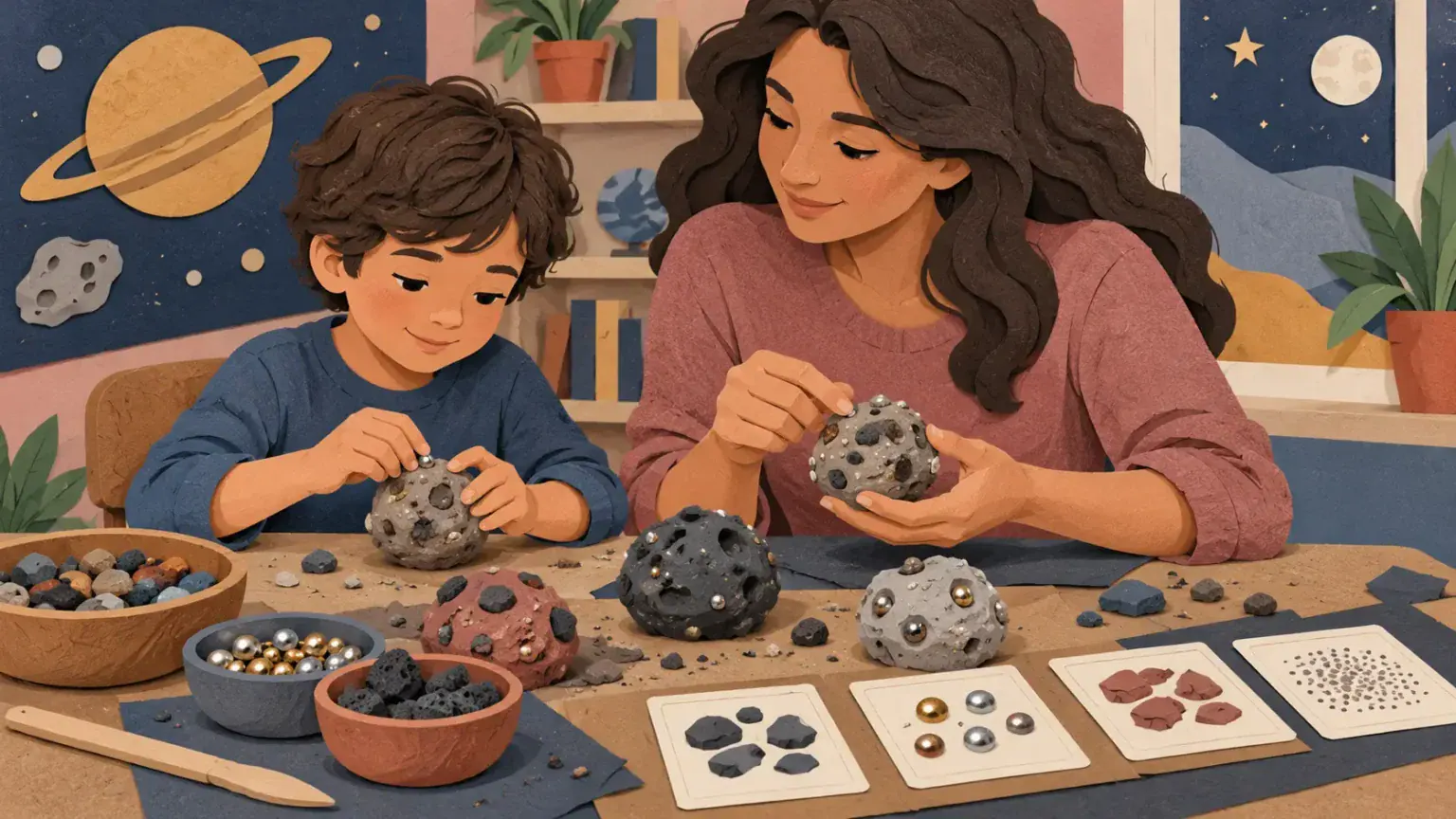
Make three intentional models
- Choose a model type: mostly rocky, more metallic or a mixture.
- Select inserts that symbolise those materials.
- Shape an irregular body rather than assuming it must be spherical.
- Press shallow craters and surface textures without splitting the model.
- Make a label listing every material and what it represents.
- Repeat with a deliberately different composition.
Keep actual and represented materials separate in conversation. A foil bead may stand for metal, but a real asteroid is not made of craft foil. Pebbles can represent rock without matching the mineral composition.
Compare properties fairly
Keep models near the same size if comparing mass, or the same mass if comparing volume. Use a simple balance, measure maximum width and describe texture. Ask whether the observation comes from the model itself or from the scientific information used to design it.
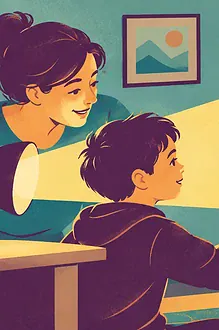
Children can also test how a flashlight reflects from dark clay, matte pebbles and foil. This demonstrates material reflectivity in the model; it does not prove how bright a particular asteroid would look because angle, surface roughness, distance and composition all matter.
Age and access variations
Ages 6–9 can sort materials and explain one model. Ages 10–12 can make a comparison table and identify limitations. Children with limited hand strength can select ingredients, direct a partner or use softer clay. Offer tools with broad handles and large inserts. A texture-sensitive child can work with sealed bags of clay or document the models.
Reflect like a planetary scientist
- Which features are based on images?
- Which choices are inferences?
- What instrument could collect better evidence?
- How would new data change the model?
Compare the activity with the Moon-crater impact test, design an observing tool in the model satellite challenge, or practise redesign in family engineering challenges.
Safety and storage
Supervise small pieces, wash hands and keep craft materials separate from food. Store models where younger siblings and pets cannot reach them. Reuse components when the investigation ends.
Add a mission evidence card
Place a card beside each model with three columns: “chosen feature,” “reason for the choice,” and “evidence still needed.” A dark surface might be inspired by an image, while a metallic interior may be an inference that would need spectral or sample evidence. This keeps attractive craft decisions from becoming accidental facts.
Older children can assign each model a hypothetical density by keeping volume similar and varying safe internal materials, then predict which would have greater mass. Treat the result as a comparison between classroom objects only. Real asteroid density depends on composition, porosity and internal structure, which the model cannot reproduce. End by having another family member identify one strong feature and one limitation. Good scientific models are useful precisely because their boundaries are made visible.