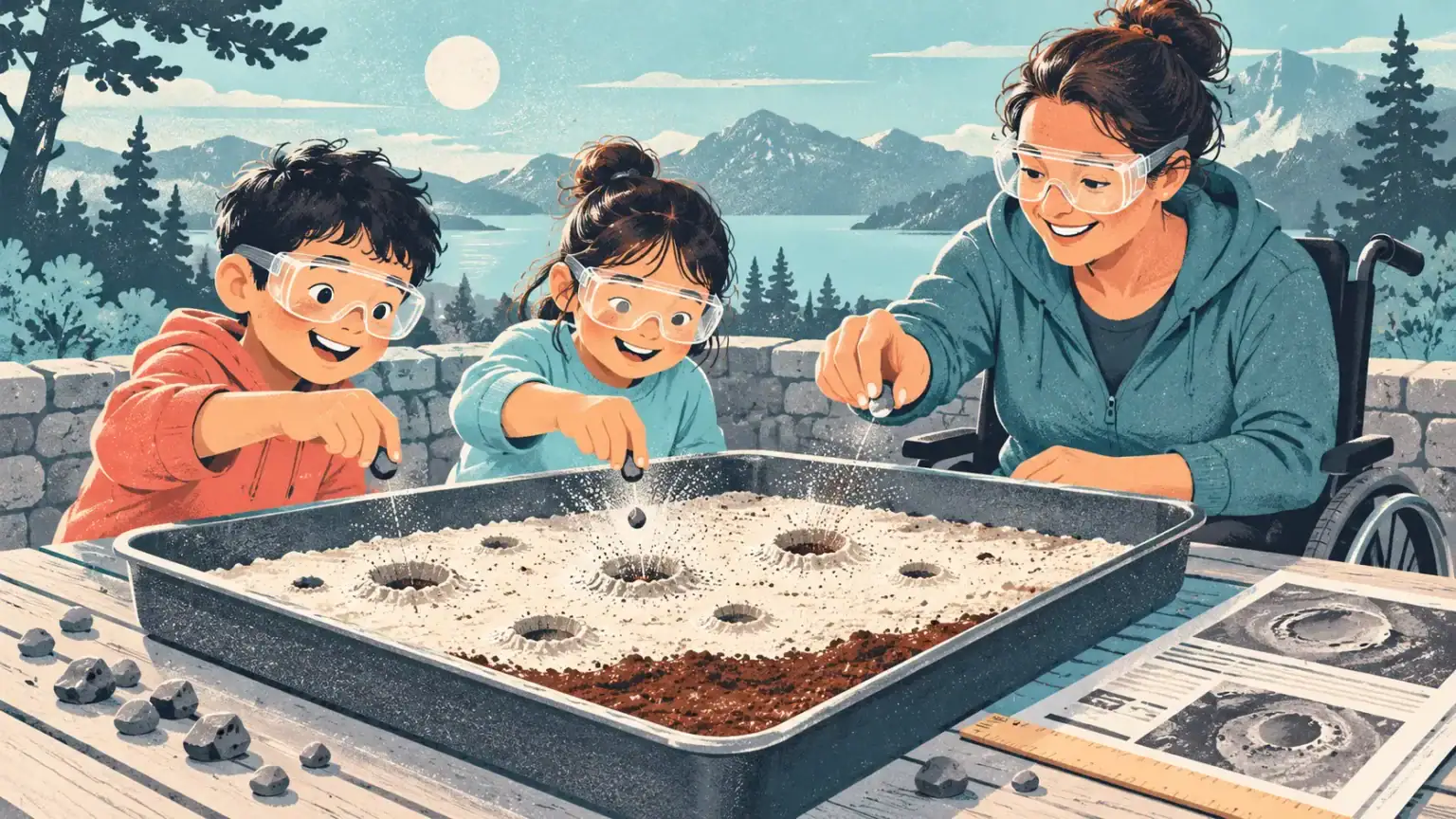
The Moon’s surface preserves many impact craters because it lacks the weather, flowing water and active surface processes that erase features quickly on Earth. A tray of flour with a thin coloured top layer can model some visible effects of an impact and give children a strong fair-test question.
Materials
- A deep tray or shallow storage box
- Plain flour or fine sand
- A thin layer of cocoa powder or coloured play sand
- Several rounded “impactors,” such as marbles or small balls of different sizes
- Ruler, spoon, paper and pencil
- Table covering and adult supervision
Check for food allergies and avoid loose powders around anyone with asthma or respiratory sensitivity. In that case use damp kinetic sand or another low-dust material. Keep marbles away from children who mouth objects.
Prepare the lunar surface
- Fill the tray with a level layer several centimetres deep.
- Sprinkle a very thin contrasting surface layer on top. Do not blow or shake powder into the air.
- Choose one impactor and one marked drop height.
- Hold the impactor directly above the surface and release it without pushing.
- Observe the central hollow, raised rim and material thrown outward. Remove the impactor carefully.
- Measure crater width across the widest point and record the result.
- Smooth and re-level the tray before the next trial.
The splashed material represents ejecta. The model can show how an impact redistributes material, but it does not reproduce lunar gravity, speed, rock strength, vacuum or scale. Real space impacts happen at far greater speeds than a classroom drop.
Choose one fair-test variable
Compare drop height using the same impactor, or compare impactor size from the same height. Do not change both at once. Repeat each condition three times, re-level the surface and use the same measurement method. Older children can calculate an average crater diameter; younger children can order paper circles representing the crater sizes.
Ask for a prediction with a reason. After testing, use language such as “In our model, greater drop height was associated with…” rather than claiming the small trial proves a law for every impact.
Observe more than diameter
Record depth, rim height, ejecta pattern and symmetry if they can be measured consistently. Try an angled release only as a separate investigation, and note that controlling angle by hand is difficult. A messy or uneven crater may be evidence about the method rather than a result to erase.
Adapt for different ages and abilities
Ages 3–5 can make one adult-supervised drop and compare big and small craters. Ages 6–9 can measure and repeat. Ages 10–12 can graph height against crater width and discuss reliability. A child who cannot drop from above can choose conditions, operate a safe release ramp, measure or record. Use high-contrast surface materials and large impactors for easier viewing.
Troubleshooting the model
If craters collapse immediately, the base may be too shallow or loose. If every result differs widely, mark the drop position, use a fixed height and re-level carefully. If powder clouds appear, stop, let dust settle and switch to a damp or low-dust medium. Never climb on furniture to create a greater drop height.
Connect the evidence
Use the Moon phase model to distinguish the Moon’s changing appearance from its physical surface. Add observations to a family Moon journal, and compare the method with EdCaptain’s foil boat fair test.
Safety and cleanup
Protect eyes and lungs from dust, use only light rounded impactors and keep the drop zone below face level. Adults should supervise small objects. Scoop materials rather than sweeping vigorously, wipe the area with a damp cloth and wash hands after the activity.