A Moon journal shifts learning from memorising a row of phase pictures to noticing the real sky. The Moon may be visible after sunset, late at night or during the day, so the goal is not perfect daily attendance. It is a growing record of honest observations.
Make a simple journal page
Give each entry the same useful fields:
- Date and local time
- Viewing location
- A circle in which to shade the dark part or draw the lit part
- Moon position using a landmark, such as above the roof or beside a tree
- Sky conditions: clear, cloudy, hazy or raining
- One question or comparison with the previous entry
Exact compass directions and angles can come later. For a young child, “high,” “low,” “left of the chimney” and “not visible because of cloud” are legitimate data.
Begin the observation routine
- Choose two or three practical viewing times each week rather than promising to look every night.
- Go with an adult to a safe, familiar place with a clear view.
- Look first with unaided eyes. Find the Moon’s shape and position.
- Draw what is actually visible. Do not copy a phase chart to make the entry “correct.”
- Note clouds or obstacles. If the Moon cannot be seen, record that result.
- Compare with the last entry and make a cautious prediction for the next one.
The Moon rises and sets at different times across its monthly cycle. If it is absent at the usual evening check, that does not mean anything is wrong. It may be below the horizon, hidden or visible at another time.
Look for patterns slowly
After several observations, lay the pages in date order. Ask: “Does the lit part seem to be growing or shrinking?”, “Is the Moon in the same place at the same clock time?” and “How many observations support that idea?” Weather and missed days create gaps, so children should avoid inventing the missing shape.
Ages 3–5 can choose among a few shape cards and dictate a sentence. Ages 6–9 can draw, date and use landmarks. Ages 10–12 can add compass direction, estimate altitude with a fist-at-arm’s-length method, and compare the observed sequence with a reliable phase calendar after making their own interpretation.
Make the journal accessible
A child with low vision can use a large page, high-contrast pencil, binoculars with adult support or an accessible astronomy app after first checking the sky. A child who cannot go outdoors can observe through a safe window when reflections allow, direct a partner, or analyse family photographs taken from the same location. Keep the scientific role meaningful rather than treating recording as a consolation task.
When observations disagree
Two drawings may differ because the time, place, cloud cover or orientation changed. Rather than choosing a winner, compare the context fields. A photo can help, but phone cameras often overexpose the Moon and erase the visible shape. The naked-eye sketch may preserve more relevant information.
Link the journal to a model
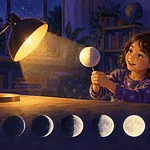
Use EdCaptain’s lamp-and-ball Moon phase model to explore why the view changes. Try Walk Like a Planet for another movement-based space activity, or practise repeated recording with the shadow investigation.
Safe sky watching
The Moon is safe to view directly, but the Sun is not. Never use binoculars or a telescope near the Sun, and do not search for a daytime Moon by sweeping optics across the sky. Adults should supervise outdoors, choose a location away from traffic and uneven ground, and dress for the weather.
Sources and further reading
Review the month together
At the end of several weeks, invite the child to select three entries that show a useful change. Add a short caption explaining the evidence, the remaining uncertainty and one question for a future month. The journal then becomes a record of thinking, not only a collection of drawings.