The Moon does not physically change from a crescent into a circle. Half of it is illuminated by the Sun at any moment, and as the Moon travels around Earth we see different portions of that lit half. A lamp-and-ball model lets children change their viewpoint and see this geometry directly.
What you need
- One uncovered lamp that can act as the Sun
- A light-coloured foam ball on a pencil, chopstick or safe handle
- A room that can be dimmed
- Enough clear space for a child to turn slowly
- Paper and pencil for a phase sequence
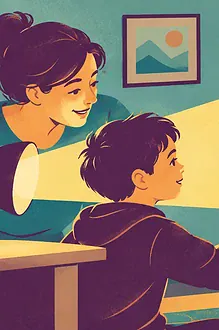
Use an LED bulb that stays cool, keep the ball and hands away from the lamp, and secure electrical cords. The child’s head represents Earth, the ball represents the Moon and the lamp represents the Sun. Like every model, this simplifies real sizes and distances.
Observe the phases
- Place the lamp near the centre of the room at about head height. Turn off other lights.
- Stand several steps away and hold the ball slightly above eye level at arm’s length.
- Face the lamp. The side of the ball facing you looks mostly dark: this position models new Moon. Never stare into a bright bulb.
- Turn slowly to the left while keeping the ball in front of you. Stop after a small turn and sketch the lit part you can see.
- At a quarter-turn, about half the visible ball is lit. At a half-turn, the visible face is mostly illuminated, modelling full Moon.
- Continue turning to observe the waning sequence until you face the lamp again.
The ball must remain in the lamp’s light. If the child’s body casts a shadow on it at the “full Moon” position, raise the ball a little. The ordinary phases are caused by changing viewing geometry, not by Earth’s shadow. Earth’s shadow is involved in a lunar eclipse, which is a separate event.
Build meaning before memorising names
Ask, “Is the ball still a sphere?”, “Which half is illuminated by the lamp?” and “Why does our view change when we turn?” Invite the child to describe the visible light as growing or shrinking before introducing waxing and waning. Then match the observations to new, crescent, quarter, gibbous and full.
Ages 6–9 can draw four main positions. Ages 10–12 can make eight sketches, add arrows showing the direction of light and explain why the far side is not permanently dark. Older children can compare the model with a diagram drawn from above and identify which perspective each shows.
Common misconceptions to notice
The Moon does not produce its own visible light; it reflects sunlight. The “dark side” changes as the Moon orbits, though one side generally faces Earth because of synchronous rotation. Phases are not caused by clouds, by Earth’s daily rotation or by a shadow crossing the Moon each month.
Make participation comfortable
A child who cannot turn can stay seated while another person carries the ball around them at a constant distance. A child sensitive to a dark room can use a bright focused lamp with ordinary room lights reduced only slightly. Large high-contrast balls help with low vision. Another child can draw or photograph each stopping point.
Continue with real observations
After the model, begin a family Moon journal and compare the sky with the predicted sequence. The Walk Like a Planet activity offers another body-based space model, while the shadow investigation supports thinking about a changing light source and viewpoint.
Safety
Adults should manage cords and the lamp. Do not use a hot bulb, flame or laser. Keep the model clear of faces and move slowly to prevent dizziness. Pause between positions if turning is uncomfortable.