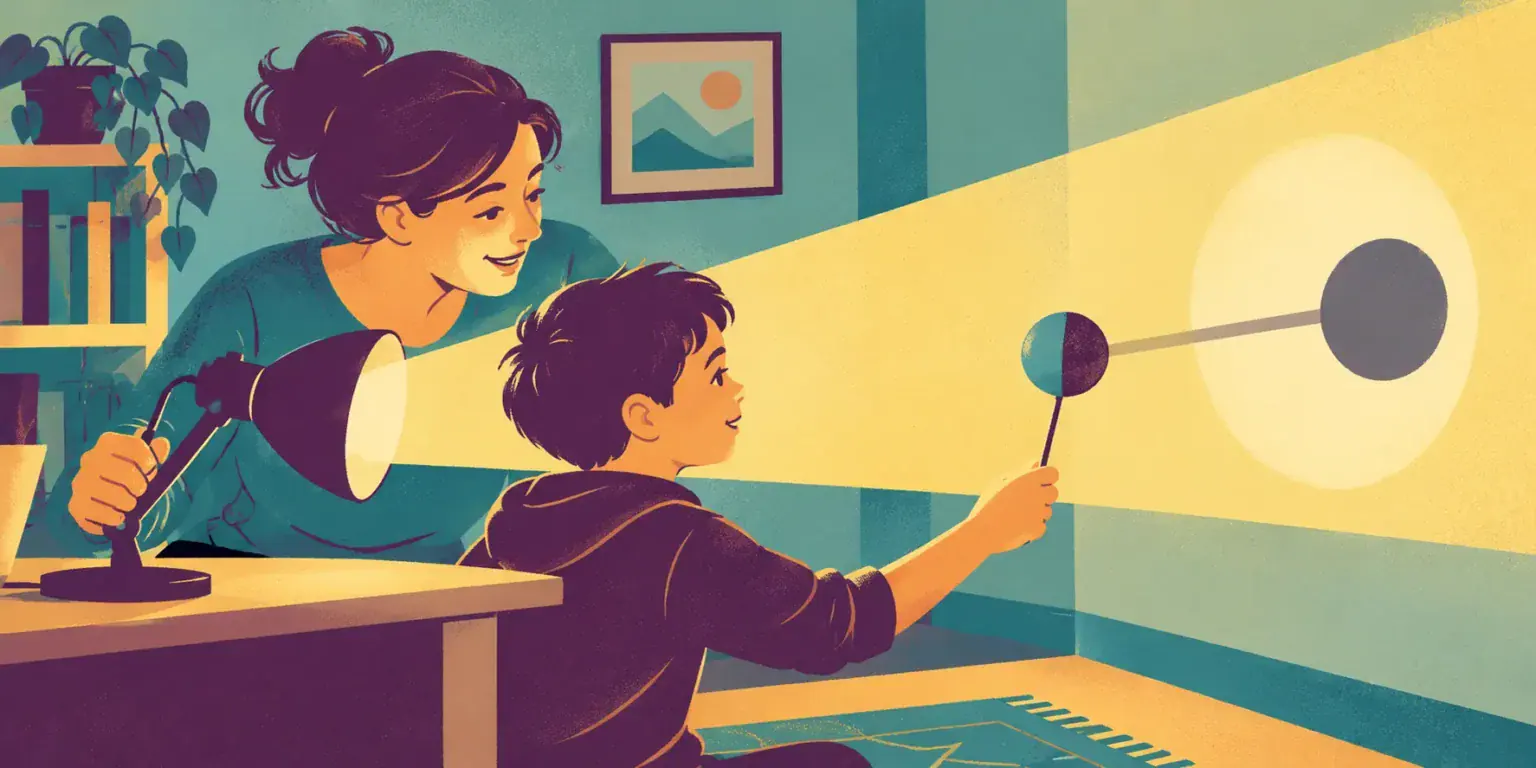
A solar eclipse happens when the Moon passes between Earth and the Sun and blocks some or all of the Sun from a particular viewpoint. A small indoor model can show why alignment matters. It must also carry one unambiguous message: never look directly at the real Sun during this activity.
Materials and room setup
- A bright, cool LED lamp or large illuminated circle representing the Sun
- A small foam or paper ball on a blunt handle
- An open indoor space with secured cords
- Paper for sketches
The child’s head represents Earth and the ball represents the Moon. The sizes and distances are not to scale. Do not use a laser, candle or hot bare bulb.
Find three kinds of alignment
- Stand several steps from the lamp, facing it without staring into the bulb.
- Hold the ball at arm’s length and move it slowly across the line of sight.
- Notice a position where the ball covers only part of the lamp: a partial-eclipse model.
- Find a position where it appears to cover the lamp: a total-eclipse model.
- Move the ball farther away until a ring of light seems to remain: an annular-eclipse model.
- Shift the ball slightly above or below the line and notice how quickly the alignment disappears.
The apparent size of an object depends partly on its actual size and distance. The Moon is much smaller than the Sun but also much closer to Earth, so their apparent sizes in our sky can be similar. Changing orbital distances helps explain why some central eclipses are total and others annular.
Why there is not an eclipse every month
The Moon’s orbit is tilted relative to Earth’s path around the Sun. Most months the new Moon passes a little above or below the exact line. The model can show this by moving the ball on a slightly tilted path rather than always straight across the lamp.
Separate phases from eclipses
Ordinary Moon phases come from seeing different portions of the Moon’s sunlit half. They are not caused by Earth’s shadow. A solar eclipse is a specific alignment with the Moon between Earth and the Sun. Ask the child to explain which object casts the shadow in this model.
Adapt the investigation
Ages 6–9 can draw partial and total alignments. Ages 10–12 can compare angular size and add the tilted orbit. A child who cannot hold the ball can direct a partner or move a ball on a tabletop stand. Keep normal room lighting if darkness is uncomfortable.
Real-eclipse safety
This model is not viewing equipment. For direct observation of a real partial or annular eclipse, use only certified solar viewers that meet the current ISO 12312-2 standard and are obtained from a trustworthy source; ordinary sunglasses are not safe. During totality, location-specific official instructions matter. Binoculars, cameras and telescopes need correctly mounted front-end solar filters and expert guidance. Children require close adult supervision.
Explore the related geometry with the Moon-phase lamp model, record the real Moon in a family journal, or investigate changing shadows with the shadow laboratory.
Separate the model from eclipse viewing
The lamp-and-balls setup can show alignment and shadows indoors, but it does not make direct solar viewing safe. If your family later watches a real partial or annular eclipse, use only certified eclipse viewers that meet the ISO 12312-2 standard and follow their instructions. Ordinary sunglasses, smoked glass, exposed film and homemade filters are not safe. Never look through binoculars, a telescope or a camera at the Sun unless the front of the instrument has a purpose-built solar filter installed correctly by a knowledgeable adult.
For the model, darken the room enough to see shadows while keeping floors clear. Move the small “Moon” slowly and notice that the darkest shadow reaches only a narrow area. Change one distance at a time, and record how the shadow changes rather than claiming the tabletop proportions match the real Earth–Moon system.