By EdCaptain editorial desk · Published
Research-based review · Overall rating: 3.8 out of 5
Verdict: SET is a compact physical card game for families who enjoy noticing patterns and checking an idea carefully. It earns its place when children want a puzzle they can revisit alone or share with an adult. The main drawback is the race: someone who spots patterns quickly can dominate unless the family changes the pace.
This review assesses the standard PlayMonster SET 81-card game, model 1000, linked below on Amazon US as ASIN B00000IV34. It is based on published rules and specifications, not firsthand testing. Ratings and family-fit judgments are editorial inferences from those mechanics. All play described here uses the physical cards away from a screen.
Quick facts
- Edition: PlayMonster SET, standard 81-card deck, model 1000. This is the physical game, not SET Junior, a download or an app.
- Age guidance: Recommended in this review for ages 9–18 and adult partners. PlayMonster’s general product page and rules say 6+, while the linked US listing title says 8+ and its age fields vary. We use a more conservative editorial starting age of 9 for this review; check the supplied pack’s label and follow any higher minimum.
- Players: Official rules allow 1 or more; the US listing specifies 1–10. For a first family session, try two people sharing one clearly visible layout.
- Time: Allow an estimated 10–20 minutes for a learning session. This is our planning estimate, not a manufacturer duration; a full deck may take longer.
- Contents: 81 cards and rules. You also need a flat surface where everyone can see the layout.
- Safety: The US listing carries a small-parts choking warning, not for under-threes. Keep the pack and any small packaging pieces away from toddlers. This review does not recommend younger-child play.
How the game works
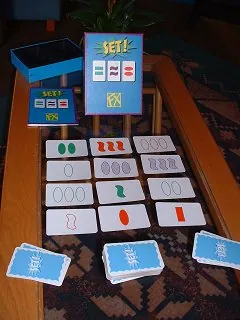
Each card varies in shape, colour, number and shading. Deal 12 face up. Find three cards where, for each feature considered separately, the three values are either identical or all different. Two matching values and one different value fail that feature. For example, one, two and three solid red ovals form a SET: only the number changes.
In the standard competitive game, everyone searches together. Call “SET” before taking cards; the others check the claim. A valid group earns one point and is replaced from the deck. An incorrect claim loses a point. If everyone agrees there is no SET, add three cards; after the next claim, let the layout return to 12. Finish when the deck is exhausted and no further SET remains; the highest score wins. These are summaries of the publisher’s rules.
The interesting decision is often to stop looking for three cards at once. Pick two, describe what the missing third card would need, then search for it. That gives adults something useful to model without simply announcing the answer.
Who it suits, and who might skip it
For a child aged 9, start beside an adult with a shared search and no speed target. Ages 10–12 can enjoy checking claims feature by feature, while teenagers aged 13–18 can take on the full deck, explain difficult combinations or choose a solo search when they do not want a family competition. An older player should still be allowed to prefer a simpler game.
It suits a small-space household needing a reusable tabletop puzzle. Once someone explains the rule, the cards require no reading, so a grandparent and child can discuss a pattern in Hindi, English, Kiswahili or another shared language. It needs enough surface space for all the cards to remain visible; it is less convenient on a moving bus or a tiny tray.
Skip it if the family wants storytelling, movement or a relaxed game with built-in turns. A large experience gap can turn it into one person’s performance. Colour-vision differences, low vision or difficulty scanning a crowded layout may make the core task inaccessible; do not assume that a slower pace solves a colour barrier. The card-only contents also give us no basis to rate long-term durability as tested.
Eight editorial ratings
Scale: 1 means poor fit, 3 workable with trade-offs, and 5 excellent fit for the stated audience. These are editorial scores, not customer ratings.
| Indicator | Score / 5 | Reason |
|---|---|---|
| Age fit | 4/5 | For the stated ages 9–18, checking four features offers a real puzzle; a nine-year-old may still need an untimed introduction. |
| Ease of learning and setup | 3/5 | Dealing is simple, but “all the same or all different” must be checked separately for every feature. |
| Child engagement | 4/5 | Every player can search at once, though a fast adult can leave beginners watching. |
| Replay value | 5/5 | Shuffling creates fresh layouts, and the same deck supports solo searching and group play. |
| Opportunities to practise skills | 4/5 | Players compare attributes and explain why a choice works; this is practice, not evidence of improved school performance. |
| Quality of family interaction | 3/5 | Checking a claim can prompt useful discussion, but the standard race gives slower players little protected time. |
| Accessibility and adaptability | 3/5 | No reading is needed on the cards; colour discrimination and scanning many small symbols remain substantial barriers. |
| Value for money | 4/5 | Likely good value for families who enjoy repeated visual puzzles; borrowing first is sensible when nobody knows whether they enjoy this kind of search. |
Overall: 3.8/5. The eight equally weighted scores total 30; 30 ÷ 8 = 3.75, rounded to one decimal. Accessibility and competitive pace hold back an otherwise reusable puzzle.
How to play it meaningfully
A realistic first round: For ages 9 and up, use only the solid-symbol cards, following the publisher’s easier-start idea. Deal 12 and search together. An adult can prepare one valid trio before the child joins if needed, then shuffle that trio into the opening layout. Agree to find three SETs together and stop; this is a learning variation, not the full scored game.
- Say: “Let’s check just the colour first. Are they all the same, all different, or two and one?” Then check shape, number and shading without rushing.
- Do: Point to two cards and ask, “What would our missing card look like?” Wait while the child describes it; accept pointing or a gesture instead of a spoken answer.
Easier: Keep the solid-only deck and offer two candidate cards for the missing third. Check both together rather than treating the wrong choice as a failure. Keep this adaptation within the review’s ages 9+ recommendation.
Harder: For confident older children and teenagers, restore all four features and ask each claimant to explain their group before replacing it. Try finding two groups that do not share a card. There is no need to add a timer.
Access adjustment: Use even lighting, generous spacing and a viewing position chosen by the child. For limited reach or hand control, number the card positions on a separate paper grid so the child can indicate choices and another player moves them. If colours cannot be distinguished reliably, choose a different game or work as a team with a partner describing colours, recognising that this changes the task.
If frustration rises: Say, “We can leave this puzzle unfinished. Would you like one clue or to pack it away?” Honour a request to stop. Avoid turning a missed pattern into a lesson about intelligence or effort. Our plan for handling winning and losing offers a useful next step if competition keeps upsetting family play.
Borrow first, or try a no-buy alternative
Borrow a complete deck from a friend or game library before buying; check that it has all 81 cards. A swap also works if a family has outgrown its copy. For a free taste of attribute-checking, lay out ordinary playing cards and ask a child to explain three cards that are all the same suit or all different suits, then check their ranks. That is a simpler comparison activity, not a substitute with SET’s full four-feature system.
Check the physical edition
Amazon US: Standard PlayMonster SET, model 1000, 81 physical cards and rules; ASIN B00000IV34. Confirm the edition and the supplied age label before ordering, especially outside the US. The advice above does not depend on buying a copy.
As an Amazon Associate I earn from qualifying purchases.
Sources and review basis
Checked 11 November 2026. Product facts come from the sources below; ratings, suggested age focus, time estimates and family adaptations are our editorial analysis. No customer reviews were used.
- PlayMonster: SET, item 1000 — contents and general manufacturer age guidance.
- PlayMonster: official SET rules — attributes, scoring, player count and easier start.
- SET: official cooperative variation — another way to use the physical deck together.
- The Amazon US edition linked above was checked against model 1000, PlayMonster, 81 cards, age guidance and the listing’s safety warning.
Report an error or suggest an improvement
Was this useful?