Cardboard tubes, fabric squares, lids, boxes and large wooden pieces can become roads, costumes, shops or machines. Open-ended materials invite children to decide what an object will be. Household objects, however, were not necessarily designed or tested as toys. A safe loose-parts setup begins with adult selection, mixed-age zoning and regular inspection.
Define a loose part carefully
For family play, use movable materials that children can combine in many ways without a single correct result. “Loose” should not mean tiny, broken or unknown. Avoid anything sharp, splintered, rusty, fragile, chemically treated, contaminated or able to trap a child’s head or body.
Head Start encourages open-ended everyday materials in safe, stimulating play environments. Its guidance also emphasizes attentive adults, accessible choices and following a child’s lead.
Screen every item before it enters play
- Check size, especially when a child under three or a child who mouths objects can enter the space.
- Pull and twist attached parts to see whether anything detaches.
- Reject cords, ribbons and loops long enough to create entanglement.
- Avoid plastic bags, large airtight containers and boxes with locking lids.
- Remove staples, nails, sharp wire, cracked plastic and rough wood.
- Know the material and previous use; do not offer containers that held medicines, chemicals, nicotine, cannabis or hazardous products.
CPSC guidance explains that a whole object, separate component or piece that breaks off can become a small-parts hazard for children under three. A regulatory exclusion does not certify an everyday object as safe for home play.
Create separate zones for mixed ages
Use large, washable pieces in the shared family area. Keep smaller construction pieces for older children in a closed room, high table or lidded container that younger siblings cannot access. Count high-risk pieces in and out rather than relying on a quick floor sweep.
Do not make an older child solely responsible for protecting a toddler. The adult controls storage and supervision. Let the older child preserve an ongoing project in a protected location rather than requiring it to be dismantled after every session.
Start with a small invitation
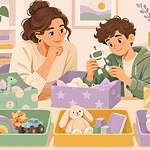
Offer six to ten pieces in two or three material types: sturdy boxes, large fabric squares and wide cardboard tubes, for example. Ask, “What could these become?” Avoid demonstrating one finished product that turns open-ended play into copying.
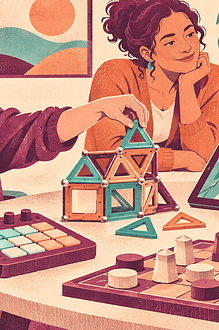
EdCaptain’s team construction challenge gives older children a shared building prompt. The safer toy guide helps families distinguish play value from age and hazard information.
Supervise the changing use
An item safe on the floor may become unsafe when tied to furniture, thrown from a balcony, placed over a face or used as a step. Stay close enough to notice the new use without directing every idea. State boundaries plainly: “Build on the floor,” “Fabric stays below shoulders,” or “This box does not close with a person inside.”
Adapt access without creating new hazards
Place materials within reach, use high contrast against the floor and offer pieces that are easy to grasp. A child can direct another person, choose materials or tell the story if moving pieces is difficult. Avoid assuming that more pieces automatically means richer play.
End with an inspection
Sort together, then let the adult check for torn cardboard, frayed fabric, moisture, missing pieces and new sharp edges. Clean materials according to what they are made from and dry them fully. Recycle or discard pieces that no longer pass the screen.
Loose-parts play works because materials can change meaning. The safety plan must be just as flexible: select carefully, separate by household risk, observe how play changes and remove any object that no longer belongs in children’s hands.