Age guide: 3–8 years. Adapt the activity to your child’s interests and abilities.
The dog has one enormous ear. Your child looks at it, pushes the paper away and announces, “I can’t draw.” You can already see ten lovely things about the picture. They can see only the ear.
Before trying to persuade them that it is beautiful, find out what they wanted to make. A little understanding often opens a more useful door than a bigger compliment.
1. Start with the disappointment
Try: “You wanted it to look different.” Then wait. Perhaps they wanted a recognisable dog, perhaps someone laughed at a picture, or perhaps the pencil is uncomfortable to hold. Those are different problems.
- Ask what part they would like help with.
- Let them demonstrate if explaining is difficult.
- Avoid comparing their picture with another child’s.
- Keep their work private if they do not want an audience.
2. Give the next drawing an easier beginning
A blank page can feel surprisingly demanding. Offer one playful starting point: make a wandering line and turn it into a road, draw an imaginary animal with no correct appearance, or fill a page with different marks.
For a child who wants a recognisable object, explore it together. Look at a real leaf, notice its edges, and try drawing one small part. You can demonstrate a technique on your own paper without replacing their picture.
3. Leave room for art that isn’t a likeness
NAEYC’s guidance on creativity distinguishes exploring materials and ideas from reproducing a predetermined finished product. A picture does not have to look like an adult’s example to be worth making.
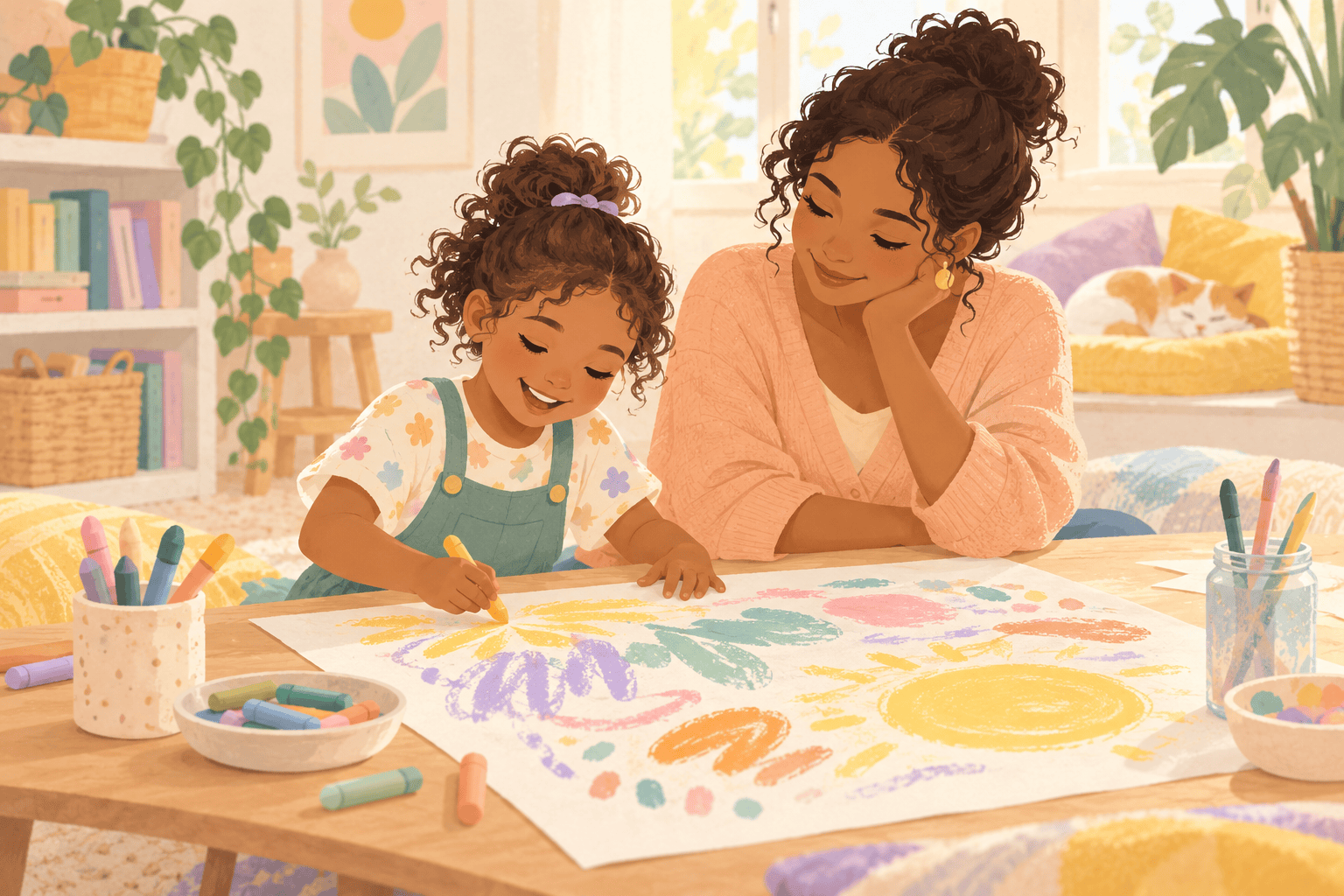
Try an invitation such as: “What could we make with these three colours?” There is room for a storm, a map, a collection of circles or something your child has not named yet. Do not require a story about every mark.
4. Make the materials work for the child
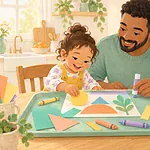
Offer chunky crayons, a larger sheet, a supported drawing surface or another comfortable tool. A child can also direct your hand, choose colours or make a collage. Enjoying creative expression should not depend on mastering one grip.
Choose age-appropriate materials and supervise as needed. Keep the first invitation small enough that starting does not require a full table-clearing operation.
5. Notice a choice they made
Instead of rating the picture, comment on something real: “You tried two ways to make that ear,” or “You chose a different colour for the rain.” If they ask whether you like it, answer warmly and honestly. You do not have to withhold affection in pursuit of perfect praise.
Keep a fresh page available without suggesting that the first one must be thrown away. Sometimes the kindest ending is simply, “We can come back to it.” The drawing can wait. The feeling of being welcome beside you matters now.
Try next
- Creative play, smaller clean-up: art that fits real family life
- You don’t have to be the crafty parent