Hand your child a blank page and the word “draw” alone, and you will often get a blank look back. Give them a theme, a picture to talk about first, or a story to tell, and something genuinely different happens. Theme Drawing turns an open-ended, slightly intimidating blank page into something a child actually knows how to start.
What you need
Paper. Crayons or coloured pencils, chunky ones for younger children, finer ones for older children who have more control. Optionally, a picture book, a jigsaw, or a photo to look at together first.
How to play
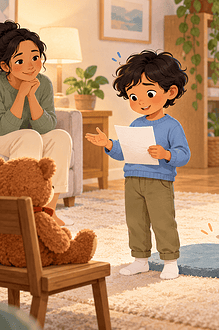
Pick a simple theme together: the seasons, animals, family members, trees, whatever feels relevant that week. If you have a picture book, puzzle, or photo on the theme, sit together and look at it first. Ask your child what they see, and encourage them to describe it in detail, not just name it. Then ask them to tell you a short story about what they’re looking at, their own invented version, not necessarily the “right” answer. Only once they have talked it through do you hand them the paper and crayons and ask them to draw their story.
Variations
For an older sibling and younger sibling drawing together, have the older child narrate the story out loud while the younger one draws, which keeps both genuinely involved even if their drawing abilities are very different.
Collage and mosaic: instead of drawing from scratch, gather leaves, scraps of paper, fabric, or cut-out pictures from an old magazine, and build a scene by sticking them onto a page and colouring around them.
Why talking first matters
The describing-and-storytelling step before drawing is doing real work, not just filling time. A child who has already put a scene into words has something concrete to translate onto paper, rather than facing a blank page with no starting point at all. This is often the difference between a child who says “I don’t know what to draw” and one who gets straight to it.
A note on display
However the drawing turns out, put it somewhere visible, a wall, a fridge, a folder they can flip through themselves. Seeing their own work displayed, even briefly, does something for a child’s sense of their own creativity that a quick glance and a “lovely, well done” does not quite achieve on its own.
A page that started out blank and a little daunting becomes, with just a theme and a few minutes of talking first, something your child already half-knows how to fill. That small shift, from nothing to a starting point, is worth remembering well beyond drawing time, since the same trick, talk it through before you start, works for a surprising number of things a child finds difficult to begin.